

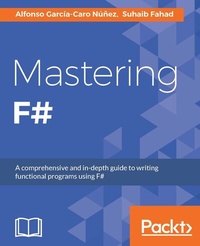
Mastering F#
A comprehensive and in-depth guide to writing functional programs using F#
Published on 8. July 2025
264 pages
978-1-78439-684-8 (ISBN)
Description

A comprehensive and in-depth guide to writing functional programs using F#
Key Features
[*] Learn how to manage, run, and automate your servers using Puppet
[*] Explore how to use F# to develop large-scale applications quickly and simply, and become more productive in today's age of cloud computing and multi-core programming
[*] This easy-to-follow guide is packed with real-world examples that will jump-start you with F# development on the .NET platform
Book DescriptionF# is a multi-paradigm programming language that encompasses object-oriented, imperative, and functional programming language properties. Now adopted in a wide range of application areas and is supported both by industry-leading companies who provide professional tools and by an active open community, F# is rapidly gaining popularity as it emerges in digital music advertising, creating music-focused ads for Spotify, Pandora, Shazam, and anywhere on the web. This book will guide you through the basics and will then help you master F#. The book starts by explaining how to use F# with Visual Studio, file ordering, and the differences between F# and C# in terms of usage. It moves on to explain the functional core of F# such as data types, type declarations, immutability, strong type interference, pattern matching, records, F# data structures, sequence expressions, and lazy evaluation. Next, the book takes you through imperative and asynchronous programming, F# type providers, applications, and testing in F#. Finally, we look into using F# with distributed programming and using F# as a suitable language for data science. In short, this book will help you learn F# for real-world applications and increase your productivity with functional programming. What you will learn
[*] Understand the basics of F# and organize F# source code with Visual Studio
[*] Work with F# data structures and create functional data structures in F# interoperate with C#
[*] Build and use asynchronous programming patterns with F#
[*] Create and use type providers that help perform data analysis from within Visual Studio
[*] Develop applications with pure F# code in WPF or ASP.NET MVC
[*] Find out how to perform distributed programming with ServiceBus or ZeroMQ
[*] Visualize data with charts, and work with Excel and R language Type providers
Who this book is forIf you are a C# developer with a basic knowledge of F# and want to explore the functional programming paradigm further to master your F# skills, then this book is for you.
Key Features
[*] Learn how to manage, run, and automate your servers using Puppet
[*] Explore how to use F# to develop large-scale applications quickly and simply, and become more productive in today's age of cloud computing and multi-core programming
[*] This easy-to-follow guide is packed with real-world examples that will jump-start you with F# development on the .NET platform
Book DescriptionF# is a multi-paradigm programming language that encompasses object-oriented, imperative, and functional programming language properties. Now adopted in a wide range of application areas and is supported both by industry-leading companies who provide professional tools and by an active open community, F# is rapidly gaining popularity as it emerges in digital music advertising, creating music-focused ads for Spotify, Pandora, Shazam, and anywhere on the web. This book will guide you through the basics and will then help you master F#. The book starts by explaining how to use F# with Visual Studio, file ordering, and the differences between F# and C# in terms of usage. It moves on to explain the functional core of F# such as data types, type declarations, immutability, strong type interference, pattern matching, records, F# data structures, sequence expressions, and lazy evaluation. Next, the book takes you through imperative and asynchronous programming, F# type providers, applications, and testing in F#. Finally, we look into using F# with distributed programming and using F# as a suitable language for data science. In short, this book will help you learn F# for real-world applications and increase your productivity with functional programming. What you will learn
[*] Understand the basics of F# and organize F# source code with Visual Studio
[*] Work with F# data structures and create functional data structures in F# interoperate with C#
[*] Build and use asynchronous programming patterns with F#
[*] Create and use type providers that help perform data analysis from within Visual Studio
[*] Develop applications with pure F# code in WPF or ASP.NET MVC
[*] Find out how to perform distributed programming with ServiceBus or ZeroMQ
[*] Visualize data with charts, and work with Excel and R language Type providers
Who this book is forIf you are a C# developer with a basic knowledge of F# and want to explore the functional programming paradigm further to master your F# skills, then this book is for you.
All prices
More details
Edition
Digital original
Language
English
Place of publication
Birmingham
United Kingdom
Target group
US School Grade: College Graduate Student
Edition type
Digital original
File size
1,61 MB
ISBN-13
978-1-78439-684-8 (9781784396848)
Copyright in bibliographic data and cover images is held by Nielsen Book Services Limited or by the publishers or by their respective licensors: all rights reserved.
Schweitzer Classification
Other editions
Additional editions
Alfonso García-Caro Núñez | Suhaib Fahad
Mastering F
Book
11/2016
Packt Publishing
€55.80
Shipment within 3-4 weeks
Persons
Garcia-Caro Nunez Alfonso :
Alfonso Garca-Caro Nez is a linguist who, in recent years, changed the study of natural languages by the practice of their programming counterparts. He currently focuses on JavaScript and .NET development and has worked on developing mobile, web, and desktop applications for several industries, such as video games, education, green energy, or digital performances. He is also an international speaker who has presented at several conferences around the globe. His admiration for both the thriving JavaScript ecosystem and functional programming with F# made him look for a way to bring together both worlds, leading to the creation of Fable, an F# to JavaScript compiler that is attracting lot of attention from the community, and integrates the power and elegance of F# with the hundreds of JavaScript tools and libraries available.Fahad Suhaib :
Suhaib Fahad is an entrepreneur and is running a startup; he is also an expert F# programmer and enthusiast, using F# in various domains within the products that he is building. He is extremely passionate about developing in functional languages and loves to engage with developers of different communities. He has also been researching and working with cloud scale applications since 2012. Fahad lives in Bangalore, the IT hub of India, with his wife and baby boy.
Alfonso Garca-Caro Nez is a linguist who, in recent years, changed the study of natural languages by the practice of their programming counterparts. He currently focuses on JavaScript and .NET development and has worked on developing mobile, web, and desktop applications for several industries, such as video games, education, green energy, or digital performances. He is also an international speaker who has presented at several conferences around the globe. His admiration for both the thriving JavaScript ecosystem and functional programming with F# made him look for a way to bring together both worlds, leading to the creation of Fable, an F# to JavaScript compiler that is attracting lot of attention from the community, and integrates the power and elegance of F# with the hundreds of JavaScript tools and libraries available.Fahad Suhaib :
Suhaib Fahad is an entrepreneur and is running a startup; he is also an expert F# programmer and enthusiast, using F# in various domains within the products that he is building. He is extremely passionate about developing in functional languages and loves to engage with developers of different communities. He has also been researching and working with cloud scale applications since 2012. Fahad lives in Bangalore, the IT hub of India, with his wife and baby boy.
Content
Table of Contents
Getting Started with F#
Functional core with F#
Data Structures in F#
Imperative Programming in F#
Asynchronous Programming
F# Type Providers
Applications with F#
Web Applications with F#
Testing in F#
Distributed Programming with F#
Getting Started with F#
Functional core with F#
Data Structures in F#
Imperative Programming in F#
Asynchronous Programming
F# Type Providers
Applications with F#
Web Applications with F#
Testing in F#
Distributed Programming with F#

