

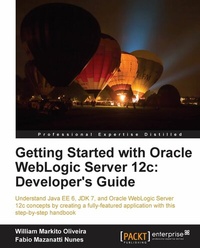
Getting Started with Oracle WebLogic Server 12c: Developer's Guide
If you've dipped a toe into Java EE development and would now like to dive right in, this is the book for you. Introduces the key components of WebLogic Server and all that's great about Java EE 6.
Published on 13. January 2025
374 pages
978-1-84968-697-6 (ISBN)
Description

If you ve dipped a toe into Java EE development and would now like to dive right in, this is the book for you. Introduces the key components of WebLogic Server and all that s great about Java EE 6.
Key Features
Create a complete Java EE 6 application leveraging WebLogic features like JMS, SOAP and RESTful Web Services
Learn how to use Oracle WebLogic Server's key components and features
Step-by-step instructions with screenshots and code samples to help understand and apply concepts
Book DescriptionOracle WebLogic server has long been the most important, and most innovative, application server on the market. The updates in the 12c release have seen changes to the Java EE runtime and JDK version, providing developers and administrators more powerful and feature-packed functionalities. Getting Started with Oracle WebLogic Server 12c: Developer's Guide provides a practical, hands-on, introduction to the application server, helping beginners and intermediate users alike get up to speed with Java EE development, using the Oracle application server. Starting with an overview of the new features of JDK 7 and Java EE 6, Getting Started with Oracle WebLogic Server 12c quickly moves on to showing you how to set up a WebLogic development environment, by creating a domain and setting it up to deploy the application. Once set up, we then explain how to use the key components of WebLogic Server, showing you how to apply them using a sample application that is continually developed throughout the chapters. On the way, we'll also be exploring Java EE 6 features such as context injection, persistence layer and transactions. After the application has been built, you will then learn how to tune its performance with some expert WebLogic Server tips.What you will learn
Create and package applications and shared libraries that use Java EE resources such aspersistence layer, interceptors, and managed beans
Expose and consume Web Services using both SOAP (JAX-WS) and REST (JAX-RS) technologies
Utilize WebLogic Server s security providers to add authentication and authorization to an application
Publish and consume messages using JMS features, understanding and programming both server and standalone client pieces
Scale up your application using features such as session replication, caching and optimized data access
Unlock WebLogic full potential with expert performance tuning tips
Understand the concepts and usage of validators, events, and listeners
Who this book is forGetting Started with Oracle WebLogic Server 12c: Developer's Guide is written for developers who are just getting started, or who have some experience, with Java EE who want to learn how to develop for and use Oracle WebLogic Server. Getting Started with Oracle WebLogic Server 12c: Developer's Guide also provides a great overview of the updated features of the 12c release, and how it integrates Java EE 6 and JDK 7 to remove boilerplate code.
Key Features
Create a complete Java EE 6 application leveraging WebLogic features like JMS, SOAP and RESTful Web Services
Learn how to use Oracle WebLogic Server's key components and features
Step-by-step instructions with screenshots and code samples to help understand and apply concepts
Book DescriptionOracle WebLogic server has long been the most important, and most innovative, application server on the market. The updates in the 12c release have seen changes to the Java EE runtime and JDK version, providing developers and administrators more powerful and feature-packed functionalities. Getting Started with Oracle WebLogic Server 12c: Developer's Guide provides a practical, hands-on, introduction to the application server, helping beginners and intermediate users alike get up to speed with Java EE development, using the Oracle application server. Starting with an overview of the new features of JDK 7 and Java EE 6, Getting Started with Oracle WebLogic Server 12c quickly moves on to showing you how to set up a WebLogic development environment, by creating a domain and setting it up to deploy the application. Once set up, we then explain how to use the key components of WebLogic Server, showing you how to apply them using a sample application that is continually developed throughout the chapters. On the way, we'll also be exploring Java EE 6 features such as context injection, persistence layer and transactions. After the application has been built, you will then learn how to tune its performance with some expert WebLogic Server tips.What you will learn
Create and package applications and shared libraries that use Java EE resources such aspersistence layer, interceptors, and managed beans
Expose and consume Web Services using both SOAP (JAX-WS) and REST (JAX-RS) technologies
Utilize WebLogic Server s security providers to add authentication and authorization to an application
Publish and consume messages using JMS features, understanding and programming both server and standalone client pieces
Scale up your application using features such as session replication, caching and optimized data access
Unlock WebLogic full potential with expert performance tuning tips
Understand the concepts and usage of validators, events, and listeners
Who this book is forGetting Started with Oracle WebLogic Server 12c: Developer's Guide is written for developers who are just getting started, or who have some experience, with Java EE who want to learn how to develop for and use Oracle WebLogic Server. Getting Started with Oracle WebLogic Server 12c: Developer's Guide also provides a great overview of the updated features of the 12c release, and how it integrates Java EE 6 and JDK 7 to remove boilerplate code.
All prices
More details
Edition
Digital original
Language
English
Place of publication
Birmingham
United Kingdom
Edition type
Digital original
File size
9,22 MB
ISBN-13
978-1-84968-697-6 (9781849686976)
Copyright in bibliographic data and cover images is held by Nielsen Book Services Limited or by the publishers or by their respective licensors: all rights reserved.
Schweitzer Classification
Other editions
Additional editions
Book
06/2013
Packt Publishing
€69.60
Shipment within 3-4 weeks
Persons
Fabio Mazanatti Nunes: With more than two decades of experience in system design and development, Fabio worked in a wide range of projects and architectures (mainframe, client-server, distributed architecture, and SOA) for large corporations in Brazil, and for the last dozen years, he specialized in the architecture and implementation of Java EE and SOA solutions, mainly using BEA and Oracle products. You can find more material related to t hese topics on his blog, http://mazanatti.info.
Content
Table of Contents

