

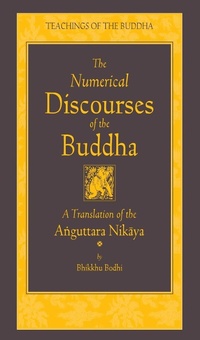
The Numerical Discourses of the Buddha
A Complete Translation of the Anguttara Nikaya
Wisdom Publications (Publisher)
Published on 13. November 2012
1944 pages
978-1-61429-044-5 (ISBN)
Description

Like the River Ganges flowing down from the Himalayas, the entire Buddhist tradition flows down to us from the teachings and deeds of the historical Buddha, who lived and taught in India during the fifth century B.C.E. To ensure that his legacy would survive the ravages of time, his direct disciples compiled records of the Buddha's teachings soon after his passing. In the Theravada Buddhist tradition, which prevails in Sri Lanka and Southeast Asia, these records are regarded as the definitive "word of the Buddha." Preserved in Pali, an ancient Indian language closely related to the language that the Buddha spoke, this full compilation of texts is known as the Pali Canon.
At the heart of the Buddha's teaching were the suttas (Sanskrit sutras), his discourses and dialogues. If we want to find out what the Buddha himself actually said, these are the most ancient sources available to us. The suttas were compiled into collections called "Nikayas," of which there are four, each organized according to a different principle. The Digha Nikaya consists of longer discourses; the Majjhima Nikaya of middle-length discourses; the Samyutta Nikaya of thematically connected discourses; and the Anguttara Nikaya of numerically patterned discourses.
The present volume, which continues Wisdom's famous Teachings of the Buddha series, contains a full translation of the Anguttara Nikaya. The Anguttara arranges the Buddha's discourses in accordance with a numerical scheme intended to promote retention and easy comprehension. In an age when writing was still in its infancy, this proved to be the most effective way to ensure that the disciples could grasp and replicate the structure of a teaching.
At the heart of the Buddha's teaching were the suttas (Sanskrit sutras), his discourses and dialogues. If we want to find out what the Buddha himself actually said, these are the most ancient sources available to us. The suttas were compiled into collections called "Nikayas," of which there are four, each organized according to a different principle. The Digha Nikaya consists of longer discourses; the Majjhima Nikaya of middle-length discourses; the Samyutta Nikaya of thematically connected discourses; and the Anguttara Nikaya of numerically patterned discourses.
The present volume, which continues Wisdom's famous Teachings of the Buddha series, contains a full translation of the Anguttara Nikaya. The Anguttara arranges the Buddha's discourses in accordance with a numerical scheme intended to promote retention and easy comprehension. In an age when writing was still in its infancy, this proved to be the most effective way to ensure that the disciples could grasp and replicate the structure of a teaching.
More details
Other editions
Additional editions
Book
10/2012
Wisdom Publications,U.S.
€81.00
Shipment within 3-4 weeks
Person
Ven. Bhikkhu Bodhi is an American Buddhist monk from New York City, born in 1944. He obtained a BA in philosophy from Brooklyn College and a PhD in philosophy from Claremont Graduate School. After completing his university studies he traveled to Sri Lanka, where he received novice ordination in 1972 and full ordination in 1973, both under the leading Sri Lankan scholar-monk, Ven. Balangoda Ananda Maitreya (1896-1998). From 1984 to 2002 he was the editor for the Buddhist Publication Society in Kandy, where he lived for ten years with the senior German monk, Ven. Nyanaponika Thera (1901-1994), at the Forest Hermitage. He returned to the U.S. in 2002. He currently lives and teaches at Chuang Yen Monastery in Carmel, New York. Ven. Bodhi has many important publications to his credit, either as author, translator, or editor. These include The Middle Length Discourses of the Buddha (Majjhima Nikaya, 1995), The Connected Discourses of the Buddha (Samyutta Nikaya, 2000), and The Numerical Discourses of the Buddha (Anguttara Nikaya, 2012). In 2008, together with several of his students, Ven. Bodhi founded Buddhist Global Relief, a nonprofit supporting hunger relief, sustainable agriculture, and education in countries suffering from chronic poverty and malnutrition.
Content
- Front Cover
- Contents
- Preface
- Key to the Pronunciation of Pali
- Abbreviations
- Introduction
- A Thematic Guide to the A?guttara Nikaya
- 1. The Book of the Ones
- 2. The Book of the Twos
- 3. The Book of the Threes
- 4. The Book of the Fours
- 5. The Book of the Fives
- 6. The Book of the Sixes
- 7. The Book of the Sevens
- 8. The Book of the Eights
- 9. The Book of the Nines
- 10. The Book of the Tens
- 11. The Book of the Elevens
- Notes
- Appendixes
- 1. Expanded Parallels in the A?guttara Nikaya
- 2. Composite Numerical Suttas in the A?guttara Nikaya
- Pali-English Glossary
- Bibliography
- Indexes
- Of Subjects
- A
- B
- C
- D
- E
- F
- G
- H
- I
- J
- K
- L
- M
- N
- O
- P
- Q
- R
- S
- T
- U
- V
- W
- Of Proper Names
- A
- B
- C
- D
- E
- G
- H
- I
- J
- K
- L
- M
- N
- P
- R
- S
- T
- U
- V
- Y
- Of Similes and Parables
- A
- B
- C
- D
- E
- F
- G
- H
- I
- J
- K
- L
- M
- N
- O
- P
- R
- S
- T
- V
- W
- Y
- Of Pali Terms Discussed in the Notes
- A
- B
- C
- D
- G
- H
- J
- K
- M
- N
- O
- P
- S
- T
- U
- V
- Y
