

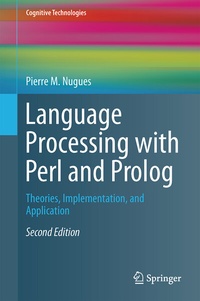
Language Processing with Perl and Prolog
Description

The areas of natural language processing and computational linguistics have continued to grow in recent years, driven by the demand to automatically process text and spoken data. With the processing power and techniques now available, research is scaling up from lab prototypes to real-world, proven applications.
This book teaches the principles of natural language processing, first covering practical linguistics issues such as encoding and annotation schemes, defining words, tokens and parts of speech and morphology, as well as key concepts in machine learning, such as entropy, regression and classification, which are used throughout the book. It then details the language-processing functions involved, including part-of-speech tagging using rules and stochastic techniques, using Prolog to write phase-structure grammars, syntactic formalisms and parsing techniques, semantics, predicate logic and lexical semantics and analysis of discourse and applications in dialogue systems. A key feature of the book is the author's hands-on approach throughout, with sample code in Prolog and Perl, extensive exercises, and a detailed introduction to Prolog. The reader is supported with a companion website that contains teaching slides, programs and additional material.
The second edition is a complete revision of the techniques exposed in the book to reflect advances in the field the author redesigned or updated all the chapters, added two new ones and considerably expanded the sections on machine-learning techniques.
More details
Other editions
Additional editions
Person
Pierre Nugues is a professor in the Dept. of Computer Science of Lund University. His research is focused on natural language processing for advanced user interfaces and spoken dialogue. This includes the design and the implementation of conversational agents within a multimodal framework and text visualization. He led the team that designed a navigation agent - Ulysse - that enables a user to navigate in a virtual reality environment using language, and the team that designed the CarSim system that generates animated 3D scenes from written texts. He has taught natural-language processing and computational linguistics at the following institutions: ISMRA, Caen, France; University of Nottingham, UK; Staffordshire University, UK; FH Konstanz, Germany; Lund University, Sweden and Ghent University, Belgium.
Content
An Overview of Language Processing.- Corpus Processing Tools.- Encoding and Annotation Scheme.- Topics in Information Theory and Machine Learning.- Counting Words.- Words, Parts of Speech, and Morphology.- Part-of-Speech Tagging Using Rules.- Part-of-Speech Tagging Using Statistical Techniques.- Phrase-Structure Grammars in Prolog.- Partial Parsing.- Syntactic Formalisms.- Constituent Parsing.- Dependency Parsing.- Semantics and Predicate Logic.- Lexical Semantics.- Discourse.- Dialogue.- Appendix A, An Introduction to Prolog Index References.
