

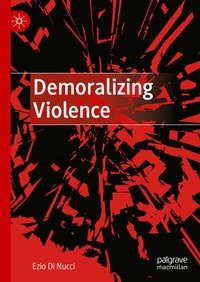
Demoralizing Violence
Description

Is non-violence oppressive? This book argues that non-violent ethics keeps minoritized peoples down and helps the bourgeoisie tolerate structural injustice. Like sex, violence needs de-moralizing , in order to fulfil its emancipatory potential. Social injustice and global inequality will not deprive the privileged of their sleep, if radical measures are morally ruled out from the start. And the ethics of non-violence robs the working classes of one of the few mechanisms they have left to help them cope with our increasingly digitalized bureaucracies, developed around the needs of highly educated urban classes. There is not just the normative obvious point that it is not fair to deprive the oppressed of one of the only resources they have left; it is also that it isn't surprising that the bourgeoisie would settle on a non-violent ethics, since that happens to prop up their privileged position - while at the same time soothing their precious conscience: capital with a soul. The book defends three overall claims: first, non-violence is oppressive, in the traditional feminist sense of keeping people down ; second, non-violence helps the bourgeoisie tolerate structural injustice; and thirdly, that access to violent means is not distributed fairly across gender or race, for example.
More details
Other editions
Additional editions
Person
Content
- Is non-violence oppressive?.- Part I. Defining Non-Violence.- 2. Non-Violence, Democracy and Structural Injustice.- 3. The Dilemma of Non-Violence.- 4. Non-Violence and what it is NOT.- Part II. Defining Violence.- 5. Does Violence Even Exist? Beyond Physical Violence.- 6. It Was Only Violence If You Feared For Your Life.- 7. Is Violence Ever About Violence?.- 8. Defining Genocide and Conceptual Inclusivism.- Part III. Applying Non-Violence 9. Gewaltbereitschaft and Oppressive Non-Violence.- 10. Why Do Some Many People Like Trump, Papà ?.- 11. The Logic of Non-Violence.- 12. Self-Defense, Non-Violence and Structural Injustice.- 13. Non-Violence, Civil Disobedience and Violent Resistance.- 14. Democracy and Structural Injustice.- 15. Is Non-Violence Democratic?.- 16. Non-Violence as Religion? Some Progress on How Oppression Operates.- Part IV. Applying Violence.- 17. Sexual Violence, Intimate Partner Violence and Violence Against Women.- 18. Gun violence and the Second Amendment.- 19. Terrorism and Political Violence.- 20. Political Self-Sacrifice and the Legitimacy of Non-Violence.- 21. Boycotts as Non-Violent Posturing?.- 22. Violent Money? On the Violence of Threats.- 23. The End?.
