

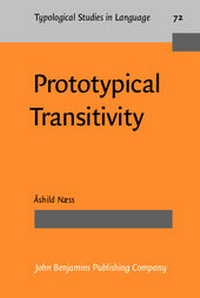
Prototypical Transitivity
1st Edition
Published on 13. July 2007
X, 240 pages
978-90-272-9221-6 (ISBN)
Description

This book presents a functional analysis of a notion which has gained considerable importance in cognitive and functional linguistics over the last couple of decades, namely 'prototypical transitivity'. It discusses what prototypical transitivity is, why it should exist, and how it should be defined, as well as how this definition can be employed in the analysis of a number of phenomena of language, such as case-marking, experiencer constructions, and so-called ambitransitives. Also discussed is how a prototype analysis relates to other approaches to transitivity, such as that based on markedness. The basic claim is that transitivity is iconic: a construction with two distinct, independent arguments is prototypically used to refer to an event with two distinct, independent participants. From this principle, a unified account of the properties typically associated with transitivity can be derived, and an explanation for why these properties tend to correlate across languages can be given.
More details
Other editions
Additional editions
Ashild Naess
Prototypical Transitivity
Book
07/2007
John Benjamins Publishing Co
€121.90
Shipment within 10-15 days
Person
Content
- Prototypical Transitivity
- Editorial page
- Title page
- LCC data
- Table of contents
- Preface
- I. Introduction
- 1.1 Why transitivity?
- 1.2 Theoretical preliminaries
- 1.2.1 Functional typology and prototype theory
- 1.2.2 Definitions and terminology
- 1.3 Structure of the book
- II. Why a transitive prototype?
- 2.1 Introduction
- 2.2 Prototype models
- 2.2.1 Characteristics of a prototype model
- 2.2.2 Transitivity as a prototype concept
- 2.2.3 Descriptive and explanatory issues
- 2.3 Markedness vs. prototypicality
- 2.3.1 Comrie's generalisation
- 2.3.2 Transitives vs. intransitives
- 2.3.3 Transitivity and the maximal distinction of categories
- 2.3.4 The markedness of prototypically transitive clauses
- 2.4 Conclusion
- III. Defining the transitive prototype
- 3.1 Introduction
- 3.2 The maximally distinguished arguments hypothesis
- 3.2.1 Transitivity and the distinguishability of participants
- 3.2.2 Inherent vs. relational properties
- 3.2.3 The trouble with agents
- 3.2.4 Participant roles vs. thematic relations
- 3.2.5 The properties of agents and patients
- 3.2.6 Agent and patient as maximally distinct categories
- 3.3 Maximal distinction and functional explanations
- IV. The affected agent
- 4.1 Introduction
- 4.2 "Ingestive verbs" and affected agents
- 4.3 Crosslinguistic data
- 4.3.1 Indefinite object deletion and suppletive verb pairs
- 4.3.2 Labile verbs
- 4.3.3 Cross-referencing properties
- 4.3.4 Causativisation
- 4.3.5 Case-marking properties
- 4.4 'Eat' and markers of agent affectedness
- 4.4.1 Affected Agents and the meaning of 'eat'
- 4.4.2 'Eat' and reflexive constructions
- 4.4.3 'Eat' grammaticalised as marker of agent affectedness
- 4.5 Alternative analyses
- 4.6 Other affected-agent constructions
- 4.7 Concluding remarks
- V. Transitivity in verbs and clauses
- 5.1 Introduction
- 5.2 Previous feature-decompositional accounts
- 5.3 Semantic specifications of participant types
- 5.3.1 [+VOL, -INST, +AFF]: Volitional Undergoers
- 5.3.2 [-VOL, +INST, -AFF]: Force
- 5.3.3 [-VOL, +INST, +AFF]: Instrument
- 5.3.4 [+VOL, -INST, -AFF]: Frustrative
- 5.3.5 [-VOL, -INST, -AFF]: Neutral
- 5.4 Semantic features in verb subcategorisation
- 5.5 Properties of argument NPs
- 5.6 Clause-level properties
- 5.6.1 Clausal operators as "feature-switchers"
- 5.6.2 Negation and mood
- 5.6.3 Aspect
- 5.7 Formal correlates
- 5.8 Conclusion
- VI. Ambitransitivity and indefinite object deletion
- 6.1 Introduction
- 6.2 Indefinite object deletion
- 6.2.1 Defining the term
- 6.2.2 Typical IOD verbs
- 6.2.3 Clausal-level IOD
- 6.2.4 Previous approaches
- 6.3 Transitivity and indefinite object deletion
- 6.3.1 IOD as a detransitivising mechanism
- 6.3.2 Additional factors
- 6.3.3 Semantic specialisation: The case of 'eat' and 'drink'
- 6.4 IOD and S/O ambitransitives
- VII. Maximal semantic distinction in core case-marking
- 7.1 Introduction
- 7.2 The discriminatory analysis
- 7.3 The indexing analysis
- 7.4 Case and the maximal semantic distinction of arguments
- 7.4.1 Patient/object marking
- 7.4.2 Agent/subject marking
- 7.5 Case and semantic transitivity - unifying discrimination and indexing
- 7.6 Semantic extensions
- 7.7 Discriminatory extensions
- 7.8 Split ergativity
- 7.9 A note on case-marking labels
- VIII. Experiencers and the dative
- 8.1 Introduction
- 8.2 The semantic diversity of experience events
- 8.3 Experience clauses and the transitive prototype
- 8.4 The dative case
- 8.4.1 Dative as a marker of Volitional Undergoers
- 8.4.2 From recipients to possessors
- 8.4.3 Causee case-marking
- 8.4.4 The relevance of animacy
- 8.4.5 Less affected objects
- 8.4.6 Uncontrolled intransitives
- IX. Beyond prototypical transitivity
- 9.1 From Agent and Patient to subject and object
- 9.2 Structural vs. semantic case
- 9.3 Other prototypes
- 9.4 Concluding remarks
- Appendix: Nonstandard abbreviations in glosses
- References
- Author index
- Language index
- Subject index
- The series Typological Studies in Language
