

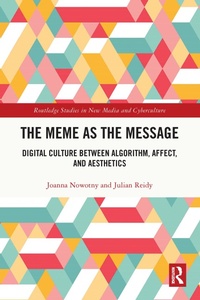
The Meme as the Message
Digital Culture Between Algorithm, Affect, and Aesthetics
Published on 31. October 2025
278 pages
978-1-040-60035-1 (ISBN)
Description

This book sheds light on the phenomenon of memes, covering everything from pandemic humour to far-right propaganda, from feminist memes to algorithmic censorship. Memes are far more than light entertainment - they are complex cultural artefacts that play a role in politics, in art, and in platform economics.
Taking a cultural studies perspective, the authors analyse individual memes in entertaining case studies, systematising their findings in order to redefine this digital form of communication. Chapters connect memes with other digital phenomena such as trolling, and combine extensive close readings of exemplary individual memes with regards to form and aesthetics with an acute awareness of power dynamics and other context phenomena surrounding memes. The book develops an innovative theoretical approach that presents the term "memesis" to capture the very specific quality of meme production and reception as a form of collective creative rewriting of a template in accordance with algorithmic logic.
Offering an important contribution not only to the still young field of meme studies but also to the general negotiations of questions around digital literacy, this book will interest not only scholars and students of digital media, visual communication, cultural studies, and media and politics but anyone with a keen interest in digital culture - and how it shapes our lives.
Taking a cultural studies perspective, the authors analyse individual memes in entertaining case studies, systematising their findings in order to redefine this digital form of communication. Chapters connect memes with other digital phenomena such as trolling, and combine extensive close readings of exemplary individual memes with regards to form and aesthetics with an acute awareness of power dynamics and other context phenomena surrounding memes. The book develops an innovative theoretical approach that presents the term "memesis" to capture the very specific quality of meme production and reception as a form of collective creative rewriting of a template in accordance with algorithmic logic.
Offering an important contribution not only to the still young field of meme studies but also to the general negotiations of questions around digital literacy, this book will interest not only scholars and students of digital media, visual communication, cultural studies, and media and politics but anyone with a keen interest in digital culture - and how it shapes our lives.
More details
Series
Language
English
Place of publication
London
United Kingdom
Publishing group
Taylor & Francis Ltd
Target group
College/higher education
Illustrations
40 Halftones, black and white; 40 Illustrations, black and white
File size
69,02 MB
ISBN-13
978-1-040-60035-1 (9781040600351)
Copyright in bibliographic data and cover images is held by Nielsen Book Services Limited or by the publishers or by their respective licensors: all rights reserved.
Schweitzer Classification
Other editions
Additional editions
Joanna Nowotny | Julian Reidy
The Meme as the Message
Digital Culture Between Algorithm, Affect, and Aesthetics
Book
10/2025
1st Edition
Routledge
€207.90
Shipment within 10-20 days
Persons
Joanna Nowotny is a researcher at the Swiss Literary Archives (SLA) at the Swiss National Library in Bern, Switzerland, and holds a PhD in Literary and Cultural Studies.
Julian Reidy works as a teacher in Bern, Switzerland, and holds a PhD in Literary and Cultural Studies.
Julian Reidy works as a teacher in Bern, Switzerland, and holds a PhD in Literary and Cultural Studies.
Content
1. Introduction - Digital Culture and "Real Life"
2. Referentiality - Memetic Cultures between the Local and the Global
3. Humour - Coping and Joking, Empowerment and Oppression
4. Politics - Memes between Activism and Sabotage
5. The Mainstream - Technology, Economy, and Ideology
6. Canonisation - Pixelated Power and Trolling
7. The End? Main Takeaways - and New Perspectives
Index
2. Referentiality - Memetic Cultures between the Local and the Global
3. Humour - Coping and Joking, Empowerment and Oppression
4. Politics - Memes between Activism and Sabotage
5. The Mainstream - Technology, Economy, and Ideology
6. Canonisation - Pixelated Power and Trolling
7. The End? Main Takeaways - and New Perspectives
Index
