
Stating the Family
Description
Alles über E-Books | Antworten auf Fragen rund um E-Books, Kopierschutz und Dateiformate finden Sie in unserem Info- & Hilfebereich.
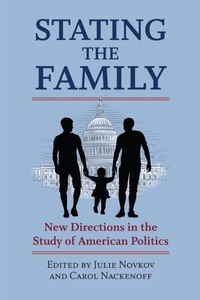
Glance at a political party's platform, catch a politician's speech, sample the news, and you will find the family-not as a mere group of people living together in the private sphere, but as a contentious entity at the center of political disputes and policy debates over everything from marriage equality and gender identity to immigration and welfare reform. The key role of the family in politics and public policy, so often relegated to the outer margins of political science and theory, comes in for long overdue consideration in this volume. Bringing together political scientists and legal scholars of wide-ranging interests and perspectives, Stating the Family explores the role of the family in American political development: as a focus of political struggle, a place where policy happens, a means of distributing governmental goods, and a way of relating individuals to the state and to each other in legal terms.
While the authors gathered here examine important policy questions that relate to the family-including immigration, welfare, citizenship, partisanship, and ideology-they pay particular attention to changes in family structures and responsibilities in light of the rise of neoliberalism. Illustrated with case studies-some contemporary, some historical-their essays provide individual takes on different links between family and politics, creating a nuanced conversation on this complex topic. The result is a multifaceted view of the family's place in the development of American political institutions and a unique understanding of the work that family does to structure politics-and that politics does to structure families.
All prices
More details
Other editions
Additional editions
Content
Foreword: Responsibility for the Well-Being of Families, Joan Tronto
Introduction. Stated Families, Family Stakes: The Family, the American State, and Political Development, Julie Novkov and Carol Nackenoff
1. Democracy and Family, June Carbone and Naomi Cahn
2. Obergefell, Marriage, and the Neoliberal Politics of Care, Tamara Metz
3. Constituting Families: Marriage Equality Activism and the Role of the State, Ellen Ann Andersen
4. The Legal Construction of Motherhood and Paternity: Interracial Unions and the Color Line in Antebellum Louisiana, Gwendoline Alphonso and Richard Bensel
5. A ?Bridge to Our Daughters?: Title IX Fathers and Policy Development, Elizabeth Sharrow
6. The Feudal Family versus American Political Development: From Separate Spheres to Woman Suffrage, Eileen McDonagh
7. Building the Administrative State: Courts and the Admission of Chinese Persons to the United States, 1870s-1920s, Carol Nackenoff and Julie Novkov
8. Deportability and (Dis)unification: Family Status and US Immigration Policy, Alison Gash and Priscilla Yamin
Conclusion, Julie Novkov and Carol Nackenoff
About the Contributors
Index

System requirements
File format: ePUB
Copy protection: Adobe-DRM (Digital Rights Management)
System requirements:
- Computer (Windows; MacOS X; Linux): Install the free reader Adobe Digital Editions prior to download (see eBook Help).
- Tablet/smartphone (Android; iOS): Install the free app Adobe Digital Editions or the app PocketBook before downloading (see eBook Help).
- E-reader: Bookeen, Kobo, Pocketbook, Sony, Tolino and many more (not Kindle).
The file format ePub works well for novels and non-fiction books – i.e., „flowing” text without complex layout. On an e-reader or smartphone, line and page breaks automatically adjust to fit the small displays.
This eBook uses Adobe-DRM, a „hard” copy protection. If the necessary requirements are not met, unfortunately you will not be able to open the eBook. You will therefore need to prepare your reading hardware before downloading.
Please note: We strongly recommend that you authorise using your personal Adobe ID after installation of any reading software.
For more information, see our ebook Help page.
File format: PDF
Copy-Protection: Adobe-DRM (Digital Rights Management)
System requirements:
- Computer (Windows; MacOS X; Linux): Install the free reader Adobe Digital Editions prior to download (see eBook Help).
- Tablet/smartphone (Android; iOS): Install the free app Adobe Digital Editions or the app PocketBook before downloading (see eBook Help).
- E-reader: Bookeen, Kobo, Pocketbook, Sony, Tolino and many more (only limited: Kindle).
The file format PDF always displays a book page identically on any hardware. This makes PDF suitable for complex layouts such as those used in textbooks and reference books (images, tables, columns, footnotes). Unfortunately, on the small screens of e-readers or smartphones, PDFs are rather annoying, requiring too much scrolling.
This eBook uses Adobe-DRM, a „hard” copy protection. If the necessary requirements are not met, unfortunately you will not be able to open the eBook. You will therefore need to prepare your reading hardware before downloading.
Please note: We strongly recommend that you authorise using your personal Adobe ID after installation of any reading software.
For more information, see our eBook Help page.
File format: ePUB
Copy protection: Watermark-DRM (Digital Rights Management)
System requirements:
- Computer (Windows; MacOS X; Linux): Use a reading software that can process the file format ePUB: e.g., Adobe Digital Editions or FBReader – both free (see eBook Help).
- Tablet/Smartphone (Android; iOS): Before downloading, install the free app Adobe Digital Editions (see eBook Help).
- E-reader: Bookeen, Kobo, Pocketbook, Sony, Tolino and many more (not Kindle).
The file format ePUB works well for novels and non-fiction books – i.e., „flowing” text without complex layout. On an e-reader or smartphone, line and page breaks automatically adjust to fit the small displays.
This eBook uses Watermark-DRM, a „soft” copy protection. This means that there are no technical restrictions to prevent illegal distribution. However, there is a personalised watermark embedded in the eBook that can be used to identify the purchaser of the eBook in the event of misuse and to provide evidence for legal purposes.
For more information, see our eBook Help page.
