

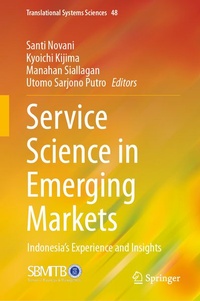
Service Science in Emerging Markets
Description

This book delves deeply into the evolution of service science and its application to Indonesia, a country characterized by its agrarian and maritime identities, rich cultural tapestry, and huge physical geography. It investigates how these elements influence customer behaviors, the decision-making processes, and service perceptions, presenting both difficulties and possibilities for business, academia, and government to create value in this diversified context.
The book is the first to investigate how service science might be implemented within Indonesia's unique cultural and geographical environment, incorporating the country's special idea of gotong-royong (mutual cooperation) into the value co-creation framework. Unlike other research, it combines global ideas with local practices, providing new insights into adapting service science and innovation to regional diversity.
By combining theory and practical case studies, this book provides a holistic understanding of the concept of service science as well as the development of scientific application. It highlights the significance of tailoring service to the local situation in Indonesia. Also, it reflects Indonesia's unique traits while providing ideas relevant outside its borders, with examples drawn from academia, business, and government sectors.
Designed as a guide for practitioners, academics, and policymakers, this book provides modeling approaches in both hard and soft systems thinking. It uses qualitative, quantitative, and mixed methodologies to show how service science may promote value co-creation and innovation. The book has two major parts; the first discusses the concept of service science from the systems science perspective, and the second deals with the application of the service science concept to real cases in Indonesia.
More details
Other editions
Additional editions
Persons
Santi Novani received her Bachelor of Science degree on Mathematic from Padjadjaran University, Bandung in 2000. From 2000 to 2008 she worked at private university in Bandung. From 2004 up to 2008 she joints as research assistant and part-time tutor of interest group Decision Making and Strategic Negotiation. She earned Master of Engineering in Industrial Engineering and Management Department, ITB in 2005. Her master thesis investigated the development of Adaptive Learning Model of Hypergame in Hierarchical Organization. In 2013, she got Doctoral degree from Tokyo Institute of Technology, Department of Value and Decision Science.
Prof. Kyoichi Kijima received an M.A. from Tokyo Institute of Technology in 1976 and a Ph.D. in 1980. Later, in 1988, he spent a year in England to familiarize himself with soft systems engineering. In 1997 he spent another four months in England in collaboration with members of the United Kingdom Systems Society (UKSS) to further familiarize himself with the soft systems approach. In 1980 Jim Kijima started working as an assistant professor in the Department of Industrial Engineering and Management at the Tokyo Institute of Technology. After he returned from England in 1988, he was appointed associate professor of Management Systems in the same department.
Manahan Siallagan received the B.Eng. degree in mathematics from Institut Teknologi Bandung, and the master's and Ph.D. degrees in computational intelligence and systems science from the Tokyo Institute of Technology. His research interests include social simulation, decision science and negotiation, system thinking, big data analytics and agent based modeling. He was active as an expert in the President's Delivery Unit for Development Monitoring and Oversight (UKP4), young researcher of Indonesian National Member Organization in IIASA (International Institute of Applied System Analysis), and member of INCASA (Indonesian National Committee of Applied System Analysis). He has many International publications, such as Systems Research and Behavioral Science, Evolutionary and Institutional Economics Review, and Frontiers in Psychological and Behavioral Science also some book chapters in Springer edition and also active as reviewer at several international journals. He is also the director of Big Data and Business Analytics Laboratory at SBM-ITB and he is very active in developing research on modelling and simulation including big data analytics. He was also interested in developing the use of business analytics for Small and Medium Enterprise (SME) and actively conducted supervisions programs for SME.
Prof. Utomo Sarjono Putro got his bachelor degree from the Department of Industrial Engineering ITB in 1992, he then continued his Master and Doctoral education in the Department of Value and Decision Science, Tokyo Institute of Technology, Japan, in the field of decision science from 1995 until 2001. He published his works in reputable national and international journals such as, IEEE Transaction on Systems, Man, and Cybernetics, Systems Analysis Modelling Simulation, and Systems Research and Behavioural Science.
Content
Chapter 1. Science of Service Systems and Management (Kyoichi Kijima and Santi Novani).- Chapter 2. The concept and practice of service science (Santi Novani and Kyoichi Kijima).- Chapter 3. Service Science model for developing a process of problem based learning in business school education (Manahan Siallagan, Shimaditya Nuraeni, Henndy Ginting, Utomo Sarjono Putro, and Yudo Anggoro).- Chapter 4. The role of Value Co-creation within Technology Incubator Ecosystem in Indonesian Context (Eka Yuliana, Utomo Sarjono Putro, Pri Hermawan, Astri Ghina).- Chapter 5. Modeling stakeholders collaboration to promote value co-creation in food security (Valid Hasyimi, Utomo Sarjono Putro, Santi Novani, Agung Hendriadi).- Chapter 6. Analysis of co-creation in managing project operationalization in a branding agency (Muhammad Farhan Rizaldy, Krisna Ariyanto).- Chapter 7. Designing E-Tourism Experiences through Orchestration: A Case Study of West Kalimantan Tourism Information Center (Nadiah Vitha Julfira, Santi Novani).- Chapter 8. Viable System Model as Value Co-Creation Diagnostic Tool: A Case Study for 3-Star Hotel in Jayapura (Kayleen Priscilia, Santi Novani).- Chapter 9. Exploring Value Co-Creation in Community-Based Microfinance: A Perspective on Economic Empowerment (Nurmanjaya, Santi Novani).- Chapter 10. The role of service science in driving tourism entrepreneurship (Santi Manalu, Togar Simatupang, Santi Novani).- Chapter 11. Value co-creation among stakeholders in Innovation process: Living Lab in Indonesia (Surya Nugroho, Utomo Sarjono Putro, Santi Novani).- Chapter 12. Service Science in Digital Adoption for Social Impact (Devi Adityawarman, Utomo Sajono Putro, Santi Novani).- Chapter 13. Sadulur as a Digital Platform for MSME Empowerment (Santi Novani, Afisindika Fadhilah, Nadiah Vitha, Kayleen Priscilia, Hurriyah Mujahidah).
