

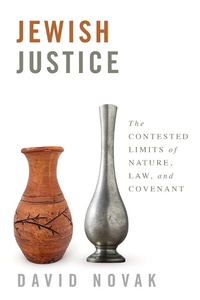
Jewish Justice
Description

In Jewish Justice David Novak explores the continuing role of Judaism for crafting ethics, politics, and theology. Drawing on sources as diverse as the Bible, the Talmud, and ancient, medieval, and modern philosophy, Novak asserts Judaism's integral place in communal discourse of the public square.
According to Novak, biblical revelation has universal implications-that it is ultimately God's law to humanity because humans made in God's image are capable of making intelligent moral choices. The universality of this claim, however, stands in tension with the particularities of Jewish monotheism (one God, one people, one law). Novak's challenge is for Judaism to capitalize on the way God's law transcends particularity without destroying difference. Thus it is as Jews that Jews are called to join communities across the faithful denominations, as well as secular ones, to engage in debates about the common good.
Jewish Justice follows a logical progression from grounded ethical quandaries to larger philosophical debates. Novak begins by considering the practical issues of capital punishment, mutilation and torture, corporate crime, the landed status of communities and nations, civil marriage, and religious marriage. He next moves to a consideration of theoretical concerns: God's universal justice, the universal aim of particular Jewish ethics, human rights and the image of God, the relation of post-Enlightenment social contract theory to the recently enfranchised Jewish community, and the voices of Jewish citizens in secular politics and the public sphere. Novak also explores the intersection of universality and particularity by examining the practice of interfaith dialogue among Jews, Christians, and Muslims.
More details
Other editions
Additional editions
Person
Content
Introduction1. Can Capital Punishment Ever Be Justified in the Jewish Tradition?2. The Elimination of Mutilation and Torture in Rabbinic Thought and Practice3. Natural Law, Human Dignity, and the Protection of Human Property4. Land and People: One Jewish Perspective5. Jewish Marriage and Civil Law: A Two-Way Street?6. Jewish Marriage: Nature, Covenant, and Contract7. Divine Justice/Divine Command8. The Universality of Jewish Ethics: A Rejoinder to Secularist Critics9. The Judaic Foundation of Rights10. Social Contract in Modern Jewish Thought: A Theological Critique11. Toward a Jewish Public Philosophy in America12. Defending Niebuhr from Hauerwas13. Is Natural Law a Border Concept Between Judaism and Christianity?
