

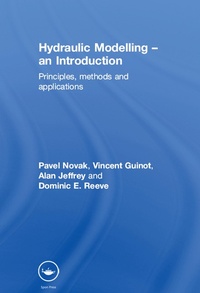
Hydraulic Modelling: An Introduction
Principles, Methods and Applications
1st Edition
Published on 24. October 2018
616 pages
978-1-351-98893-3 (ISBN)
Description

Modelling forms a vital part of all engineering design, yet many hydraulic engineers are not fully aware of the assumptions they make. These assumptions can have important consequences when choosing the best model to inform design decisions.
Considering the advantages and limitations of both physical and mathematical methods, this book will help you identify the most appropriate form of analysis for the hydraulic engineering application in question. All models require the knowledge of their background, good data and careful interpretation and so this book also provides guidance on the range of accuracy to be expected of the model simulations and how they should be related to the prototype.
Applications to models include:
open channel systems
closed conduit flows
storm drainage systems
estuaries
coastal and nearshore structures
hydraulic structures.
This an invaluable guide for students and professionals.
Considering the advantages and limitations of both physical and mathematical methods, this book will help you identify the most appropriate form of analysis for the hydraulic engineering application in question. All models require the knowledge of their background, good data and careful interpretation and so this book also provides guidance on the range of accuracy to be expected of the model simulations and how they should be related to the prototype.
Applications to models include:
open channel systems
closed conduit flows
storm drainage systems
estuaries
coastal and nearshore structures
hydraulic structures.
This an invaluable guide for students and professionals.
Reviews / Votes
'This book should definitely find its place in all libraries concerned with hydraulics, hydroinformatics and modelling. It certainly should be available in their respective institutions to all engineers who are involved in modelling or are using results of models. And it should be advised as essential reading to students at postgraduate level in hydraulics and hydroinformatics.'-Jean A. Cunge, Journal of Hydroinformatics
'The book is not only an invaluable guide for students but addresses all researchers and practitioners working in the field of water resources. Because of this it should find its place not only in the libraries of research institutes and universities, but also should be of interest and available to all concerned with the design and construction of all hydraulic structures.'
-Vodni Hospodarstvi (Water Management, in Czech)
'The authors have written an outstanding and timely work.'
-Willi H. Hager and Michael Pfister, Journal of Hydraulic Research
'A must-have for every hydraulics engineer who looks to the future of their profession.'
-Corado Gissoni, L'Acqua
More details
Edition
1. Auflage
Language
English
Place of publication
London
United Kingdom
Publishing group
Taylor & Francis Ltd
Target group
College/higher education
Professional and scholarly
Illustrations
8 Tables, black and white; 170 Illustrations, black and white
File size
41,70 MB
ISBN-13
978-1-351-98893-3 (9781351988933)
Copyright in bibliographic data and cover images is held by Nielsen Book Services Limited or by the publishers or by their respective licensors: all rights reserved.
Schweitzer Classification
Other editions
Additional editions
Pavel Novak | Vincent Guinot | Alan Jeffrey
Hydraulic Modelling: An Introduction
Principles, Methods and Applications
Book
01/2010
1st Edition
CRC Press
€279.90
Shipment within 10-20 days
Pavel Novak | Vincent Guinot | Alan Jeffrey
Hydraulic Modelling: An Introduction
Principles, Methods and Applications
Book
01/2010
1st Edition
CRC Press
€135.30
Shipment within 10-20 days
Persons
Pavel Novak is Emeritus Professor of Civil and Hydraulic Engineering at the University of Newcastle upon Tyne, UK.
Vincent Guinot is Professor at University of Montpellier, France.
Alan Jeffrey is Emeritus Professor of Engineering Mathematics at the University of Newcastle upon Tyne, UK.
Dominic Reeve is Professor of Coastal Dynamics at the University of Plymouth, UK.
Vincent Guinot is Professor at University of Montpellier, France.
Alan Jeffrey is Emeritus Professor of Engineering Mathematics at the University of Newcastle upon Tyne, UK.
Dominic Reeve is Professor of Coastal Dynamics at the University of Plymouth, UK.
Content
Introduction. Theoretical Background. Development of Physical Models. Development of Numerical Models. Procedure and Tools - Physical Models. Procedure and Tools - Mathematical Models. Hydrodynamic Modelling of Open Channel Systems. Environmental Modelling of Open Channel Systems. Hydrodynamic Modelling of Closed Conduit Flows. Modelling of Storm Drainage Systems. Modelling of Estuaries. Modelling of Coastal and Offshore Structures and Processes. Modelling of Hydraulic Structures.
