

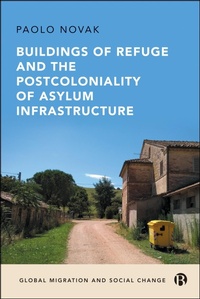
Buildings of Refuge and the Postcoloniality of Asylum Infrastructure
1st Edition
Published on 18. June 2025
200 pages
978-1-5292-3422-0 (ISBN)
Description

This book offers a fresh perspective on the European migration crisis, chronicling its everyday realities in a central Italian province. Through vivid ethnographic accounts, it reveals how the forces and relations animating this crisis are reproduced and transformed in the rooms of ordinary buildings converted into shelters for asylum seekers.
Drawing on postcolonial and feminist approaches, the author explores the intersection of global and local histories, migrant stories and bordering processes, providing a timely lens for understanding migration today.
This is an invaluable contribution to debates on EU borders, including their logistical management, their coloniality and the autonomous force of migration that subverts them.
Drawing on postcolonial and feminist approaches, the author explores the intersection of global and local histories, migrant stories and bordering processes, providing a timely lens for understanding migration today.
This is an invaluable contribution to debates on EU borders, including their logistical management, their coloniality and the autonomous force of migration that subverts them.
Reviews / Votes
"Buildings of Refuge is a beautiful and thoughtfully constructed homage to how place is made through the dialectical interaction of individual stories with wider social forces. Novak artfully renders a multi-layered chronicling of a diverse array of buildings used to house asylum seekers in the Macerata province of Italy as places at the height of what is often, wrongly, as Novak too insists, seen as Europe's migration crisis of the mid to late 2010s. The book's concluding discussion is highly timely in its call to use a capacious and open conceptualisation of place as a resource in the fight against the nationalist right. The road to this conceptualisation is tightly argued in respectful and sometimes divergent conversation with Marxist geographers Gillian Hart, Doreen Massey and Milton Santos and a broad array of other scholarship. Novak holds together complexity, insisting as much on proper regard for history and more broadly for time, in the analysis of contemporary places, as on an engagement with how the buildings at the heart of the book are produced by and productive of, local social relations, just as they are shot through with the stories of the people whose refuge they became in the first part of the twenty-first century. A sophisticated, scholarly, grounded and humane contribution and one that is well worth making time to read." Ben Rogaly, University of Sussex "Refugee studies never fail to surprise us. In this book, buildings requisitioned by the European border machine as extraordinary reception centres for asylum seekers transform into astonishing heterotopic sites - simultaneously spaces of institutional and operational control, shelters for displaced populations, objects of scrutiny from surrounding communities, and, not least, birthplaces of stories from those who work in or experience them in various ways. To read the dynamics of production of space in a new way, read Buildings of Refuge." Ranabir Samaddar, Mahanirban Calcutta Research Group"Novak's crisp, thick description and novel theoretical project depart from critical border studies as we know it. He shows how borders are reproduced on their own terms at the finest of scales - in buildings where asylum seekers wait. Buildings are the protagonists of this book which eschews views from nowhere and avoids categorial distinctions between migrant and non-migrant. Informed by critical feminist epistemologies, from Haraway and Blunt to Zaragocin and Lugones, Buildings of Refuge is an exquisite carto-ethnography of how the EU border machine can dwell far away from any border." Jennifer Hyndman, York University "Novak walks us through the forged paths and lives of reception centers for asylum seekers in Macerata in an unusually inspiring way. He leaves no stone unturned in their politics, economy, and governance, while blowing histories into them as if he were a glass artist. What remains as the strongest aftertaste of this book is Novak's courage and skills in provincializing not only logistics but also postcolonial thought. It has been long overdue." Ayse Caglar, IWM
"A deeply insightful interrogation of borders - not just as lines on a map, but as dynamic sites where power, movement and place-making collide. Conceptually bold and empirically rich, Novak breaks new ground in our understanding of the EU border machine." Adam Hanieh, University of Exeter
"In Buildings of Refuge, Paolo Novak offers a compelling exploration of the shifting dynamics of border crossings and bordering practices in Europe. This work provides an original and timely analysis of the spatiotemporal dimensions of the so-called migration crisis. Drawing on ethnographic fieldwork and framed within critical feminist epistemologies as well as decolonial migration studies, Buildings of Refuge makes a significant contribution to the understanding of placemaking practices and embodied experiences in relation to borders. Novak's work is both engaging and insightful, offering a nuanced perspective on the complexities of migration and the lived realities of those navigating these borders." Shahram Khosravi, Stockholm University
"Novak's book is a fascinating and much-needed work that connects the 'global' and the 'local' in the study of refugee reception processes. He does this through his analysis of buildings as situated places of bordering processes, while also paying close attention to the localized social contexts in which they are embedded, always relating them to broader global trends." Lucas Oesch, University of Neuchatel
More details
Series
Edition
First Edition
Language
English
Place of publication
Bristol
United Kingdom
Target group
Professional and scholarly
Product notice
Reflowable
Illustrations
1 s/w Abbildung
1 Illustrations, black and white
File size
0,87 MB
ISBN-13
978-1-5292-3422-0 (9781529234220)
Copyright in bibliographic data and cover images is held by Nielsen Book Services Limited or by the publishers or by their respective licensors: all rights reserved.
Schweitzer Classification
Other editions
Additional editions
Book
approx. 12/2026
1st Edition
Bristol University Press
€42.50
Not yet published
Book
06/2025
1st Edition
Bristol University Press
€129.50
Shipment within 3-4 weeks
Person
Paolo Novak is Senior Lecturer in Development Studies and Co-Director of the Centre for Migration and Diaspora Studies at SOAS University of London.
Content
Introduction
1. Buildings as Protagonists
2. The Place of Asylum Infrastructure
3. Provincializing Logistics
4. Destabilizing Coloniality
5. Placing Autonomy
6. The Postcoloniality of Asylum Infrastructure
1. Buildings as Protagonists
2. The Place of Asylum Infrastructure
3. Provincializing Logistics
4. Destabilizing Coloniality
5. Placing Autonomy
6. The Postcoloniality of Asylum Infrastructure
