

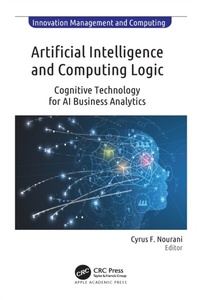
Artificial Intelligence and Computing Logic
Cognitive Technology for AI Business Analytics
1st Edition
Published on 22. December 2021
286 pages
978-1-000-40090-8 (ISBN)
Description

Focusing on the cutting-edge applications of AI cognitive computing from neuromorphic to quantum cognition as applied to AI business analytics, this new volume explores AI's importance in managing cognitive processes along with ontological modeling concepts for venturing into new business frontiers. The volume presents a selection of significant new accomplishments in the areas of AI cognitive computing ranging from neurocognition perception and decision-making in the human brain-combining neurocognitive techniques and effective computing-to basic facial recognition computing models. Topics include:
Agent neurocomputing techniques for facial expression recognition
Computing haptic motion and ontology epistemic
Characterizations of morph schemas for visual analytics
Learning and perceptive computing
Functional and structural neuroimaging modeling
Observed links between facial recognition and affective emotional processes
Interaction of cognitive and emotional processes during social decision-making
Neurocognitive processing of emotional facial expressions in individuals
Neurocognitive affective system for emotive robot androids
Virtual reality-based affect adaptive neuromorphic computing
Executive surveys indicate that cognitive adoption is very important in business strategy for success and to remain competitive. Employing cognitive-based processes provides the way to get the right information in the right hands at the right time, which is the key to winning in the digital era and to driving business value that emphasizes competitive differentiation. Several chapters of the volume address the goal of using cognitive technology to improve search capabilities, to provide personalized customer service in business and in health and wellness, and to create better workflow management. Key features:
Looks at the newest frontiers on very popular AI and analytics topics
Discusses new techniques for visual analytics and data filtering
Shows how AI and cognitive science merges with quantum neurocognitive computing
Presents ontology models with ontology preservation data filtering techniques
Provides a cross-transposition on AI and digitizations for business model innovations
Artificial Intelligence and Computing Logic: Cognitive Technology for AI Business Analytics is a valuable resource that informs businesses and other enterprises the value of artificial intelligence and computing logic applications.
Agent neurocomputing techniques for facial expression recognition
Computing haptic motion and ontology epistemic
Characterizations of morph schemas for visual analytics
Learning and perceptive computing
Functional and structural neuroimaging modeling
Observed links between facial recognition and affective emotional processes
Interaction of cognitive and emotional processes during social decision-making
Neurocognitive processing of emotional facial expressions in individuals
Neurocognitive affective system for emotive robot androids
Virtual reality-based affect adaptive neuromorphic computing
Executive surveys indicate that cognitive adoption is very important in business strategy for success and to remain competitive. Employing cognitive-based processes provides the way to get the right information in the right hands at the right time, which is the key to winning in the digital era and to driving business value that emphasizes competitive differentiation. Several chapters of the volume address the goal of using cognitive technology to improve search capabilities, to provide personalized customer service in business and in health and wellness, and to create better workflow management. Key features:
Looks at the newest frontiers on very popular AI and analytics topics
Discusses new techniques for visual analytics and data filtering
Shows how AI and cognitive science merges with quantum neurocognitive computing
Presents ontology models with ontology preservation data filtering techniques
Provides a cross-transposition on AI and digitizations for business model innovations
Artificial Intelligence and Computing Logic: Cognitive Technology for AI Business Analytics is a valuable resource that informs businesses and other enterprises the value of artificial intelligence and computing logic applications.
More details
Series
Edition
1. Auflage
Language
English
Place of publication
London
United Kingdom
Publishing group
Taylor & Francis Ltd
Target group
College/higher education
Professional and scholarly
Product notice
Reflowable
Illustrations
3 Tables, black and white; 6 Illustrations, color; 17 Illustrations, black and white
ISBN-13
978-1-000-40090-8 (9781000400908)
Copyright in bibliographic data and cover images is held by Nielsen Book Services Limited or by the publishers or by their respective licensors: all rights reserved.
Schweitzer Classification
Other editions
Additional editions
Cyrus F. Nourani
Artificial Intelligence and Computing Logic
Cognitive Technology for AI Business Analytics
Book
07/2024
1st Edition
Apple Academic Press Inc.
€127.50
Shipment within 3-4 weeks
Cyrus F. Nourani
Artificial Intelligence and Computing Logic
Cognitive Technology for AI Business Analytics
Book
12/2021
1st Edition
Apple Academic Press Inc.
€194.62
Shipment within 3-4 weeks
Artificial Intelligence and Computing Logic
Cognitive Technology for AI Business Analytics
Book
09/2021
Apple Academic Press
Unfortunately, price unknown
Available (delivery time upon request)
Person
Cyrus F. Nourani, PhD, has a national and international reputation in computer science, artificial intelligence, mathematics, virtual haptic computation, enterprise modeling, decision theory, data sciences, predictive analytics economic games, information technology, and management science. In recent years he has been engaged as a research professor at Simon Frasier University in Burnaby, British Columbia, Canada, and at the Technical University of Berlin, Germany, and has been working on research projects in Germany, Sweden, and France. He has many years of experience in the design and implementation of computing systems. Dr. Nourani's academic experience includes faculty positions at the University of Michigan-Ann Arbor, the University of Pennsylvania, the University of Southern California, UCLA, MIT, and the University of California, Santa Barbara. He was a visiting professor at Edith Cowan University, Perth, Australia, and a lecturer of Management Science and IT at the University of Auckland, New Zealand.
Dr. Nourani has taught AI to the Los Angeles aerospace industry and has worked in many R&D and commercial ventures. He has written and coauthored several books. He has over 400 publications in computing science, mathematics, and management science, and he has written several books and has edited several volumes on additional topics, such as pure mathematics; AI, EC, and IT management science; decision trees; and predictive economics game modeling. In 1987, he founded Ventures for computing R&D and was a consultant for such clients such as System Development Corporation (SDC), the US Air Force Space Division, and GE Aerospace. Dr. Nourani has designed and developed AI robot planning and reasoning systems at Northrop Research and Technology Center, Palos Verdes, California. He also has comparable AI, software, and computing foundations and R&D experience at GTE Research Labs.
Dr. Nourani commenced his university degrees at MIT, where he became interested in algebraic semantics. That was pursued with a world-renowned category theorist at the University of California and Oxford University. Dr. Nourani's dissertation on computing models and categories proved to have pure mathematics foundations developments that were published from his postdoctoral times in US and Europe publications.
Dr. Nourani has taught AI to the Los Angeles aerospace industry and has worked in many R&D and commercial ventures. He has written and coauthored several books. He has over 400 publications in computing science, mathematics, and management science, and he has written several books and has edited several volumes on additional topics, such as pure mathematics; AI, EC, and IT management science; decision trees; and predictive economics game modeling. In 1987, he founded Ventures for computing R&D and was a consultant for such clients such as System Development Corporation (SDC), the US Air Force Space Division, and GE Aerospace. Dr. Nourani has designed and developed AI robot planning and reasoning systems at Northrop Research and Technology Center, Palos Verdes, California. He also has comparable AI, software, and computing foundations and R&D experience at GTE Research Labs.
Dr. Nourani commenced his university degrees at MIT, where he became interested in algebraic semantics. That was pursued with a world-renowned category theorist at the University of California and Oxford University. Dr. Nourani's dissertation on computing models and categories proved to have pure mathematics foundations developments that were published from his postdoctoral times in US and Europe publications.
Content
1. Fundamental Notions and Applications of Symbiotic Recursive Pulsative Systems 2. Cognitive Computing: Quo Vadis? 3. Digital Transformations Imperatives: Predictive Goal Processes for Business Model Innovation 4. Toward a Quantum Theory of Cognitive Affect from Poe to Robotic Helpers: Newton, Arousal, and Covalent Bonding 5. AI Predictive Digital Analytics: A Model Computing Basis 6. Effect of Digitization on Business Model Innovation 7. AI Process Description Algebras and Ontology Preservation Techniques
