

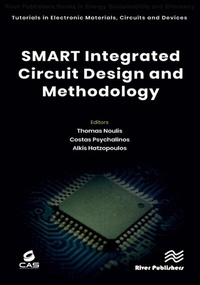
SMART Integrated Circuit Design and Methodology
1st Edition
Published on 7. December 2023
204 pages
978-1-003-82813-6 (ISBN)
Description

This book describes advanced flows and methodologies for the design and implementation of system-on-chip (SoC). It is written by a mixture of industrial experts and key academic professors and researchers. The intended audience is not only students but also engineers with system-on-chip and semiconductor background currently working in the semiconductor industry.
Integrated Circuits are available in every electronic product, especially in emerging market segments such as 5G mobile communications, autonomous driving, fully electrified vehicles, and artificial intelligence. These product types require real-time processing at billions of operations per second. The development design cycle time is driving costs and time to market more than ever before. The traditional design methodologies have reached their limits and innovative solutions are essential to serve the emerging SoC design challenges. In the framework of the Circuit and System Society (CASS) Outreach Initiative 2022 call, the SMART Integrated Circuits design methodology - named SMARTIC - Seasonal School was performed in November 2022, in Thessaloniki (Greece).
Features
Core analog circuits of any system of chip, such as high-performance rectifiers and filters, are addressed in detail, together with their respective design methodology.
New advanced methodologies towards design cycle speed up based on machine learning and artificial intelligence applications.
Advanced analog design methodology based on gm/Id and lock up tables. A powerful flow for enabling fast time to market analog circuit design focusing on baseband circuits
More exotic methodologies and applications with focus on digital-based analog processing in nanoscale CMOS ICs and the design and development of depleted monolithic active pixel sensors for high-radiation applications, together with all the respective challenges of this application.
Integrated Circuits are available in every electronic product, especially in emerging market segments such as 5G mobile communications, autonomous driving, fully electrified vehicles, and artificial intelligence. These product types require real-time processing at billions of operations per second. The development design cycle time is driving costs and time to market more than ever before. The traditional design methodologies have reached their limits and innovative solutions are essential to serve the emerging SoC design challenges. In the framework of the Circuit and System Society (CASS) Outreach Initiative 2022 call, the SMART Integrated Circuits design methodology - named SMARTIC - Seasonal School was performed in November 2022, in Thessaloniki (Greece).
Features
Core analog circuits of any system of chip, such as high-performance rectifiers and filters, are addressed in detail, together with their respective design methodology.
New advanced methodologies towards design cycle speed up based on machine learning and artificial intelligence applications.
Advanced analog design methodology based on gm/Id and lock up tables. A powerful flow for enabling fast time to market analog circuit design focusing on baseband circuits
More exotic methodologies and applications with focus on digital-based analog processing in nanoscale CMOS ICs and the design and development of depleted monolithic active pixel sensors for high-radiation applications, together with all the respective challenges of this application.
More details
Series
Edition
1. Auflage
Language
English
Place of publication
London
United Kingdom
Publishing group
Taylor & Francis Ebooks
Target group
College/higher education
Professional and scholarly
Product notice
Reflowable
Illustrations
184 Line drawings, color; 90 Halftones, color; 274 Illustrations, color
ISBN-13
978-1-003-82813-6 (9781003828136)
Copyright in bibliographic data and cover images is held by Nielsen Book Services Limited or by the publishers or by their respective licensors: all rights reserved.
Schweitzer Classification
Other editions
Additional editions
Thomas Noulis | Costas Psychalinos | Alkis Hatzopoulos
SMART Integrated Circuit Design and Methodology
Book
12/2023
1st Edition
River Publishers
€151.60
Article not available for order
Persons
Thomas Noulis is an academic and a semiconductor industry expert (INTEL Corp., INFINEON AG, HELIC Inc. (acquired by ANSYS)) with more than 12 years of international experience in design system development, analog/RFMS circuit design, design methodology and international project management. He holds a B.Sc. Degree in Physics (2003), M.Sc. Degree in Electronics Engineering (2005), and a Ph.D. (2009) from Aristotle University of Thessaloniki (collaboration with LAAS, Toulouse-France). He has participated in integrated circuit design European and national research projects. Dr. Noulis is the main author of more than 70 publications, holds one European patent and he is the editor of two books. He is an active reviewer and a member of the editorial board of international scientific journals and conferences. He has given invited presentations on cross-talk and Readout from end IC design. His research interests are focused on low noise circuit design, signal and power integrity, instrumentation and sensor interfaces. Currently he is an Assistant Professor in the Physics Department of Aristotle University of Thessaloniki, Greece.
Costas Psychalinos received his B.Sc. and Ph.D. degrees in Physics and Electronics from the University of Patras, Greece, in 1986 and 1991, respectively. From 1993 to 1995, he worked as Post-Doctoral Researcher in the VLSI Design Laboratory, University of Patras. From 1996 to 2000, he was an Adjunct Lecturer at the Department of Computer Engineering and Informatics, University of Patras. From 2000 to 2004 he served as Assistant Professor at the Electronics Laboratory, Department of Physics, Aristotle University of Thessaloniki, Greece. From 2004 he served as faculty member at the Electronics Laboratory, Department of Physics, University of Patras, Greece and, currently, he is full Professor. His research area is in the development of CMOS analog integrated circuits, including fractional-order circuits and systems, continuous and discrete-time analog filters, amplifiers, and low voltage/low power building blocks for analog signal processing. He serves as Editor-in-Chief of the Circuit and Signal Processing Section of the MDPI Electronics Journal, as Area Editor of the International Journal of Electronics and Communications (AEUE) Journal, and Editor of the International Journal of Circuit Theory and Applications. He is Associate Editor of the Circuits Systems and Signal Processing Journal, and the Journal of Advanced Research. He is member of the Editorial Board of the Microelectronics Journal, Analog Integrated Circuits and Signal Processing Journal, Fractal & Fractional Journal, and Journal of Low Power Electronics and Applications. He is IEEE Senior Member and Member of the Nonlinear Circuits and Systems Technical Committee of the IEEE CAS Society.
Alkis A. Hatzopoulos (Chatzopoulos) received his Degree in Physics (with honours), his Master Degree in Electronics and his Ph.D. Degree in Electrical Engineering from the Aristotle University of Thessaloniki, Greece, in 1980, 1983 and 1989, respectively. He has been with the Department of Electrical and Computer Engineering at the Aristotle University of Thessaloniki since 1981, where he is now a full Professor. Since 2002 he has been elected as the Director of the Electronics Laboratory of the ECE Department. His research interests include modelling, design and testing of integrated circuits and systems (analog, mixed-signal, high-frequency), three dimensional integrated circuits (3D ICs), electronic communication circuits, thin-film transistors, instrumentation electronics, bioelectronics systems and space electronics. He is actively involved in educational and research projects, and he is the author or co-author of more than 170 scientific papers in international journals and conference proceedings and three book chapters in international textbooks. He has been also granted a European and American patent. He has been a Member (2010-2018) of the Belgian Research Foundation Committee (FWO Expert panel WT7) for National (Flanders) Grants and Project evaluations. He has given a large number of lectures on his research topics in various Universities. He has been a visiting Professor at Michigan State University, MI, USA, (February-July 1995), at the Katholieke Universiteit Leuven, Belgium (February-July 2004), and at the University of Texas at Dallas (UTD) (January-July 2016). He is a Senior Member of IEEE and he served as the IEEE Greece CASS-SSCS joint Chapter Chair from 2010 to 2019.
Costas Psychalinos received his B.Sc. and Ph.D. degrees in Physics and Electronics from the University of Patras, Greece, in 1986 and 1991, respectively. From 1993 to 1995, he worked as Post-Doctoral Researcher in the VLSI Design Laboratory, University of Patras. From 1996 to 2000, he was an Adjunct Lecturer at the Department of Computer Engineering and Informatics, University of Patras. From 2000 to 2004 he served as Assistant Professor at the Electronics Laboratory, Department of Physics, Aristotle University of Thessaloniki, Greece. From 2004 he served as faculty member at the Electronics Laboratory, Department of Physics, University of Patras, Greece and, currently, he is full Professor. His research area is in the development of CMOS analog integrated circuits, including fractional-order circuits and systems, continuous and discrete-time analog filters, amplifiers, and low voltage/low power building blocks for analog signal processing. He serves as Editor-in-Chief of the Circuit and Signal Processing Section of the MDPI Electronics Journal, as Area Editor of the International Journal of Electronics and Communications (AEUE) Journal, and Editor of the International Journal of Circuit Theory and Applications. He is Associate Editor of the Circuits Systems and Signal Processing Journal, and the Journal of Advanced Research. He is member of the Editorial Board of the Microelectronics Journal, Analog Integrated Circuits and Signal Processing Journal, Fractal & Fractional Journal, and Journal of Low Power Electronics and Applications. He is IEEE Senior Member and Member of the Nonlinear Circuits and Systems Technical Committee of the IEEE CAS Society.
Alkis A. Hatzopoulos (Chatzopoulos) received his Degree in Physics (with honours), his Master Degree in Electronics and his Ph.D. Degree in Electrical Engineering from the Aristotle University of Thessaloniki, Greece, in 1980, 1983 and 1989, respectively. He has been with the Department of Electrical and Computer Engineering at the Aristotle University of Thessaloniki since 1981, where he is now a full Professor. Since 2002 he has been elected as the Director of the Electronics Laboratory of the ECE Department. His research interests include modelling, design and testing of integrated circuits and systems (analog, mixed-signal, high-frequency), three dimensional integrated circuits (3D ICs), electronic communication circuits, thin-film transistors, instrumentation electronics, bioelectronics systems and space electronics. He is actively involved in educational and research projects, and he is the author or co-author of more than 170 scientific papers in international journals and conference proceedings and three book chapters in international textbooks. He has been also granted a European and American patent. He has been a Member (2010-2018) of the Belgian Research Foundation Committee (FWO Expert panel WT7) for National (Flanders) Grants and Project evaluations. He has given a large number of lectures on his research topics in various Universities. He has been a visiting Professor at Michigan State University, MI, USA, (February-July 1995), at the Katholieke Universiteit Leuven, Belgium (February-July 2004), and at the University of Texas at Dallas (UTD) (January-July 2016). He is a Senior Member of IEEE and he served as the IEEE Greece CASS-SSCS joint Chapter Chair from 2010 to 2019.
Content
1. On the Realization of High Accuracy Rectifiers Based on Modern Active Elements 2. Analog Integrated Filters Design Methodology 3. Circuits and Systems for Machine Learning and Artificial Intelligence Applications 4. Machine Learning Classification on Printed Circuits 5. The Analog Designer's Toolbox (ADT) Towards a New Paradigm for Analog IC Design 6. Digital-based Analog Processing for the IoT 7. Design and Development of Depleted Monolithic Active Pixel Sensors for High-Radiation Applications 8. Why is a Verification Engineer the Most Wanted Person these Days?
