

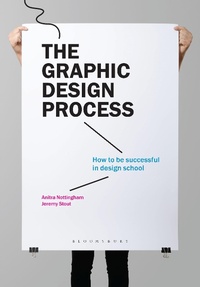
The Graphic Design Process
How to be Successful in Design School
1st Edition
Published on 14. November 2019
200 pages
978-1-350-05079-2 (ISBN)
Description

One of the main challenges students face upon entering design school is little knowledge of the field, its terminology and best practices. Unsurprisingly, most new students have never fully developed a concept or visual idea, been in a critique, or have been asked to explain their work to others.
This book demystifies what design school is really like and explains what will be experienced at each stage, with particular focus on practical advice on topics like responding to design briefs and developing ideas, building up confidence and understanding what is expected.
· Student work is critiqued to show how projects are really assessed
· Profiles highlight how professional designers themselves address client briefs
· Tips for real-life problems are outlined, like getting stuck and dealing with critical feedback
Written by experienced instructors, this is the perfect guide for those starting their design education.
This book demystifies what design school is really like and explains what will be experienced at each stage, with particular focus on practical advice on topics like responding to design briefs and developing ideas, building up confidence and understanding what is expected.
· Student work is critiqued to show how projects are really assessed
· Profiles highlight how professional designers themselves address client briefs
· Tips for real-life problems are outlined, like getting stuck and dealing with critical feedback
Written by experienced instructors, this is the perfect guide for those starting their design education.
More details
Edition
1. Auflage
Language
English
Place of publication
London
United Kingdom
Publishing group
Bloomsbury Publishing PLC
Illustrations
200 colour illus
ISBN-13
978-1-350-05079-2 (9781350050792)
Copyright in bibliographic data and cover images is held by Nielsen Book Services Limited or by the publishers or by their respective licensors: all rights reserved.
Schweitzer Classification
Other editions
Additional editions
Book
09/2019
Bloomsbury Visual Arts
€30.00
Shipment within 15-20 days
Persons
Anitra Nottingham is a Director for the School of Graphic Design at the Academy of Art University, San Francisco where she leads the online learning team, develops curriculum and teaches history, design, typography, and design research methods. She is a graduate of the Design School at Monash University, Australia, and holds an MPhil from the Graduate School of Education at the University of Melbourne. Anitra has been a book designer for Oxford University Press and Penguin Books Australia, and a creative director at both small and large design companies in the San Francisco Bay Area.
Jeremy Stout is associate director for the School of Graphic Design at the Academy of Art University, San Francisco where he instructs research methods, typography, brand, digital and print design. Jeremy has worked at a number of large and small firms in the Bay Area including Chronicle Books, Character and Landor and Associates. He has created branding for clients such as FedEx, Visa, Nike, Facebook and Adobe. Jeremy has received numerous awards for his graphic design and fine art painting. He is a recipient of the Gold Award for packaging. His work is in the permanent collection of the San Francisco Museum of Modern Art and has been shown nationwide in numerous galleries.
Jeremy Stout is associate director for the School of Graphic Design at the Academy of Art University, San Francisco where he instructs research methods, typography, brand, digital and print design. Jeremy has worked at a number of large and small firms in the Bay Area including Chronicle Books, Character and Landor and Associates. He has created branding for clients such as FedEx, Visa, Nike, Facebook and Adobe. Jeremy has received numerous awards for his graphic design and fine art painting. He is a recipient of the Gold Award for packaging. His work is in the permanent collection of the San Francisco Museum of Modern Art and has been shown nationwide in numerous galleries.
Content
1: Introduction
1: The purpose of this book
2: How to use this book
1: The "Design Thinking" process in graphic design
2: The 4D design process: how to be creative on demand
3: How this book is structured
4: The problem with "design process"
3: Discover
1: Kicking off a design project
2: All about the design brief
3: Understanding the design problem
4: Design
1: About Divergent thinking
2: Techniques for generating Ideas
3: Talking about your ideas
5: Develop
1: Convergent thinking
2: Giving (and getting) critique
3: Working with instructor feedback
6: Deploy
1: Presenting your work
2: Design juries (and clients)
3: Understanding your grade
1: The purpose of this book
2: How to use this book
1: The "Design Thinking" process in graphic design
2: The 4D design process: how to be creative on demand
3: How this book is structured
4: The problem with "design process"
3: Discover
1: Kicking off a design project
2: All about the design brief
3: Understanding the design problem
4: Design
1: About Divergent thinking
2: Techniques for generating Ideas
3: Talking about your ideas
5: Develop
1: Convergent thinking
2: Giving (and getting) critique
3: Working with instructor feedback
6: Deploy
1: Presenting your work
2: Design juries (and clients)
3: Understanding your grade
