

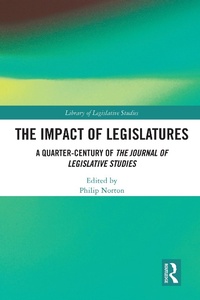
The Impact of Legislatures
A Quarter-Century of The Journal of Legislative Studies
1st Edition
Published on 10. September 2020
518 pages
978-1-000-09582-1 (ISBN)
Description

The Impact of Legislatures brings together key articles and path-breaking scholarship published in The Journal of Legislative Studies during its first 25 years of publication, enabling the reader to make sense of the impact of legislatures in the modern world.
Encompassing theory, comparative analysis, and county-based empirical studies, the volume examines the impact of legislatures as the key representative institutions of nations, addressing their relationships both to government and to the people. Legislatures are ubiquitous. They provide legitimacy to measures of public policy and to government. As such, they are key to how a nation is governed. But they do much more than confer legitimacy. They are generally multi-functional and functionally adaptable bodies, and are an essential link between citizen and government. However, scholarship on them has not been extensive and has often been descriptive and country- specific, limiting the capacity to make sense of them as a particular species of institution. The chapters in this volume reflect scholarship that helps the reader appreciate the significance of the place and consequences of legislatures, examining not only the relationship between the legislature and the executive, but also the oft-neglected relationship between legislatures and the people.
Reflecting the growing body of research in the field of legislative studies, carried by The Journal of Legislative Studies since its inception in 1995, The Impact of Legislatures is essential reading for anyone wishing to understand the impact of legislatures in the world today.
Encompassing theory, comparative analysis, and county-based empirical studies, the volume examines the impact of legislatures as the key representative institutions of nations, addressing their relationships both to government and to the people. Legislatures are ubiquitous. They provide legitimacy to measures of public policy and to government. As such, they are key to how a nation is governed. But they do much more than confer legitimacy. They are generally multi-functional and functionally adaptable bodies, and are an essential link between citizen and government. However, scholarship on them has not been extensive and has often been descriptive and country- specific, limiting the capacity to make sense of them as a particular species of institution. The chapters in this volume reflect scholarship that helps the reader appreciate the significance of the place and consequences of legislatures, examining not only the relationship between the legislature and the executive, but also the oft-neglected relationship between legislatures and the people.
Reflecting the growing body of research in the field of legislative studies, carried by The Journal of Legislative Studies since its inception in 1995, The Impact of Legislatures is essential reading for anyone wishing to understand the impact of legislatures in the world today.
More details
Series
Edition
1. Auflage
Language
English
Place of publication
London
United Kingdom
Publishing group
Taylor & Francis Ltd
Target group
College/higher education
ISBN-13
978-1-000-09582-1 (9781000095821)
Copyright in bibliographic data and cover images is held by Nielsen Book Services Limited or by the publishers or by their respective licensors: all rights reserved.
Schweitzer Classification
Other editions
Additional editions
Book
01/2024
1st Edition
Routledge
€67.00
Shipment within 15-20 days
Book
07/2020
1st Edition
Routledge
€208.30
Shipment within 15-20 days
Person
Philip Norton (Lord Norton of Louth) is Professor of Government and Director of the Centre for Legislative Studies at the University of Hull, UK, and is a member of the UK House of Lords. He is the Founding Editor of The Journal of Legislative Studies.
Content
Introduction
Philip Norton
DEVELOPING THEORY
1. Rational Choice Theory in Legislative Studies: Models of Politics without Romanticism
Thomas Saalfeld
2. Conditional Agenda-Setting and Decision-Making Inside the European Parliament
George Tsebelis
COMPARING LEGISLATURES
3. Introduction: Comparing the Legislative Performance of Legislatures
David Arter
4. Social Choice and Comparing Legislatures: Constitutional Versus Institutional Constraints
Anthony J. McGann
5. Rethinking Bicameral Strength: A Three-Dimensional Approach
Meg Russell
6. Conclusion: Questioning the "Mezey Question": An Interrogatory Framework for the Comparative Study of Legislators
David Arter
PARTY, DIVISION AND CONSENSUS
7. Party Unity in Parliamentary Democracies: A Comparative Analysis
Ulrich Sieberer
8. Parliamentary Consociationalism in Lebanon: Equal Citizenry v. Quotated Confessionalism
Imad Salamey and Rhys Payne
9. Parliamentary Opposition in Westminster Democracies: Britain, Canada, Australia and New Zealand
Andre Kaiser
10. Differences and Changes in Danish Party Organisations: Central Party Organisation Versus Parliamentary Party Group Power
Helene Helboe Pedersen
REPRESENTATION
11. Ethnic Group Representation in Cross-National Comparison
Didier Ruedin
12. Women's Substantive Representation: Defending Feminist Interests or Women's Electoral Preferences?
Anouk Lloren
13. State Based Representation and National Policymaking: The Evolution of the Australian Senate and the Federation
Scott Brenton
14. "A More Representative Chamber": Representation and the House of Lords
Hugh Bochel and Andrew Defty
INFLUENCE OF MEMBERS
15. Assessing the Influence of Select Committees in the UK: The Education and Skills Committee, 1997-2005
Andrew Hindmoor, Phil Larkin and Andrew Kennon
16. Exploring the Role of "Legislators" in Canada: Do Members of Parliament Influence Policy?
Kelly Blidook
17. Parliament and the Poll Tax: A Case Study in Parliamentary Pressure
Philip Cowley
PARLIAMENTS AND CITIZENS
18. Studying the Relationship between Parliaments and Citizens
Cristina Leston-Bandeira
19. How are Parliaments Using New Media to Engage with Citizens?
Jeffrey Griffith and Cristina Leston-Bandeira
20. Parliaments and Citizens in the United Kingdom
Philip Norton
21. Microblogging, Constituency Service and Impression Management: UK MPs and the Use of Twitter
Nigel Jackson and Darren Lilleker
PARLIAMENTARY QUESTIONS
22 Parliamentary Questions: The Behaviour of Legislators, and the Function of Legislatures: An Introduction
Shane Martin
23. Questioning Parliamentary Questions
Olivier Rozenberg and Shane Martin
24. Parliamentary Questions in 17 European Parliaments: Some Steps Towards Comparison
Frederico Russo and Matti Wiberg
25. Parliamentary Questions as Instruments of Substantive Representation: Visible Minorities in the UK House of Commons, 2005-2010
Thomas Saalfeld
Philip Norton
DEVELOPING THEORY
1. Rational Choice Theory in Legislative Studies: Models of Politics without Romanticism
Thomas Saalfeld
2. Conditional Agenda-Setting and Decision-Making Inside the European Parliament
George Tsebelis
COMPARING LEGISLATURES
3. Introduction: Comparing the Legislative Performance of Legislatures
David Arter
4. Social Choice and Comparing Legislatures: Constitutional Versus Institutional Constraints
Anthony J. McGann
5. Rethinking Bicameral Strength: A Three-Dimensional Approach
Meg Russell
6. Conclusion: Questioning the "Mezey Question": An Interrogatory Framework for the Comparative Study of Legislators
David Arter
PARTY, DIVISION AND CONSENSUS
7. Party Unity in Parliamentary Democracies: A Comparative Analysis
Ulrich Sieberer
8. Parliamentary Consociationalism in Lebanon: Equal Citizenry v. Quotated Confessionalism
Imad Salamey and Rhys Payne
9. Parliamentary Opposition in Westminster Democracies: Britain, Canada, Australia and New Zealand
Andre Kaiser
10. Differences and Changes in Danish Party Organisations: Central Party Organisation Versus Parliamentary Party Group Power
Helene Helboe Pedersen
REPRESENTATION
11. Ethnic Group Representation in Cross-National Comparison
Didier Ruedin
12. Women's Substantive Representation: Defending Feminist Interests or Women's Electoral Preferences?
Anouk Lloren
13. State Based Representation and National Policymaking: The Evolution of the Australian Senate and the Federation
Scott Brenton
14. "A More Representative Chamber": Representation and the House of Lords
Hugh Bochel and Andrew Defty
INFLUENCE OF MEMBERS
15. Assessing the Influence of Select Committees in the UK: The Education and Skills Committee, 1997-2005
Andrew Hindmoor, Phil Larkin and Andrew Kennon
16. Exploring the Role of "Legislators" in Canada: Do Members of Parliament Influence Policy?
Kelly Blidook
17. Parliament and the Poll Tax: A Case Study in Parliamentary Pressure
Philip Cowley
PARLIAMENTS AND CITIZENS
18. Studying the Relationship between Parliaments and Citizens
Cristina Leston-Bandeira
19. How are Parliaments Using New Media to Engage with Citizens?
Jeffrey Griffith and Cristina Leston-Bandeira
20. Parliaments and Citizens in the United Kingdom
Philip Norton
21. Microblogging, Constituency Service and Impression Management: UK MPs and the Use of Twitter
Nigel Jackson and Darren Lilleker
PARLIAMENTARY QUESTIONS
22 Parliamentary Questions: The Behaviour of Legislators, and the Function of Legislatures: An Introduction
Shane Martin
23. Questioning Parliamentary Questions
Olivier Rozenberg and Shane Martin
24. Parliamentary Questions in 17 European Parliaments: Some Steps Towards Comparison
Frederico Russo and Matti Wiberg
25. Parliamentary Questions as Instruments of Substantive Representation: Visible Minorities in the UK House of Commons, 2005-2010
Thomas Saalfeld
