

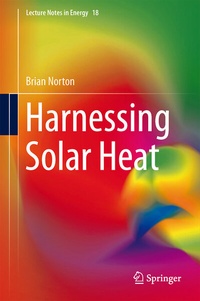
Harnessing Solar Heat
Description

Systems engineered by man to harness solar heat in a controlled manner now include a diverse range of technologies each serving distinctive needs in particular climate contexts. This text covers the breadth of solar energy technologies for the conversion of solar energy to provide heat, either as the directly-used output or as an intermediary to other uses such as power generation or cooling. It is a wholly updated, extended and revised version of "Solar Energy Thermal Technology" first published in 1992. The text draws on the own author's research and that of numerous colleagues and collaborators at Cranfield University, University of Ulster, Dublin Institute of Technology, Indian Institute of Technology, Delhi and University of Nigeria.
The initial chapters deal with relevant fundamental aspects of solar energy meteorology, radiative heat transfer, material properties and energy storage. Solar energy collectors are discussed in detail before a set of chapters dealwith each of the full range of applications. The early chapters consider: the solar energy resource, its distribution in geographical, spectral, skyward geometrical and temporal domains; the physics of solar energy absorption, transmission and loss at surfaces; and techniques for storing collected solar energy. Specific collector sub-systems are then discussed in chapters seven to nine. For each system, practical issues are discussed and a proven analytical procedure for predicting performance described. Similarly analyses are presented in the concluding chapters on solar energy systems. These range from dryers to greenhouses to systems that render buildings solar energy systems in themselves and the associated design issues.
The context for any use of solar energy is the prevailing climate. This text, being global in scope, definates the most appropriate regions for particular technologies and applications. It is a research-orientated academic work citing publications on the peer-reviewed literature covering engineering and applied science topics intended both for student use, as a reference tool for teaching solar energy and for those researching solar thermal applications in universities, industry or national/commercial laboratories. Insight into the challenges of implementation including practical constraints and operational considerations are provided to aid those undertaking feasibility studies, technical assistance, training assignments or operating testing facilities.
More details
Other editions
Additional editions
Person
Professor Brian Norton has led DIT for nine years. He has played a full role in developing and promoting DIT in national and international contexts. He is the author or co-author of six books (including a sole-authored major advanced text) and over 400 papers including 170 in learned journals. He has supervised nearly forty doctorates and serves as Associate Editor of "Solar Energy" the premier international journal in the field and on three other editorial boards.
Professor Norton has chaired of the World Renewable Energy Network. The Northern Ireland Business Education Partnership and the BSI Technical Committee on Solar Heating and represented the UK university sector on the Board of the Foundation for the Built Environment, which owns the UK Building Research Establishment. He was a ministerial appointee to the Construction Industry Training Board and chaired its Audit Committee. He is currently Chair of the Board of Action Renewables, which is responsible for developing renewable energies in Northern Ireland. He has been an invited plenary speaker to major international conferences and to Ministerial meetings.
He has a BSc (Hons) in Physics from University of Nottingham and MSc and PhD degrees, in Engineering Experimentation and Applied Energy respectively, from Cranfield University and DSc from the University of Nottingham. He is a Fellow of the Irish Academy of Engineering, the Energy Institute and the Institution of Engineers of Ireland. He is a Chartered Engineer (both in the UK and Ireland) and Fellow, Higher Education Academy. Among his awards are the Napier Shaw Medal of the Chartered Institute of Building Services Engineers (CIBSE), the Roscoe Award of the Energy Institute and the Honorary Fellowship of the CIBSE, the highest honour for his professional discipline. Previously he was Professor of Built Environmental Engineering at University of Ulster (UU) is an Honorary Professor of UU. He is an Honorary Professor of Harbin Institute of Technology, University of Ulster and University of Houston.
He has a BSc (Hons) in Physics from University of Nottingham and MSc and PhD degrees, in Engineering Experimentation and Applied Energy respectively, from Cranfield University and DSc from the University of Nottingham. He is a Fellow of the Irish Academy of Engineering, the Energy Institute and the Institution of Engineers of Ireland. He is a Chartered Engineer (both in the UK and Ireland) and Fellow, Higher Education Academy. Among his awards are the Napier Shaw Medal of the Chartered Institute of Building Services Engineers (CIBSE), the Roscoe Award of the Energy Institute and the Honorary Fellowship of the CIBSE, the highest honour for his professional discipline. Previously he was Professor of Built Environmental Engineering at University of Ulster (UU) is an Honorary Professor of UU. He is an Honorary Professor of Harbin Institute of Technology, University of Ulster and University of Houston.
He has a BSc (Hons) in Physics from University of Nottingham and MSc and PhD degrees, in Engineering Experimentation and Applied Energy respectively, from Cranfield University and DSc from the University of Nottingham. He is a Fellow of the Irish Academy of Engineering, the Energy Institute and the Institution of Engineers of Ireland. He is a Chartered Engineer (both in the UK and Ireland) and Fellow, Higher Education Academy. Among his awards are the Napier Shaw Medal of the Chartered Institute of Building Services Engineers (CIBSE), the Roscoe Award of the Energy Institute and the Honorary Fellowship of the CIBSE, the highest honour for his professional discipline. Previously he was Professor of Built Environmental Engineering at University of Ulster (UU) is an Honorary Professor of UU. He is an Honorary Professor of Harbin Institute of Technology, University of Ulster and University of Houston.
