

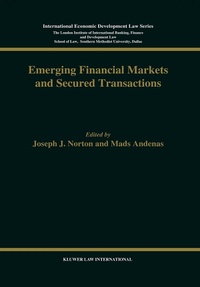
Emerging Financial Markets and Secured Transactions
Published on 1. April 1998
592 pages
978-90-411-7478-9 (ISBN)
Description

This work brings together a collection of papers dealing with various aspects of crossborder secured transactions, an issue which is becoming increasingly important to the process of the development of emerging financial markets and transitional market economies. As most medium and long term loans are no longer secured by sovereign or governmental guarantees, lenders need to find security elsewhere. A sound legal framework for lenders to effect and enforce secured transactions is called for in order to establish an investor friendly climate. Special attention is paid to the EBRD Model Law on Secured Transactions, the (UNCITRAL) Draft Convention on Assignment in Receivables Financing and the pending International Institute for the Unification of Private Law (UNIDROIT) model. The editors have provided an invaluable service in bringing together these texts which make a significant contribution to the development of scholarship in this area and which emphasise the importance to the development and transition process of the development of a modern framework for secured transactions.
More details
Other editions
Additional editions
Joseph Norton
Emerging Financial Markets and Secured Transactions
Book
04/1998
1st Edition
Kluwer Law International
€291.58
Shipment within 10-20 days
Content
- Cover
- Half Title Page
- Editorial Board
- Title Page
- Copyright Page
- Table of Contents
- List of Contributors
- Series Editor's Preface
- Institute of International Banking, Finance and Development Law
- Foreword
- 1 The Changing Nature of Security Rights
- 1 THE IMPORTANCE OF SECURITY
- 2 THE DEVELOPMENT OF SECURITY LAW
- 3 THE FUTURE OF SECURITY LAW
- 2 A Comparative Introduction to Security over Movables and Intangibles
- 1 A UNITARY SECURITY INTEREST OR MULTIPLE SECURITY INTERESTS?
- 2 FORMAL REQUIREMENT FOR THE SECURITY ARRANGEMENT
- 3 REGISTRATION OF THE SECURITY INTEREST
- 4 FLUCTUATING COLLATERAL
- 5 GLOBAL SECURITY
- 6 ENFORCEMENT OF THE SECURITY
- 7 CONCLUSION
- 3 Economic Functions of Security in a Market Economy
- 1 INTRODUCTION
- 2 MICROECONOMIC FOUNDATIONS OF LENDING
- 2.1 The benchmark of an ordinary market.
- 2.2 The market for loans.
- 2.3 Evaluating promises in the market for loans
- 2.4 Unsecured lending
- 2.5 Secured lending and secured guarantees
- 2.6 Secured versus unsecured lending
- 2.6.1 Asymmetric information
- 2.6.2 Adverse selection and moral hazard
- 2.7 Overall assessment
- 3 CRITIQUES OF THE ROLE OF SECURITY
- 3.1 Interest rates will adjust
- 3.2 The pool of risk is irreducible
- 3.3 Security simply shifts more risk to the unsecured lenders.
- 3.4 Collateral does not change the marginal lending rate
- 3.5 Equity and debt are interchangeable at the margin
- 4 COLLATERAL AND LIMITED ACCESS TO CREDIT
- 4.1 Macroeconomic problems and high bank intermediation margins
- 4.1.1 Macroeconomic risk
- 4.1.2 Higher bank spreads and the difficulty of collecting against real estate mortgages
- 4.1.3 Risk in taking personal property as collateral
- 4.2 Bank disinterest in making sma1110ans
- 4.3 Overly restrictive bank supervision
- 4.4 Insufficient Savings
- 4.5 Absence of public banks and public credit lines
- 5 THE ECONOMIC GAIN FROM REFORMING THE FRAMEWORK FOR SECURED TRANSACTIONS
- 5.1 Qualitative issues
- 5.1.1 Efficiency in allocating capital
- 5.1.2 Efficiency in the allocation of savings
- 5.1.3 Equity, poverty, and access to credit
- 5.2 How much does this matter?
- 6 BIBLIOGRAPHY
- 4 World-Wide Security - Classification of Legal Jurisdictions
- 1 INTRODUCTION
- 2 POLICIES OF SECURITY
- 3 INTERNATIONAL DIVERGENCE
- 4 JURISDICTIONAL CLASSIFICATION
- 5 CRITERIA
- 6 TITLE FINANCE
- 7 CONCLUSION
- 5. Classifications of Security Interests on the Highways of International Commerce
- 1 INTRODUCTION
- 2 THE CHOICE-OF-LAW ASPECT AS OPENING UP LEGAL ISSUES
- 2.1 The 'systemic position' of civil law
- 2.2 The 'practical approach' in common law
- 2.3 Needs for assimilation: world-wide
- 3 EXPERIENCES
- 3.1 Displacements of collateral between civil law countries
- 3.2 Reservations of title before British law courts
- 3.3 Collateral imported to the United States
- 3.3.1 In re Duplan
- 3.3.2 Hong Kong and Shanghai Banking Corp., Ltd. v. HFH USA Corporation
- 3.3.3 Summary on Characterisation
- 4 CLASSIFICATION: A CLEW OF CREDITORS' RISKS IN INTERNATIONAL TRADE
- 4.1 Substantive law
- 4.2 Procedure
- 4.3 Legal cooperation in international cases
- 4.3.1 Rights and remedies
- 4.3.2 The law of conflicts
- 4.3.3 Motions for decision in procedural matters
- 5 CONCLUSION
- 6 The Conditional Sale is Alive and Well!
- 1 INTRODUCTION
- 2 CONDITIONAL SALES AND SECURITIES: THE SITUATION UNDER THE NEW DUTCH CIVIL CODE
- 3 THE SITUATION IN FRANCE
- 4 THE SITUATION IN GERMANY
- 5 THE SITUATION IN THE UK
- 6 THE SITUATION IN THE US
- 7 FINANCE SALES AS DISTINGUISHED FROM SECURED TRANSACTIONS
- 8 CONCLUSION
- 7 General Principles of a Modern Secured Transactions Law
- 1 INTRODUCTION
- 2 PURPOSE OF SECURITY AND OBJECTIVES OF REFORM
- 3 EFFECTIVENESS OF SECURITY LAW - ENSURING THAT SECURITY ACHIEVES ITS PURPOSE
- 3.1 Essential qualities of the security right
- 3.2 Certainty of the security right
- 3.3 Means of recovery of the debt from the secured asset
- 3.4 Costs of creating, maintaining and exercising the security right
- 4 ENCOURAGING THE USE OF SECURITY IN THE WIDEST POSSIBLE RANGE OF CIRCUMSTANCES
- 4.1 Any person may give security over his assets
- 4.2 Security may be given to any person to whom the secured debt is owed
- 4.3 Secured debt
- 4.3.1 Security can be given for any present or future debt or debts
- 4.3.2 Security may be given for a changing pool of debt
- 4.4 Assets given as security
- 4.4.1 Security can be given over all types of assets
- 4.4.2 Security can be given over assets which are acquired subsequently
- 4.4.3 Security may be given over a changing pool of assets
- 4.5 Use of secured assets
- 4.6 General
- Contractual flexibility
- 8 A Functional Analysis of the EBRD Model Law on Secured Transactions
- 1 WHAT CONDUCT DOES SOCIETY SEEK FROM A POTENTIAL SECURED CREDITOR BY ENACTING THE EBRD MODEL LAW?
- 2 HOW EFFECTIVELY DOES THE EBRD MODEL LAW INDUCE A POTENTIAL SECURED CREDITOR TO GIVE VALUE FOR THE COLLATERAL?
- 2.1 Does it cost a lot to create an enforceable charge?
- 2.2 Does it cost a lot to enforce the charge?
- 2.3 Does enforcement of the charge provide real commercial value for the creditor?
- 2.4 Can potential secured creditors determine, with certainty and at little cost, before the loan is made, whether any other creditor will have a better claim to the charged property?
- 2.5 Is the secured creditor protected from the claims of third parties, including other creditors, the trustee in bankruptcy, purchasers and statutory claimants?
- 3 HOW WOULD THE EBRD MODEL LAW SYSTEM WORK IN PRACTICE?
- 4 CONCLUSION
- 9 The Model Law on Secured Transactions of the EBRD from a German Point of View
- 1 INTRODUCTION
- 2 OUTLINE OF THE PRESENT GERMAN LAW ON SECURED TRANSACTIONS AND PROPOSALS FOR ITS REFORM
- 2.1 Law in the books
- 2.2 Living Law
- 2.3 Proposals for a reform
- 3 ASSESSMENT OF THE EBRD-MODEL LAW FROM A GERMAN POINT OF VIEW
- 3.1 Requirements
- 3.2 Assessment
- 3.2.1 General points
- 3.2.1.1 Optimal use of the debtor's assets as security
- 3.2.1.2 Right to possession and to use by the party granting security and compensatory securities for the secured party (vertical extension)2
- 3.2.1.3 Possibility of horizontal extension of the security right
- 3.2.1.4 Simple, effective and cheap enforcement of the security for the secured party
- 3.2.2 Special problems
- 3.2.2.1 Public disclosure
- 3.2.2.2 Priorities
- 3.2.2.3 Excessive securing
- 3.2.2.4 Charges with foreign elements
- 3.2.2.5 Article 5.7 MLST as internal law rule?
- 3.2.2.6 Article 5.7 MLST as hidden choice-of-law rule?
- 3.2.2.7 Recognition of foreign charges
- 4 SUMMARY AND CONCLUSIONS
- 10 The EBRD Model Law and the Hungarian Law
- 1 INTRODUCTION
- 2 THE BACKGROUND
- 3 HUNGARIAN CONDITIONS TO BE CONSIDERED BY LEGISLATION
- 3.1 Economic actors
- 3.1.1 Possible debtors
- 3.1.2 Banks
- 3.2 Legal Environment
- 4 EBRD MODEL LAW AND THE HUNGARIAN BILL ON CHARGES
- 4.1 Scope of Regulation
- 4.2 The object of the charge
- 4.3 Adaptation to the system
- 11 UNCITRAL's Work in the Field of Secured Transactions
- 1 INTRODUCTION
- 2 SECURITY INTERESTS
- 3 ASSIGNMENT IN RECEIVABLES FINANCING
- 3.1 The background
- 3.2 The problem and the suggested solution
- 3.3 Scope of work
- 3.4 Possible issues
- 3.5 Future work
- 12 Credit Security and Debt Recovery: Law's Role in Reform in Asia and the Pacific
- 1 INTRODUCTION
- 2 THE LAW'S CONTEXT
- 2.1 Pro-creditor/pro-debtor contexts
- 2.2 The different dimensions of context
- 2.2.1 The economic dimension
- 2.2.2 The political dimension
- 2.2.3 The culture dimension
- 3 LAW AND ITS ADMINISTRATION
- 4 CREDIT APPRAISAL
- 4.1 The role of lawyers
- 4.2 Credit referencing
- 4.3 Registration of security (collateral)
- 5 LENDING AGREEMENTS
- 5.1 Freedom of contract
- interest
- 5.2 The terms of a loan
- 5.3 Monitoring of the borrower
- 5.4 The documentation
- 5.5 Legal formalities
- 6 SECURITY (COLLATERAL)
- 6.1 Range of security
- 6.2 Extrajudicial enforcement of security
- 6.3 Stamp duty and security
- 7 LAW'S ADMINISTRATION
- 7.1 Procedural rules
- 7.2 The legal culture: lawyers, judges and officials
- 7.3 Special debt recovery courts
- 7.4 Execution
- 8 CONCLUSIONS
- 13 Difficulties in Obtaining Secured Lending in Latin America: Why Law Reform Really Matters
- 1 INTRODUCTION
- 2 PRACTICAL CONCERNS IN OBTAINING SECURED CREDIT IN DIFFERENT FINANCING SCENARIOS
- 3 REGULATION OF PERSONAL PROPERTY SECURED LENDING
- 4 MAIN LEGAL OBSTACLES TO SECURED LENDING
- 5 RELATIONSHIP BETWEEN ASSETS-BASED SECURED LENDING AND THE AVAILABILITY OF CREDIT IN LATIN AMERICA
- 6 RELATIONSHIP BETWEEN PERSONAL PROPERTY SECURITY LAW, THE HIGH COST OF COMMERCIAL AND CONSUMER CREDIT, AND SOCIAL INEQUALITY
- 7 WHY THE INADEQUACY OF THE LEGAL RULES REALLY MATTERS
- 8 WHAT KIND OF LAW REFORM EFFORTS ARE TO BE COMMENDED?
- 9 EFFORTS OF LAW REFORM AT THE DOMESTIC LEVEL
- 10 LAW REFORM EFFORTS AT THE INTERNATIONAL LEVEL
- 11 SIGNIFICANCE OF HARMONISATION AT THE REGIONAL LEVEL
- 12 CONCLUSION
- 14 Selected Security Interests in the United States
- 1 A BIT OF HISTORY
- 2 THE SINGLE CONCEPTUAL FRAMEWORK
- 3 INVENTORY FINANCING
- 3.1 After-acquired property and future advance clauses
- 3.2 Proceeds
- 3.3 Inventory
- 3.4 Priority contests
- 3.5 The floating lien in bankruptcy
- 3.6 Field warehouses
- 4 EQUIPMENT FINANCING
- 4.1 Equipment leases
- 4.2 Equipment as a fixture
- 4.3 Accessions to equipment
- 4.4 Equipment subject to a certificate of title
- 4.5 Mobile equipment
- 4.6 Financing buyer
- 5 FINANCING OF INTANGIBLES
- 15 Mixed Systems: Scotland
- 1 INTRODUCTION TO SCOTS LAW
- 2 INTRODUCTION TO SECURED TRANSACTIONS
- 3 THE FOCUS OF THIS CHAPTER: THE CULTURE GAP
- 3.1 Immovable hypothecs
- 3.2 Securities over corporeal movables
- 3.3 Security over incorporeal movables
- 3.4 The floating charge
- 4 IS SECURITY A GOOD THING?
- 5 SOME CONCLUSIONS
- 16 Security Issues under Russian Law
- 1 BRIEF GENERAL CHARACTERISTICS OF RUSSIAN ECONOMIC AND LEGAL DEVELOPMENT
- 2 APPLICABLE LEGISLATION
- 3 SECURITY/PLEDGE - A PROPRIETARY RIGHT OR A TYPE OF OBLIGATION?
- 4 TYPES OF SECURITY, THEIR COMMON FEATURES AND DIFFERENCES
- 5 TYPES OF PROPERTY/PROPRIETARY RIGHTS SUBJECTS TO CHARGE
- 6 RUSSIAN CONCEPT OF CHARGE AND THE FLOATING CHARGE CONCEPT
- 7 PARTICULAR REQUIREMENTS OF THE RUSSIAN LAW
- 7.1 General principles and protection of rights of pledgor and pledgee
- 7.2 Registration of pledges: mortgages
- 7.3 Other specific provisions
- 8 ENFORCEMENT
- 8.1 Grounds for enforcement
- 8.2 Ranking of creditors' claims:
- 8.3 Manners of enforcement
- 8.4 Realisation of charged assets
- 9 CHOICE OF LAW AND ENFORCEMENT OF FOREIGN JUDGMENTS
- 17 Secured Financing Issues for International Lenders: Bridging the Gap Between the Civil and Common Law through Asset-backed Securitisation - Lessons From and Respecting Argentina and Mexico
- 1 INTRODUCTION
- 2 HOW LEGAL RESTRICTIONS ON COLLATERAL LIMIT ACCESS TO CREDIT IN MEXICO
- 2.1 Commercial credit environment in Mexico
- 2.2 Legal issues with respect to guaranteed credit transactions - personal property that may be pledged
- 2.2.1 Accounts receivable and intangible rights
- 2.2.2 'Floating liens' (guarantía flotante sobre bienes muebles)
- 2.3 Perfection
- 2.4 Enforcement
- 2.5 Selected aspects of Mexican real estate development and practice
- 2.5.1 Collateral security for financing
- 2.5.2 Practical aspects of Mexican real estate investments
- 3 HOW LEGAL RESTRICTIONS ON COLLATERAL LIMIT ACCESS TO CREDIT IN ARGENTINA
- 3.1 Findings of World Bank mission
- 3.2 Economic consequences of the collateral problem and growth
- 4 DEVELOPMENT OF MORTGAGE-BACKED SECURITISATION
- 4.1 The argument for mortgage-backed securitisation.
- 4.2 The model for mortgage-backed securitisation - Fannie Mae
- 4.2.1 History of mortgage-backed securities in the US
- 4.2.2 The Fannie Mae model
- 4.2.3 Shifting of risk with Fannie Mae
- 4.2.4 The secondary market for mortgage loans
- 4.3 Existing legal barriers to mortgage-backed Securitisation in Mexico.
- 4.3.1 Restrictions on the transfer of mortgages in Mexico
- 4.4 What is being done in Mexico
- 4.5 Developments in Argentina
- 4.5.1 Legal restrictions to securitisation in Argentina
- 4.5.2 Argentina's Securitisation Law
- 5 CONCLUSION
- 18 The Japanese Approach
- 1 INTRODUCTION
- 2 SECURITY OVER INVENTORY AND EQUIPMENT
- 2.1 Pledge
- 2.2 Hypothec
- 2.3 Pledge using some documents
- 2.4 Atypical real security rights
- 3 SECURITY OVER INTANGIBLES
- 3.1 Pledge
- 3.1.1 Obligations
- 3.1.2 Stocks and shares
- 3.1.3 Real rights on immovables
- 3.1.4 Intellectual property rights
- 3.2 Atypical real security interests
- 3.2.1 Assignment as security
- 3.2.2 Dairi bensai juryo and furikomi shitei
- 4 THE ADMISSIBILITY OF THE FLOATING CHARGE
- 4.1 Enterprise Security (Kigyo tampo)
- 4.2 Some foundation hypothec
- 4.3 Security interest over a unit of movables
- 4.4 Security interest over a unit of accounts receivable
- 19 Enforcing Security in India, Sri Lanka and Malaysia
- 1 INTRODUCTION
- 1.1 The importance of credit and security
- 1.2 Credit and security in South and South-east Asia
- 2 RANGE OF AVAILABLE SECURITY
- 2.1 Sri Lanka
- 2.1.1 Immovable property as security
- 2.1.2 Movable property as security
- 2.2 India
- 2.2.1 Immovable property as security
- 2.2.2 Security over movable property
- 2.3 Malaysia
- 2.3.1 Security over immovable property
- 2.3.2 Security Over Movables
- 3 ENFORCEMENT OF SECURITY
- 3.1 Sri Lanka
- 3.1.1 Parate execution
- 3.1.1.1 Changes in policy
- 3.1.1.2 Recovery under the provisions of the Recovery of Loans by Banks (Special Provisions) Act, No.4 of 1990
- 3.1.2 Enforcement of a mortgage security under the Mortgage Act
- 3.1.2.1 Power of sale
- 3.1.2.2 Receivership
- 3.1.3 Receivership under the Companies Act
- 3.2 India
- 3.2.1 Enforcement of mortgaged security
- 3.2.1.1 Power of extrajudicial sale
- 3.2.1.2 Private receiver
- 3.2.2 Enforcement of rights under a pledge or hypothecation
- 3.2.3 Receivership under the Companies Act
- 3.3 Malaysia
- 3.3.1 Judicial sale
- 3.3.2 Possession
- 4 PROBLEMS OF ENFORCING SECURITY
- 4.1 Sri Lanka
- 4.1.1 Recovery of Loans by Banks (Special Provisions) Act No.4 of 1990
- 4.2 India
- 4.2.1 Industrial sickness in India
- 4.2.1.1 Sick Industrial Companies (Special Provisions) Act 1985
- 4.2.1.2 Power of sale under the Transfer of Property Act
- 4.2.1.3 Enforcing a hypothecation
- 5 CONCLUSION
- 20 Overview of Laws Relating to Security Interests in Vietnam
- 1 INTRODUCTION
- 2 PERMITTED FORMS OF SECURITY
- 3 MORTGAGE
- 3.1 Introduction
- 3.2 Decree on Economic Contracts
- 3.3 Regulations on Mortgages to Obtain Bank Loans
- 3.4 Civil Code
- 4 PLEDGES
- 4.1 Introduction
- 4.2 Decree on Economic Contracts
- 4.3 Regulations on Pledge Services
- 4.4 Civil Code
- 5 GUARANTEES
- 5.1 Introduction
- 5.2 Decree on Economic Contracts
- 5.3 Guarantees of foreign loans
- 5.4 Bank guarantees
- 5.5 Security for guarantee obligations
- 5.6 Demand under guarantees
- 5.7 Civil Code
- 6 ADDITIONAL CIVIL CODE SECURITY INTERESTS
- 6.1 Advance security
- 6.2 Security deposit
- 7 SECURITY OVER INTERESTS IN LAND
- 7.1 Introduction
- 7.2 Land law
- 7.3 Rights of domestic land users
- 7.4 Rights of foreign lessees
- 7.S Civil Code
- 8 BUILD-OPERATE-TRANSFER PROJECTS
- 8.1 Introduction
- 8.2 BOT Regulations
- 8.3 Difficulties with the BOT Regulations
- 9 CHARGES OF CAPITAL
- 10 SECURITY OVER AIRCRAFT
- 11 SHIP MORTGAGES
- 12 CREDIT REGULATIONS
- 13 BANKRUPTCY LAW
- 13.1 Introduction
- 13.2 Rights of secured creditors
- 14 ENFORCEMENT OF SECURITY INTERESTS
- 14.1 Introduction
- 14.2 Economic disputes
- 14.3 Rights of creditors to realise security
- 14.4 Enforcement of judgments
- 14.5 Enforcement of arbitral awards
- 14.6 Enforcement of foreign judgments
- 21 China's New Security Law: A Closer Look
- 1 INTRODUCTION
- 1.1 Applicability of the Security Law and the place of local regulations
- 1.2 The PRC Security Law in relation to other PRC laws and local regulations
- 1.3 The relationship between the debt obligation and the security obligation under the PRC Security Law
- 1.4 The five forms of security
- 2 GUARANTEES
- 2.1 Capacity to guarantee
- 2.2 Form of the guarantee
- 2.3 General guarantee
- 2.4 Guarantee with joint and several liability
- 2.5 Guarantor's liability and rights
- 2.6 Guarantor's defences
- 3 MORTGAGES
- 3.1 What can be mortgaged
- 3.2 Mortgages of land and buildings
- 3.3 What cannot be mortgaged
- 3.4 What the mortgage contract must provide
- 3.5 Limits on the mortgage amount
- 3.6 Registration
- 3.7 Priority
- 3.8 Scope of a mortgage
- 3.9 Assignment of a mortgage
- 3.10 Enforcement
- 3.11 Prohibition of forfeiture
- 3.12 Loss of Mortgaged Property
- 3.13 Mortgage of a maximum amount
- 4 PLEDGE
- 4.1 What can be pledged
- 4.2 Delivery or registration of the pledge
- 4.3 The pledge contract
- 4.4 Shares and share certificates as pledgeable right
- 4.5 Shares as pledgeable right
- 4.6 Enforcement
- 5 LIEN
- 5.1 Requirements for a lien
- 5.2 Enforcement
- 6 DEPOSIT
- 7 CONCLUSION
- Appendix 1 A Legal System for Secured Transactions in Market Economies in Transition
- Appendix 2. Draft Convention on Assignment in Receivables Financing
- Appendix 3. Revised Draft Articles of a Future UNIDROIT Convention on International Interests in Mobile Equipment
- Index
- Back Cover
