

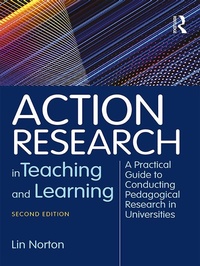
Action Research in Teaching and Learning
A Practical Guide to Conducting Pedagogical Research in Universities
2nd Edition
Published on 2. November 2018
320 pages
978-1-351-37606-8 (ISBN)
Description

Practical and down-to-earth, the second edition of Action Research in Teaching and Learning is an ideal introduction to the subject, offering a distinctive blend of the theoretical and the practical, grounded firmly in the global higher education landscape. Written in an accessible style to build confidence, it provides easily adaptable, practical frameworks, guidelines and advice on research practice within a higher education context.
The reader is guided through each stage of the action research process, from engaging with the critical theory, to the practical applications with the ultimate goal of providing a research study which is publishable. Supplemented by useful pedagogical research tools and exemplars of both qualitative and quantitative action research studies, this new edition features chapters engaging with teaching excellence and analysing qualitative and quantitative research, additions to the resources section and a new preface focusing more explicitly on the ever-growing number of part-time academics.
Action Research in Teaching and Learning combines a theoretical understanding of the scholarly literature with practical applications and is an essential, critical read for any individual teaching or undertaking action research.
The reader is guided through each stage of the action research process, from engaging with the critical theory, to the practical applications with the ultimate goal of providing a research study which is publishable. Supplemented by useful pedagogical research tools and exemplars of both qualitative and quantitative action research studies, this new edition features chapters engaging with teaching excellence and analysing qualitative and quantitative research, additions to the resources section and a new preface focusing more explicitly on the ever-growing number of part-time academics.
Action Research in Teaching and Learning combines a theoretical understanding of the scholarly literature with practical applications and is an essential, critical read for any individual teaching or undertaking action research.
Reviews / Votes
This work is a powerful and well-informed discussion of the ways in which learning may be enhanced in the university sector through pedagogical action research as a practice-changing practice. Importantly, it gives back to academic practitioners a sense of agency in an environment too often constrained by regulatory frameworks devised by others. The book acknowledges the diversity of today's tertiary students and their teachers and the dilemmas of practice that arise for each. It employs vignettes as occasions for reflection and learning. The practice examples are derived from a variety of professional fields from visual arts to engineering and psychology. The book acknowledges that teaching is forever unfinished business and should be open to ongoing change and improvement, in particular by drawing attention to the notion of praxis as morally informed action that employs ethics as a means of enhancing quality control.Susan Groundwater-Smith AM, Honorary Professor, Sydney School of Education and Social Work, University of Sydney, Australia
This is a timely and useful second edition which provides an invaluable guide on undertaking action research for pedagogical (or andragogical) research in higher education. This updated text shows how it is possible to combine a desire to understand with an impetus to act. It show how practical interests can be combined with theory to generate both practical and theoretical insights. Embracing this text would add sophistication to current trend for metrics to be the ultimate measure of quality. Following Norton's advice is likely to have an impact on these measures of performance but will more importantly ensure that any changes are deeper, more sophisticated and arguably more authentic. It is a reminder that everyone involved in education in universities can be involved in, and can benefit from, educational action research.
Andrew Townsend, Associate Professor, School of Education, University of Nottingham, UK This work is a powerful and well-informed discussion of the ways in which learning may be enhanced in the university sector through pedagogical action research as a practice-changing practice. Importantly, it gives back to academic practitioners a sense of agency in an environment too often constrained by regulatory frameworks devised by others. The book acknowledges the diversity of today's tertiary students and their teachers and the dilemmas of practice that arise for each. It employs vignettes as occasions for reflection and learning. The practice examples are derived from a variety of professional fields from visual arts to engineering and psychology. The book acknowledges that teaching is forever unfinished business and should be open to ongoing change and improvement, in particular by drawing attention to the notion of praxis as morally informed action that employs ethics as a means of enhancing quality control.
Susan Groundwater-Smith AM, Honorary Professor, Sydney School of Education and Social Work, University of Sydney, Australia
This is a timely and useful second edition which provides an invaluable guide on undertaking action research for pedagogical (or andragogical) research in higher education. This updated text shows how it is possible to combine a desire to understand with an impetus to act. It show how practical interests can be combined with theory to generate both practical and theoretical insights. Embracing this text would add sophistication to current trend for metrics to be the ultimate measure of quality. Following Norton's advice is likely to have an impact on these measures of performance but will more importantly ensure that any changes are deeper, more sophisticated and arguably more authentic. It is a reminder that everyone involved in education in universities can be involved in, and can benefit from, educational action research.
Andrew Townsend, Associate Professor, School of Education, University of Nottingham, UK
This book presents itself as a practical guide to pedagogical action research (PAR) which can assist anyone wishing to use PAR to evaluate and refine their own practice. It is aimed at a higher education (HE) audience but is intended to be accessible not only to lecturers but also to those working in a learning and teaching support role in HE who are interested in action research. The writing style lives up to this aspiration to be inclusive; it demonstrates academic rigour, but the language and layout are both accessible and inviting. The author plainly has a lot of experience and enthusiasm for the field of action research and both of these qualities come across very clearly in her writing, drawing you in to the topics she is discussing.
Cathal O'Siochru, Psychology Learning & Teaching
More details
Edition
2nd edition
Language
English
Place of publication
London
United Kingdom
Publishing group
Taylor & Francis Ltd
Target group
College/higher education
Professional and scholarly
Illustrations
20 Tables, black and white; 22 Line drawings, black and white; 22 Illustrations, black and white
File size
4,70 MB
ISBN-13
978-1-351-37606-8 (9781351376068)
Copyright in bibliographic data and cover images is held by Nielsen Book Services Limited or by the publishers or by their respective licensors: all rights reserved.
Schweitzer Classification
Other editions
Additional editions
Lin Norton
Action Research in Teaching and Learning
A Practical Guide to Conducting Pedagogical Research in Universities
Book
11/2018
2nd Edition
Routledge
€177.60
Shipment within 10-20 days
Lin Norton
Action Research in Teaching and Learning
A Practical Guide to Conducting Pedagogical Research in Universities
Book
10/2018
2nd Edition
Routledge
€45.60
Shipment within 10-20 days
Person
Lin Norton is an Emeritus Professor of Pedagogical Research at Liverpool Hope University, UK
Content
Part 1: The Theoretical Background
Chapter 1: What do we mean by teaching excellence?
Chapter 2: Why is the professionalization of university teaching important?
Chapter 3: What does being a reflective practitioner actually mean?
Chapter 4: What contributions can action research make to professionals who work in roles other than full-time university teaching?
Part 2: The Practice of Action Research
Chapter 5: Where do you start a pedagogical action research study?
Chapter 6: What are the most suitable research methodologies?
Chapter 7: How can you analyse qualitative data in pedagogical action research?
Chapter 8: How can you analyse quantitative data in pedagogical action research?
Chapter 9: Are there any useful tools?
Chapter 10: What are the ethical issues?
Chapter 11: How can you grow the influence of your findings?
Chapter 1: What do we mean by teaching excellence?
Chapter 2: Why is the professionalization of university teaching important?
Chapter 3: What does being a reflective practitioner actually mean?
Chapter 4: What contributions can action research make to professionals who work in roles other than full-time university teaching?
Part 2: The Practice of Action Research
Chapter 5: Where do you start a pedagogical action research study?
Chapter 6: What are the most suitable research methodologies?
Chapter 7: How can you analyse qualitative data in pedagogical action research?
Chapter 8: How can you analyse quantitative data in pedagogical action research?
Chapter 9: Are there any useful tools?
Chapter 10: What are the ethical issues?
Chapter 11: How can you grow the influence of your findings?
