

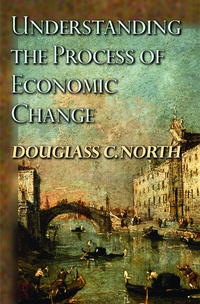
Understanding the Process of Economic Change
1st Edition
Published on 29. May 2015
200 pages
978-1-4008-2948-4 (ISBN)
Description

In this landmark work, a Nobel Prize-winning economist develops a new way of understanding the process by which economies change. Douglass North inspired a revolution in economic history a generation ago by demonstrating that economic performance is determined largely by the kind and quality of institutions that support markets. As he showed in two now classic books that inspired the New Institutional Economics (today a subfield of economics), property rights and transaction costs are fundamental determinants. Here, North explains how different societies arrive at the institutional infrastructure that greatly determines their economic trajectories.
North argues that economic change depends largely on "adaptive efficiency," a society's effectiveness in creating institutions that are productive, stable, fair, and broadly accepted--and, importantly, flexible enough to be changed or replaced in response to political and economic feedback. While adhering to his earlier definition of institutions as the formal and informal rules that constrain human economic behavior, he extends his analysis to explore the deeper determinants of how these rules evolve and how economies change. Drawing on recent work by psychologists, he identifies intentionality as the crucial variable and proceeds to demonstrate how intentionality emerges as the product of social learning and how it then shapes the economy's institutional foundations and thus its capacity to adapt to changing circumstances.
Understanding the Process of Economic Change accounts not only for past institutional change but also for the diverse performance of present-day economies. This major work is therefore also an essential guide to improving the performance of developing countries.
North argues that economic change depends largely on "adaptive efficiency," a society's effectiveness in creating institutions that are productive, stable, fair, and broadly accepted--and, importantly, flexible enough to be changed or replaced in response to political and economic feedback. While adhering to his earlier definition of institutions as the formal and informal rules that constrain human economic behavior, he extends his analysis to explore the deeper determinants of how these rules evolve and how economies change. Drawing on recent work by psychologists, he identifies intentionality as the crucial variable and proceeds to demonstrate how intentionality emerges as the product of social learning and how it then shapes the economy's institutional foundations and thus its capacity to adapt to changing circumstances.
Understanding the Process of Economic Change accounts not only for past institutional change but also for the diverse performance of present-day economies. This major work is therefore also an essential guide to improving the performance of developing countries.
More details
Edition
Course Book
Language
English
Place of publication
Princeton, NJ
United States
Publishing group
De Gruyter
Target group
Professional and scholarly
Edition type
Digital original
Illustrations
12 line illus. 1 table.
File size
0,51 MB
ISBN-13
978-1-4008-2948-4 (9781400829484)
Schweitzer Classification
Other editions
Additional editions
Douglass C. North
Understanding the Process of Economic Change
Book
05/2010
1st Edition
Princeton University Press
€37.50
Shipment within 10-20 days
Douglass C. North
Understanding the Process of Economic Change
Book
01/2005
Princeton University Press
€47.12
Article exhausted; check for reprint
Person
Douglass C. North is professor of economics and Spencer T. Olin Professor in Arts and Sciences at Washington University in St. Louis. He was the corecipient of the Nobel Prize in Economic Sciences in 1993.
Content
Preface vii
CHAPTER ONE: An Outline of the Process of Economic Change 1
PART I: THE ISSUES INVOLVED IN UNDERSTANDING ECONOMIC CHANGE 9
INTRODUCTION 11
CHAPTER TWO: Uncertainty in a Non-ergodic World 13
CHAPTER THREE: Belief Systems, Culture, and Cognitive Science 23
CHAPTER FOUR: Consciousness and Human Intentionality 38
CHAPTER FIVE: The Scaffolds Humans Erect 48
CHAPTER SIX: Taking Stock 65
PART II: THE ROAD AHEAD 81
INTRODUCTION 83
CHAPTER SEVEN: The Evolving Human Environment 87
CHAPTER EIGHT: The Sources of Order and Disorder 103
CHAPTER NINE: Getting It Right and Getting It Wrong 116
CHAPTER TEN: The Rise of the Western World 127
CHAPTER ELEVEN: The Rise and Fall of the Soviet Union 146
CHAPTER TWELVE: Improving Economic Performance 155
CHAPTER THIRTEEN: Where Are We Going? 166
Bibliography 171
Index 183
CHAPTER ONE: An Outline of the Process of Economic Change 1
PART I: THE ISSUES INVOLVED IN UNDERSTANDING ECONOMIC CHANGE 9
INTRODUCTION 11
CHAPTER TWO: Uncertainty in a Non-ergodic World 13
CHAPTER THREE: Belief Systems, Culture, and Cognitive Science 23
CHAPTER FOUR: Consciousness and Human Intentionality 38
CHAPTER FIVE: The Scaffolds Humans Erect 48
CHAPTER SIX: Taking Stock 65
PART II: THE ROAD AHEAD 81
INTRODUCTION 83
CHAPTER SEVEN: The Evolving Human Environment 87
CHAPTER EIGHT: The Sources of Order and Disorder 103
CHAPTER NINE: Getting It Right and Getting It Wrong 116
CHAPTER TEN: The Rise of the Western World 127
CHAPTER ELEVEN: The Rise and Fall of the Soviet Union 146
CHAPTER TWELVE: Improving Economic Performance 155
CHAPTER THIRTEEN: Where Are We Going? 166
Bibliography 171
Index 183
