

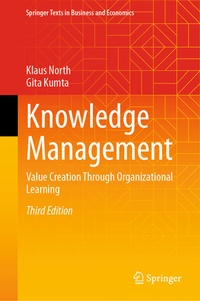
Knowledge Management
Description

This textbook on knowledge management draws on the authors' more than thirty years of research, teaching, and consulting experience. The first edition of this book brought together European, Asian, and American perspectives on knowledge-based value creation; The second edition included digital transformation's impact on knowledge work and management. This third edition features substantial updates to all chapters, reflecting the implications of digital technology on knowledge work and knowledge management with special reference to Artificial Intelligence. In particular, it addresses three new topics: blending human and machine intelligence, critical thinking, and ethical use of knowledge, and managing knowledge for sustainable development. The book is intended not only for academic education but also as an essential guide for managers, consultants, trainers, coaches, and all those engaged in business, public administration, or non-profit work who are interested in learning about organizations in a knowledge economy. Given its wealth of case studies, examples, questions, exercises, and easy-to-use knowledge management tools, it offers a true compendium for understanding and implementing knowledge management initiatives.
More details
Other editions
Additional editions
Previous edition
Persons
Dr. Klaus North is a leading expert in knowledge management and organizational learning. He was a Professor of International Management at Wiesbaden Business School, Germany, for over 25 years. His current research focuses on knowledge and innovation management, particularly examining how artificial intelligence impacts knowledge work and learning. Dr. North was the founding president of the German Knowledge Management Association and served as the scientific director of the German Knowledge Management Award. He frequently consults with major firms, governments, and international organizations and teaches regularly in business programs worldwide.
Dr. Gita A. Kumta was a faculty member in Information Systems at the School of Business Management, SVKM's Narsee Monjee Institute of Management Studies (Deemed-to-be-University), Mumbai, India. She specializes in Enterprise Systems and Knowledge Management and is a recognized Research Guide. Dr. Kumta holds a Master's Degree in Statistics from the Indian Statistical Institute, Calcutta, India, and a Doctorate in Management Studies from the University of Mumbai, India. With around 30 years of industry experience, predominantly in business analysis and consultancy in financial systems, she actively participates in discussions on Digital Transformation in industry and government. Dr. Kumta contributes papers at conferences on Knowledge Management, Enterprise Solutions, and E-Governance.
Content
1. Towards a Digitally Enabled Knowledge Society.- 2. Knowledge in Organisations.- 3. Organisational Forms to Leverage Knowledge.- 4. Knowledge Work(ers) in the Digital Age.- 5. Strategies for Managing Knowledge.- 6. Context Specific Knowledge Management Strategies.- 7. Measuring and Safeguarding Intellectual Capital.- 8. How to Put Knowledge Management into Practice.
