

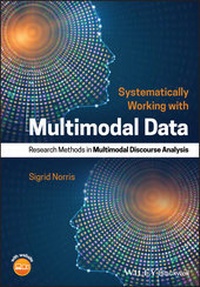
Systematically Working with Multimodal Data
Description

Systematically Working with Multimodal Data is a hands-on guide that is theoretically grounded and offers a step-by-step process to clearly show how to do a data-driven qualitative Multimodal Discourse Analysis (MDA). This full-color introductory textbook is filled with helpful definitions, notes, discussion points and tasks. With illustrative research examples from YouTube, an Experimental and a Video Ethnographic Study, the text offers many examples of how to deal with small to large amounts of data, including information on how to transcribe video data multimodally, including online videos, and how to analyze the data.
This textbook contains ample theory, directions for literature, and a teaching guide to help with a clear understanding of how to work with multimodal data.
* Contains new research data, exceptional illustrations and diagrams
* Offers step-by-step processes of working through examples, transcriptions and online videos
* Goes into great depth so that students can use the book as hands-on material to engage with their own data analysis
* Designed to be easy-to-use with color-coded definitions, tasks, discussion points and notes
Written for advanced undergraduate, graduate and PhD level students, as well as participants in research workshops, Systematically Working with Multimodal Data is an authoritative guide to understanding data-driven qualitative Multimodal Discourse Analysis.
More details
Other editions
Additional editions
Person
Sigrid Norris is Professor of Multimodal (Inter)action and Director of the AUT Multimodal Research Centre at Auckland University of Technology, New Zealand. She is editor of the international journal Multimodal Communication and author of Analyzing Multimodal Interaction (2004) and Identity in (Inter)action: Introducing Multimodal (Inter)action Analysis (2011).
Content
List of Figures xvi
List of Tables xix
Acknowledgments xxi
About the Companion Website xxiii
Chapter 1 Introduction 1
1.0 Introduction to the Book 3
1.1 Brief Introduction to Multimodal Discourse Analysis 19
Chapter 2 Background 25
2.0 Philosophical and Theoretical Background 27
2.1 Development of Scollon's Philosophical Thought 50
Chapter 3 Systematically Working with Multimodal Data Phase I 61
3.0 Phase I: Data Collection 63
3.1 Systematically Working with Small Data Sets/Data Pieces: Phase I Data Collection 86
3.2 Systematically Working with Medium-Sized Data Sets: Phase I Data Collection 93
3.3 Systematically Working with Large Data Sets: Phase I Data Collection 106
Chapter 4 Systematically Working with Multimodal Data Phase II 117
4.0 Phase II: Delineating the Data 119
4.1 Systematically Working with Small Data Sets/Data Pieces: Phase II Delineating the Data 129
4.2 Systematically Working with Medium-Sized Data Sets: Phase II Delineating the Data 137
4.3 Systematically Working with Large Data Sets: Phase II Delineating the Data 148
Chapter 5 Systematically Working with Multimodal Data: Phase III 159
5.0 Phase III: Selecting Data Pieces for Micro Analysis 161
5.1 Systematically Working with Small Data Sets/Data Pieces: Phase III Selecting Data Pieces for Micro Analysis 170
5.2 Systematically Working with Medium-Sized Data Sets: Phase III Selecting Data Pieces for Micro Analysis 178
5.3 Systematically Working with Large Data Sets: Phase III Selecting Data Pieces for Micro Analysis 187
Chapter 6 Systematically Working with Multimodal Data Phase IV 197
6 Phase IV: Transcribing Data Using Multimodal Transcription Conventions 199
Chapter 7 Systematically Working with Multimodal Data Phase V 233
7 Phase V: Using Analytical Tools 235
Chapter 8 Systematically Working with Multimodal Data: Guides for Instructors 267
8 A Quick Guide for Instructors 269
References 277
Index 296
