

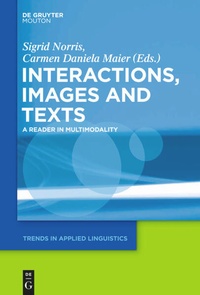
Interactions, Images and Texts
Description

Multimodality is a fast-growing interdisciplinary approach that aims to analyze the interplay of multiple modes such as gaze, gesture or spoken language that are utilized in interaction, and to examine the multimodal production and consumption of communicated messages.
This Reader provides a comprehensive text of current research into multimodality, outlining in-depth delineation of each primary theoretical and methodological approach, as well as personal accounts of scholars, who are responsible for the various approaches' advancements. The book additionally offers a plethora of analysis chapters, written by scholars from across the world, with vastly diverse themes ranging from buying popcorn, protests in Oman, coaching sessions and identity, to kitesurfing, typography, TV news, billboards, workplace practices, or analyzing web pages, Facebook, comic books, and more.
Flexible and easy to use, the Reader includes key terms, suggested further readings, and a project idea for each chapter. The key terms for the chapters also comprise the extensive alphabetical glossary. Brief introductions for the analysis chapters, written by the editors, summarize the topic, explain the methodology used, outline the thematic orientation, and link each chapter to other chapters in the book.
Showcasing multimodal analysis in detail, this Reader is essential reading for undergraduate and postgraduate students, for emergent researchers, and for advanced scholars who wish to gain insight into the current state of multimodal research.
More details
Other editions
Additional editions
Persons
Content
2 - Contributors [Seite 9]
3 - 1. Introduction [Seite 15]
4 - I. Multimodal Theory And Methodology: How Are They Developed? [Seite 19]
4.1 - 2. From Mediated Discourse And Nexus Analysis To Geosemiotics: A Personal Account [Seite 21]
4.2 - 3. Developing Multimodal (Inter)Action Analysis: A Personal Account [Seite 27]
4.3 - 4. About Images And Multimodality: A Personal Account [Seite 33]
4.4 - 5. Developing A Gem (Genre And Multimodality) Model [Seite 39]
5 - II. Multimodal Theory And Methodology: What Are Their Facets? [Seite 51]
5.1 - 6. Mediated Discourse Analysis [Seite 53]
5.2 - 7. Nexus Analysis [Seite 67]
5.3 - 8. Geosemiotics: Discourses In Place [Seite 77]
5.4 - 9. Introduction To Multimodal (Inter)Action Analysis [Seite 91]
5.5 - 10. Multimodal Analysis Of New Corporate Genres [Seite 107]
5.6 - 11. Multimodal Genre Analysis [Seite 125]
6 - III. Conducting Multimodal Research [Seite 139]
6.1 - 12. Multimodal Approaches [Seite 141]
6.2 - 13. Systemic Functional Multimodal Discourse Analysis [Seite 151]
6.3 - 14. Multimodal Transcription: A Case Study [Seite 169]
6.4 - 15. How-To-Analyze Webpages [Seite 185]
6.5 - 16. A Participatory Approach To 'Analysing' Visual Data: Involving Practitioners In Visual Feedback [Seite 209]
6.6 - 17. Collecting Video Data: Role Of The Researcher [Seite 227]
6.7 - 18. Studying Social Actors: Some Thoughts On Ethics [Seite 247]
7 - IV. Sample Analyses [Seite 257]
7.1 - 19. Mediation As Interrelationship: Example Of Kitesurfing [Seite 259]
7.2 - 20. Vertical Identity Production And Maori Identity [Seite 269]
7.3 - 21. The Matrix Phenomenon [Seite 281]
7.4 - 22. Typography [Seite 295]
7.5 - 23. Multimodal Constructions Of Factuality And Authenticity In Tv-News Bulletins [Seite 311]
7.6 - 24. Facebook: A Multimodal Discourse Analysis Of (Semi-)Automated Communicative Modes [Seite 325]
7.7 - 25. 3-D Realisation Of Discourse: The Case Of War Monuments [Seite 337]
7.8 - 26. Multimodality And Space Exploration: Communicative Space In Action [Seite 349]
7.9 - 27. Mediated Discourse Analysis, 'Embodied Learning' And Emerging Social And Professional Identities [Seite 361]
7.10 - 28. Comic Books [Seite 371]
7.11 - 29. Multimodality In Literature: An Analysis Of Jonathan Safran Foer'S A Primer For The Punctuation Of Heart Disease [Seite 385]
7.12 - 30. Concluding Remarks [Seite 395]
8 - Glossary [Seite 397]
9 - Index [Seite 413]
