

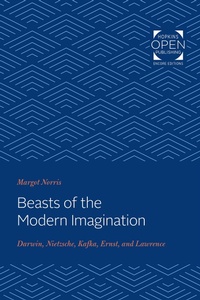
Beasts of the Modern Imagination
Darwin, Nietzsche, Kafka, Ernst, and Lawrence
Published on 26. January 2020
282 pages
978-1-4214-3133-8 (ISBN)
Description

Originally published in 1985. Beasts of the Modern Imagination explores a specific tradition in modern thought and art: the critique of anthropocentrism at the hands of "beasts"-writers whose works constitute animal gestures or acts of fatality. It is not a study of animal imagery, although the works that Margot Norris explores present us with apes, horses, bulls, and mice who appear in the foreground of fiction, not as the tropes of allegory or fable, but as narrators and protagonists appropriating their animality amid an anthropocentric universe. These beasts are finally the masks of the human animals who create them, and the textual strategies that bring them into being constitute another version of their struggle.
The focus of this study is a small group of thinkers, writers, and artists who create as the animal-not like the animal, in imitation of the animal-but with their animality speaking. The author treats Charles Darwin as the founder of this tradition, as the naturalist whose shattering conclusions inevitably turned back on him and subordinated him, the rational man, to the very Nature he studied. Friedrich Nietzsche heeded the advice implicit in his criticism of David Strauss and used Darwinian ideas as critical tools to interrogate the status of man as a natural being. He also responded to the implications of his own animality for his writing by transforming his work into bestial acts and gestures. The third, and last, generation of these creative animals includes Franz Kafka, the Surrealist artist Max Ernst, and D. H. Lawrence. In exploring these modern philosophers of the animal and its instinctual life, the author inevitably rebiologizes them even against efforts to debiologize thinkers whose works can be studied profitably for their models of signification.
The focus of this study is a small group of thinkers, writers, and artists who create as the animal-not like the animal, in imitation of the animal-but with their animality speaking. The author treats Charles Darwin as the founder of this tradition, as the naturalist whose shattering conclusions inevitably turned back on him and subordinated him, the rational man, to the very Nature he studied. Friedrich Nietzsche heeded the advice implicit in his criticism of David Strauss and used Darwinian ideas as critical tools to interrogate the status of man as a natural being. He also responded to the implications of his own animality for his writing by transforming his work into bestial acts and gestures. The third, and last, generation of these creative animals includes Franz Kafka, the Surrealist artist Max Ernst, and D. H. Lawrence. In exploring these modern philosophers of the animal and its instinctual life, the author inevitably rebiologizes them even against efforts to debiologize thinkers whose works can be studied profitably for their models of signification.
More details
Language
English
Place of publication
Baltimore
United States
Target group
Professional and scholarly
File size
20,24 MB
ISBN-13
978-1-4214-3133-8 (9781421431338)
DOI
10.1353/book.69483
Copyright in bibliographic data and cover images is held by Nielsen Book Services Limited or by the publishers or by their respective licensors: all rights reserved.
Schweitzer Classification
Other editions
Additional editions
Book
01/2020
Johns Hopkins University Press
€52.20
Article not available at the moment

Book
08/1985
Johns Hopkins University Press
€52.84
Article not available for order
Person
Margot Norris is a professor of English and comparative literature at the University of California, Irvine. Other books of hers are The Decentered Universe of Finnegans Wake: A Structuralist Analysis; Joyce's Web: The Social Unraveling of Modernism; and Suspicious Readings of Joyce's Dubliners.
Content
Acknowledgments
Abbreviations
Chapter 1. Introduction: The Biocentric Tradition
Chapter 2. Darwin's Reading of Nature
Chapter 3. Darwin, Nietzsche, Kafka, and the Problem of Mimesis
Chapter 4. Nietzsche's Ecce Homo: Behold the Beast
Chapter 5. The Fate of the Human Animal in Kafka's Fiction
Chapter 6. Kafka's "Josefine": The Animal as the Negative Site of Narration
Chapter 7. Max Ernst: The Rhetorical Beast of the Visual Arts
Chapter 8. The Ontology of D. H. Lawrence's St. Mawr
Chapter 9. The Animal and Violence in Hemingway's Death in the Afternoon
Chapter 10. Conclusion: The Biocentric Tradition in Context
Notes
Index
Abbreviations
Chapter 1. Introduction: The Biocentric Tradition
Chapter 2. Darwin's Reading of Nature
Chapter 3. Darwin, Nietzsche, Kafka, and the Problem of Mimesis
Chapter 4. Nietzsche's Ecce Homo: Behold the Beast
Chapter 5. The Fate of the Human Animal in Kafka's Fiction
Chapter 6. Kafka's "Josefine": The Animal as the Negative Site of Narration
Chapter 7. Max Ernst: The Rhetorical Beast of the Visual Arts
Chapter 8. The Ontology of D. H. Lawrence's St. Mawr
Chapter 9. The Animal and Violence in Hemingway's Death in the Afternoon
Chapter 10. Conclusion: The Biocentric Tradition in Context
Notes
Index
