

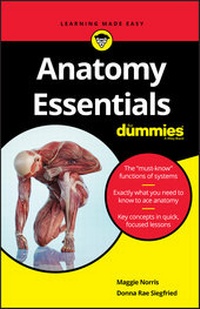
Anatomy Essentials For Dummies
1st Edition
Published on 15. April 2019
192 pages
978-1-119-59007-1 (ISBN)
Description

Anatomy Essentials For Dummies (9781119590156) was previously published as Anatomy Essentials For Dummies (9781118184219). While this version features a new Dummies cover and design, the content is the same as the prior release and should not be considered a new or updated product.
The core concepts you need to ace Anatomy
Perfect for those just starting out or returning to Anatomy after some time away, Anatomy Essentials For Dummies focuses on core concepts taught (and tested on!) in a typical Anatomy course. From names and technical terms to how the body works, you'll skip the suffering and score high marks at exam time with the help of Anatomy Essentials For Dummies.
Designed for students who want the key concepts and a few examples--without the review, ramp-up, and anecdotal content--Anatomy Essentials For Dummies is a perfect solution for exam-cramming, homework help, and reference.
* A useful and handy reference to the anatomy of the human body
* Perfect for a refresher or a quick reference
* Serves as an excellent review to score higher at exam time
If you have some knowledge of anatomy and want to polish your skills, Anatomy Essentials For Dummies focuses on just the core concepts you need to understand this fascinating topic.
The core concepts you need to ace Anatomy
Perfect for those just starting out or returning to Anatomy after some time away, Anatomy Essentials For Dummies focuses on core concepts taught (and tested on!) in a typical Anatomy course. From names and technical terms to how the body works, you'll skip the suffering and score high marks at exam time with the help of Anatomy Essentials For Dummies.
Designed for students who want the key concepts and a few examples--without the review, ramp-up, and anecdotal content--Anatomy Essentials For Dummies is a perfect solution for exam-cramming, homework help, and reference.
* A useful and handy reference to the anatomy of the human body
* Perfect for a refresher or a quick reference
* Serves as an excellent review to score higher at exam time
If you have some knowledge of anatomy and want to polish your skills, Anatomy Essentials For Dummies focuses on just the core concepts you need to understand this fascinating topic.
More details
Other editions
Additional editions
Maggie A. Norris | Donna Rae Siegfried
Anatomy Essentials For Dummies
Book
06/2019
1st Edition
Wiley
€14.00
Shipment within 15-20 days
Content
- Intro
- Title Page
- Copyright Page
- Table of Contents
- Introduction
- About This Book
- Conventions Used in This Book
- Foolish Assumptions
- Icons Used in This Book
- Where to Go from Here
- Chapter 1 Focusing on the Framework of Anatomy and Physiology
- Looking at the Science of Anatomy and Physiology
- Fitting anatomy and physiology into science
- Breaking down the subsets of anatomy
- Familiarizing Yourself with Anatomical Jargon
- Arranging Organisms by Levels of Organization
- Level I: The cellular level
- Level II: The tissue level
- Level III: The organ level
- Level IV: The organ system level
- Level V: The organism level
- Metabolism: Keeping Body Processes in Motion
- Seeing why your cells metabolize
- Understanding the process behind cellular metabolism
- Balancing Bodily Reactions with Homeostasis
- Regulating body temperature
- Maintaining a fluid balance
- Examining blood glucose concentration
- Gauging variables that keep the body balanced
- Chapter 2 Examining Cell Biology Basics
- How Cells Spend Their Time
- Creating new cells
- Manufacturing tissues
- Constructing and moving products
- Transmitting signals around the body
- Exploring Eukaryotic Cells
- Enclosing it all with the cell membrane
- Relinquishing control to the nucleus
- Giving the organelles a place to hang in the cytoplasm
- Seeing how mitochondria provide energy to cells
- Producing protein in the endoplasmic reticulum (ER)
- Taking out the trash with lysosomes
- Macromolecules, the Building Blocks of Life
- Naming the nucleic acids and nucleotides
- Energizing organisms with polysaccharides
- Peeking at proteins
- Discovering How Genetic Material Makes You Who You Are
- Cycling through Life, Cell-Style
- Progressing through interphase
- Pushing ahead to DNA replication
- Entering mitosis
- Forming Tissues from Cells
- Linking structures with connective tissue
- Reviewing types of epithelial tissue
- Chapter 3 Scoping Out the Body's Structural Layers
- The Skinny on Your Skeleton
- Examining the skeleton's makeup
- Surveying joints and their movements
- The 411 on the Muscular System
- Seeing what your skeletal muscles do
- Taking a look at tissue types
- Making muscles contract: The sliding filament model
- An Introduction to the Integument
- Studying up on the structure of the integument
- Accessorizing your skin
- Chapter 4 Getting to the Heart of the Circulatory System
- Analyzing the Cardiac Anatomy
- Examining the shape of the heart
- Looking at the heart's tissues
- Observing how blood flows to (and from) the heart
- Meet Your Blood Vessels
- Beginning at the arteries
- Moving on to the capillaries
- Traveling through the veins
- Discovering What's in Your Blood
- Plasma: Your protein carrier
- Red blood cells: In charge of moving O2 and CO2
- Platelets: The clotting cells
- White blood cells: The body's defenders
- Focusing on the Physiology of Circulation
- The cardiac cycle: Conducting electricity
- On the beating path: Blood flow through the heart and body
- Measuring the importance of blood pressure
- Hemostasis: Stopping the flow
- Chapter 5 Taking a Deep Breath with the Respiratory System
- Surveying the Duties of the Respiratory System
- Nosing around Your Respiratory Anatomy
- An entrance to the system: The nose
- Passing through the pharynx
- Winding through the windpipe, or trachea
- The lungs: The pair that just don't quit
- Exchanging gases at the respiratory membrane
- The comptroller of ventilation: The diaphragm
- Discovering the Ins and Outs of Breathing
- Breathing under normal conditions
- Seeing how stress affects breathing
- Controlling your breathing
- Chapter 6 Getting on Track with the Digestive System
- Your Digestive System in a Nutshell
- Moving through the Structures of the Digestive Tract
- Allowing entry: The mouth
- Sending food to the stomach: The pharynx and esophagus
- Lining it up: The walls
- Breaking it all down: The stomach
- Importing and exporting: The intestines
- Doing the Chemical Breakdown
- The liver
- The pancreas
- Digestive fluids, enzymes, and hormones
- Chapter 7 Passing through the Urinary System
- Running Down the Urinary System's Responsibilities
- Surveying the Structures of the Urinary System
- Creating urine: The kidneys
- Holding and releasing: The urinary tract
- The Yellow River
- Looking at the composition of urine
- Filtering the blood
- Reabsorbing selectively
- Expelling urine
- Maintaining Homeostasis
- Connecting fluid balance and blood pressure
- Regulating blood pH
- Chapter 8 Making Babies: The Reproductive System
- Surveying the Functions of the Reproductive System
- Making Gametes
- Crossing over with meiosis
- Producing female gametes: Ova
- Developing male gametes: Sperm
- Merging ova and sperm to determine sex
- The Egg-citing Female Reproductive System
- A woman's reproductive organs
- A woman's (approximately) monthly cycle
- Furthering Fertilization: The Male Reproductive System
- A man's reproductive organs
- Seminal fluid and ejaculation
- Pausing for Pregnancy
- Achieving fertilization
- Succeeding with implantation
- Adapting to pregnancy
- Going through labor and delivery
- Chapter 9 Exploring the Nervous, Endocrine, and Immune Systems
- Controlling It All: The Nervous System
- Surveying the neural tissues
- Traveling the integrated networks
- Sending Messages Chemical-Style with the Endocrine System
- Homing in on hormones
- Grouping the glands
- Defending Your "Self" with the Immune System
- Loving Your Lymphatic System
- Identifying immune system cells
- Chapter 10 Ten Phabulous Physiology Phacts
- Only Humans Have Opposable Thumbs
- Human Milk Is the Best Milk
- You're (Surprisingly) as Hairy as a Gorilla
- You Can Process Fear and Emotion
- You Smell Like You See
- Your Mouth Is More Efficient Than a Chimp's
- Millions of Microbes Owe You Their Lives
- Oxygen Can be Dangerous
- You Can Control Your Breathing but Fido Can't
- Hemoglobin Dominates Your Red Blood Cells
- Index
- EULA
