

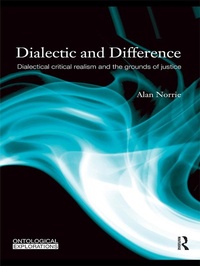
Dialectic and Difference
Dialectical Critical Realism and the Grounds of Justice
Published on 4. December 2009
272 pages
978-1-135-26077-4 (ISBN)
Description

Dialectic and Difference is the first systematic exploration of Roy Bhaskar's dialectical philosophy and its implications for ethics and justice.
That philosophy has three aims: a dialecticisation of original critical realism, a 'critical realisation' of dialectic, and a metacritique of western philosophy. In the first, real absence or negativity links structured being to dialectical becoming in a dynamic world. The second draws on Marx to locate the critical impulse in Hegel's dialectic in a material, open and changing totality. The third identifies a central problem in western philosophy from the Greeks on, the failure to think real negativity as the essence of change ('ontological monovalence').
Bhaskar's ethics connect basic human ontology with universal principles of freedom and solidarity. He marries ('constellates') these with a grasp of how principles are historically shaped. His account of freedom moves from the infant's 'primal scream' to the eudaimonic society, but thinks the limits to freedom under modern conditions. The morally real in ethics and justice is displaced and reconfigured as relations between 'the ideal' and 'the actual'.
Western philosophy systematically denies the real negativity that drives Bhaskar's dialectic. Metacritique traces this to Parmenides and Plato's account of non-being as difference. It enables a critique of the poststructural radicalisation of difference via Nietzsche and the doctrine of 'Heraclitan flux'. Mobilised as 'the other' of Plato's Forms, this remains a move on Platonic terrain. It too denies real negativity in structured being as the ground of historical change and moral praxis.
This text is essential reading for all serious students of social theory, philosophy, and legal theory.
That philosophy has three aims: a dialecticisation of original critical realism, a 'critical realisation' of dialectic, and a metacritique of western philosophy. In the first, real absence or negativity links structured being to dialectical becoming in a dynamic world. The second draws on Marx to locate the critical impulse in Hegel's dialectic in a material, open and changing totality. The third identifies a central problem in western philosophy from the Greeks on, the failure to think real negativity as the essence of change ('ontological monovalence').
Bhaskar's ethics connect basic human ontology with universal principles of freedom and solidarity. He marries ('constellates') these with a grasp of how principles are historically shaped. His account of freedom moves from the infant's 'primal scream' to the eudaimonic society, but thinks the limits to freedom under modern conditions. The morally real in ethics and justice is displaced and reconfigured as relations between 'the ideal' and 'the actual'.
Western philosophy systematically denies the real negativity that drives Bhaskar's dialectic. Metacritique traces this to Parmenides and Plato's account of non-being as difference. It enables a critique of the poststructural radicalisation of difference via Nietzsche and the doctrine of 'Heraclitan flux'. Mobilised as 'the other' of Plato's Forms, this remains a move on Platonic terrain. It too denies real negativity in structured being as the ground of historical change and moral praxis.
This text is essential reading for all serious students of social theory, philosophy, and legal theory.
Reviews / Votes
"Matches Bhaskar's striking originality with a clarity that should make his ideas more widely available. The reach of comparison with other thinkers, past and present, is truly impressive and very helpful. The emphasis on change, interaction, negativity and totality is particularly relevant for the explosive period our world has just entered." - Bertell Ollman, New York University, USA"A major contribution to the understanding of a difficult but extremely important philosophical position. The expository and critical discussion is sustained at a very high level." - William Outhwaite, University of Newcastle, UK
"Elegant, thoroughgoing, accessible, genuinely illuminating. It brilliantly elucidates dialectical critical realism's ethics and how it trumps poststructuralism in particular and irrealism in general." - Mervyn Hartwig, Editor, Journal of Critical Realism
More details
Series
Language
English
Place of publication
London
United Kingdom
Publishing group
Taylor & Francis Ltd
Target group
College/higher education
File size
1,93 MB
ISBN-13
978-1-135-26077-4 (9781135260774)
Copyright in bibliographic data and cover images is held by Nielsen Book Services Limited or by the publishers or by their respective licensors: all rights reserved.
Schweitzer Classification
Other editions
Additional editions
Book
10/2009
1st Edition
Routledge
€231.90
Shipment within 15-20 days
Book
10/2009
1st Edition
Routledge
€76.70
Shipment within 15-20 days
Person
Alan Norrie has recently taken up a Chair in Law at the University of Warwick. He was previously Drapers' Professor of Law at Queen Mary and Westfield College and Edmund-Davies Professor of Criminal Law and Criminal Justice at King's College London. He has a longstanding interest in critical realist philosophy and is President of the International Association for Critical Realism.
Content
1. Intro: Natural Necessity, Being and Becoming 2. Accentuate the Negative 3. Diffracting Dialectic 4. Opening Totality 5. Constellating Ethics 6. Metacritique I: Philosophy's 'Primordial Failing' 7. Metacritique II: Dialectic and Difference 8. Conclusion: Natural Necessity and the Grounds of Justice
