

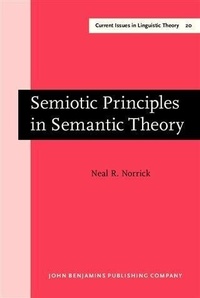
Semiotic Principles in Semantic Theory
1st Edition
Published on 1. January 1981
XIII, 252 pages
978-90-272-8094-7 (ISBN)
Description

This study represents a contribution to the theory of meaning in natural language. It proposes a semantic theory containing a set of regular relational principles. These principles enable semantic theory to describe connections from the lexical reading of a word to its figurative contextual reading, from one variant reading of a polysemous lexical item to another, from the idiomatic to its literal reading or to the literal reading(s) of one or more of its component lexical items. Semiotic theory provides a foundation by supplying principles defining motivated expression-content relations for signs generally. The author argues that regular semantic relational principles must dervive from such semiotic principles, to ensures the psychological reality and generality of the semantic principles.
More details
Other editions
Additional editions
Neal R. Norrick
Semiotic Principles in Semantic Theory
Book
01/1981
John Benjamins Publishing Co
€116.60
Shipment within 10-15 days
Content
- Intro
- SEMIOTIC PRINCIPLES IN SEMANTIC THEORY
- Editorial page
- Title page
- Dedication
- PREFACE
- Table of contents
- 0. INTRODUCTION
- 1. REGULARRELATIONSIN SEMANTIC THEORY
- 1.1 The Current State of Linguistic Semantics
- 1.2 The Need for Regular Relational Principles in Semantics
- 1.2.1 The Interpretation of Lexical Items in Contexts
- 1.2.2 The Lexicon
- 1.2.3 Motivation in Morphologically Complex Units
- 1.3 An Integrated Theory of Semantic Relations
- 2. THE SEMIOTIC BASIS OF SEMANTIC REGULARITY
- 2.0 Introduction
- 2.1 Motivation in Semiotics
- 2.2 Principies of Motivation
- 2.2.1 The Principles
- ICONIC CODE
- INDEXICAL CODE
- 2.2.2 Testing the Principles
- 2.3 The Iconic Code
- 2.3.1 Model and Object
- 2.3.2 Classes, Class Membership and Features
- 2.3.2.1 Specific-Generic
- 2.3.2.2 Specific Case-General Rule
- 2.3.2.3 Object-Feature
- 2.3.2.4 Class Member x-Class Member y
- 2.4 The Indexical Code
- 2.4.1 Cause and Effect
- 2.4.1.1 Cause-Effect
- 2.4.1.2 Producer-Product
- 2.4.1.3 Natural Source-Natural Product
- 2.4.1.4 Instrument-Product
- 2.4.2 Acts and Major Participants
- 2.4.2.1 Object-Act
- 2.4.2.2 Instrument-Act
- 2.4.2.3 Agent-Act
- 2.4.2.4 Agent-Instrument
- 2.4.3 Part and Whole
- 2.4.3.1 Part-Whole
- 2.4.3.2 Act- Complex Act
- 2.4.3.3 Central Factor-Institution
- 2.4.4 Container and Content
- 2.4.4.1 Container-Content
- 2.4.4.2 Locality-Occupant
- 2.4.4.3 Costume- Wearer
- 2.4.5 Experience and Convention
- 2.4.5.1 Experience- Convention
- 2.4.5.2 Manifestation- Definition
- 2.4.6 Possessor and Possession
- 2.4.6.1 Possessor-Possession
- 2.4.6.2 Office Bolder- Office
- 3. REGULAR SEMANTIC RELATIONS
- 3.0 Introduction
- 3.1 Principles of Motivation and Semantic Regularity
- 3.2 Regular Semantic Relational
- 3.2.1 Metaphorie Relational Principles
- 3.2.1.1 Metaphorie Principle 1
- 3.2.1.2 Metaphorie Principle 2
- 3.2.1.3 Metaphorie Principle 3
- 3.2.1.4 Metaphoric Principle 4
- 3.2.1.5 Metaphoric Principle 5
- 3.2.2 Metonymic Relational Principles
- 3.2.2.1 Metonymie Principle 1
- 3.2.2.2 Metonymic Principle 2
- 3.2.2.3 Metonymie Principle 3
- 3.2.2.4 Metonymie Principle 4
- 3.2.2.5 Metonymic Principle 5
- 3.2.2.6 Metonymic Principle 6
- 3.2.2.7 Metonymie Principle 7
- 3.2.2.8 Metonymic Principle 8
- 3.2.2.9 Metonymie Principle 9
- 3.2.2.10 Metonymie Principle 10
- 3.2.2.11 Metonymic Principle 11
- 3.2.2.12 Metonymic Principle 12
- 3.2.2.13 Metonymic Principle 13
- 3.2.2.14 Metonymie Principle 14
- 3.2.2.15 Metonymic Principle 15
- 3.2.2.16 Metonymic Principle 16
- 3.2.2.17 Metonymic Principle 17
- 3.2.2.18 Metonymic Principle 18
- 3.3 Regular Relational Principles in Semantic Theory
- 3.3.1 Comments on Semantic Theory
- 3.3.2 The Role of Semantic Relational Principles
- 4. THE PROBLEM OF POLYSEMY
- 4.0 Introduction
- 4.1 Defining 'Polysemy '
- 4.1.1 Polysemy and Ambiguity
- 4.1.2 Polysemy versus Vagueness, Generality and Depletion
- 4.1.3 Testing for Multiplicity of Meaning
- 4.1.4 Polysemy and Homophony
- 4.1.4.1 Homophony, Homography, Homonymy
- 4.1.4.2 Polysemy versus Homophony
- 4.2 Lexical Polysemy and Derived Polysemy
- 4.3 Current Proposals concerning Polysemy
- 4.3.1 Proposals concerning Lexical Polysemy
- 4.3.2 Proposals concerning Derived Polysemy
- 4.4 Comments on Feature Transfer
- 5. DERIVED POLYSEMY
- 5.0 Introduction
- 5.1 Anomaly and Selection
- 5.2 Lexical Readings
- 5.3 Regular Relational Principles in Interpretive Semantic Theory
- 6. THE LEXICON
- 6.0 Introduction
- 6.1 Semantic Classes and Relations in the Lexicon
- 6.2 Semantic Classes and Lexical Readings
- 6.3 Regular Relational Principies and the Lexicon
- 6.4 Via-rules in the Lexicon
- 6.5 Lexical Polysemy
- 6.6 Remarks on Lexicalization
- 7. MOTIVATION IN COMPLEX UNITS
- 7.0. Introduction
- 7.1. Complex Units
- 7.2. Complex Units and Motivation
- 7.3. Vía- rules and Motivation in Complex Units
- 7.3.1. Componential Motivation
- 7.3.1.1. Componential Motivation in Compounds
- 7.3.1.2. Componential Motivation in Stock Phrases
- 7.3.2. Composite Motivation
- 7.3.2.1. Composite Motivation in Compounds
- 7.3.2.2 Composite Motivation in Stock Phrases
- 7.3.3 Classifying Complex Units
- 7.4 Stock Phrases in Semantic Interpretation
- 8. EXTRA-LINGUISTIC INFORMATION IN SEMANTIC RELATIONS
- 8.0 Introduction
- 8.1 The Role of Extra-linguistic Information in the Establishment of Semantic Relations
- 8.2 Extra-linguistic Information
- 8.2.1 Etymological Information
- 8.2.2 Historical Information
- 8.2.3 Object Specific Information
- 8.2.4 Pragmatic Information
- 9. POETIC FIGURES
- 9.0 Introduction
- 9.1 Simple Replacement
- 9.2 Pointing Formulae
- 9.3 The Copula Link
- 9.4 The Make Link
- 9.5 The Genetive Link
- 9.5.1 The Three- term Formula
- 9.5.2 The Two-term Formula
- 9.6 Verb Metaphor
- 9.7 Adjective Metaphor
- 9.7.1 Metaphorically Interpreted Adjectives
- 9.7.2 Transferred Adjectives
- 9.8 Summary
- CONCLUSION
- NOTES
- Notes to Chapter 1
- Notes to Chapter 2
- Notes to Chapter 3
- Notesto Chapter 4
- Notes to Chapter 5
- Notes to Chapter 6
- Notes to Chapter 9
- BIBLIOGRAPHY
- INDICES
- A. INDEX OF AUTHORS
- B. INDEX OF SUBJECTS
- C. INDEX OF REGULAR RELATIONAL PRINCIPLES
- Iconic- Metaphoric Priniciples
- Indexical-Metonymic Principles
