

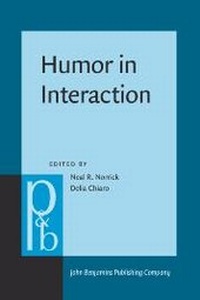
Humor in Interaction
1st Edition
Published on 3. July 2009
XVII, 238 pages
978-90-272-8933-9 (ISBN)
Description

This is the first edited volume dedicated specifically to humor in interaction. It is a rich collection of essays by an international array of scholars representing various theoretical perspectives, but all concerned with interactional aspects of humor. The contributors are scholars active both in the interdisciplinary area of humor studies and in adjacent disciplines such as linguistic pragmatics, sociolinguistics, discourse analysis, psycholinguistics, gender and translation studies. The volume effectively offers an overview of the range of phenomena falling in the broad category of 'conversational humor', and convincingly argues for the many different functions humor can fulfill, bypassing simplistic humor theories reducing humor to one function. All the articles draw on empirical material from different countries and cultures, comprising conversations among friends and family, talk in workplace situations, humor in educational settings, and experimental approaches to humor in interaction. The book is sure to become an important reference and source of inspiration for scholars in the various subfields of humor studies, pragmatics and (socio-)linguistics.
More details
Other editions
Additional editions
Neal R. Norrick | Delia Chiaro
Humor in Interaction
Book
07/2009
John Benjamins Publishing Co
€95.40
Shipment within 10-15 days
Persons
Content
- Humor in Interaction
- Editorial page
- Title page
- LCC data
- Dedication page
- Table of contents
- Contributors
- Humor and interaction
- Part I: Conversation among friends and family
- The occasioning of self-disclosure humor*
- 1. Introduction
- 2. Database
- 3. Taxonomy and analysis
- 3.1 Topical continuity
- 3.1.1 Humorous rounds
- 3.1.2 Troubles talk
- 3.1.3 Complex narration
- 3.1.4 Self-revelation as entertainment
- 3.2 Topic change
- 3.2.1 Mitigation
- 3.2.2 Elicited self-disclosures
- 3.2.3 Elicited boasts
- 3.3 Incidental responses
- 3.3.1 Responses to contextual reminders
- 3.3.2 Responses to teases
- 4. Conclusions
- References
- Direct address as a resource for humor
- 1. Vocatives
- 2. Functions of direct address
- 3. Stock jocular expressions and jokes incorporating direct address
- 4. Humorous uses of direct address
- 4.1 Banter
- 4.2 Inappropriate term of address for humor
- 5. Direct address in humorous constructed dialogue
- 6. Conclusions
- Transcription conventions
- Data sources
- References
- An interactional approach to irony development*
- 1. Introduction
- 2. Acquisition of irony competence
- 3. The data
- 4. Findings of anthropological linguistics on teasing
- 5. Highly inferential contrastive speech activities in the data
- 5.1 Stylistically marked irony
- 5.2 Simple positive comments as critique
- 5.3 Contrastive fantasizing
- 5.4 Teasing and provocation
- 5.5 Prototypical echo irony
- 6. Concluding remarks: Communicating knowledge about contradictory morals and official and unofficial stances
- Transcription conventions
- References
- Multimodal and intertextual humor in the media reception situation
- 1. Introduction
- 2. Talk in the football reception situation
- 3. Laughter as jubilation in the football reception situation
- 4. Humor in the media text
- 5. Multimodal humor in the reception situation
- 6. Intertextual humor in the reception situation
- 7. Conclusion
- References
- Part II: Doing gender with humor in talk at work
- Using humor to do masculinity at work
- 1. Introduction
- 2. Data
- 3. Analysis
- 3.1 Unmarked normatively masculine humor
- 3.2 Marked contestive, stereotypically masculine humor
- Conveying a negative message
- Challenging workplace norms
- 4. Conclusion
- Transcription conventions
- References
- Boundary-marking humor
- 1. Introduction
- 2. The data
- 3. Intergroup theory and boundary-marking humor
- 4. Analysis
- 4.1 Institutional boundary-marking
- 4.2 Gender boundary-marking
- 4.3 Ethnic boundary-marking
- 5. Discussion
- 6. Conclusion
- Appendix - Transcription conventions
- References
- Part III: Failed humor and its interactional effects
- Impolite responses to failed humor
- 1. Introduction
- 2. Background
- 2.1. (Im)politeness theory
- 2.2 Humor and rapport management
- 3. Methods
- 4. Impoliteness strategies
- 4.1 Positive impoliteness strategies
- 4.2 Negative impoliteness strategies
- 4.3 Sarcasm or mock politeness
- 4.4 Offensive vs. defensive strategies
- 5. Discussion
- 5.1 Humor as disruptive
- 5.2 Behavioral expectations
- 5.3 Interlocutor characteristics
- 5.4 Identity concerns/face claims
- 6. Conclusion
- References
- Failed humor in conversation
- 1. Introduction
- 2. Theoretical frame
- 2.1 Humor, a generic term
- 2.2 Discussing the subject's uniqueness
- 2.3 Definition of the interactive space
- 2.4 A double voicing approach to humor
- 2.5 Double voicing approach to failed humor
- 3. The corpus
- 3.1 Presentation
- 3.2 Nature of the interactive setting
- 3.3 Humor in everyday conversation
- 4. Analysis of the data
- 4.1 When humor is not perceived
- 4.2 Humor rejected
- 5. Conclusion
- Transcription conventions
- References
- Part IV: Humor in bilingual interactions
- Humor and interlanguage in a bilingual elementary school setting
- 1. Introduction
- 2. Previous findings
- 2.1 Child language acquisition and the cooperative principle
- 2.2 Child humor: Developmental issues
- 2.3 Functions of child humor
- 3. Method
- 4. Results and discussion
- 4.1 Categories of laughter
- 4.2 What's so funny? - The laughter categories and their relation to humor
- 4.4 Motives and functions
- 4.5 Issues of variation
- 5. Conclusion
- References
- Cultural divide or unifying factor?
- 1. Introduction
- 2. The study
- 2.1 Cross-cultural, bilingual couples
- 2.2 Humorous talk
- 2.3 Tools and methods
- 2.3.1 The questionnaire
- 2.3.2 The interviews
- 3. Results
- 3.1 The questionnaire
- 3.1.1 The sample
- 3.1.2 Humorous talk and language choice
- 3.1.3 Attitudes towards language use within the couple
- 3.2 The interviews
- 3.2.1 The sample
- 3.2.2 Results
- 4. Conclusions
- References
- Name index
- Subject index
