

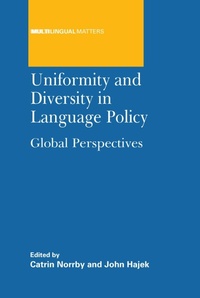
Uniformity and Diversity in Language Policy
Global Perspectives
Published on 17. October 2011
304 pages
978-1-84769-448-5 (ISBN)
Description

This book brings together current research by leading international scholars on the often contentious nature of language policies and their practical outcomes in North America, Australia and Europe. It presents a range of perspectives from which to engage with a variety of pressing issues raised by multilingualism, multiculturalism, immigration, exclusion, and identity. A recurrent theme is that of tension and conflict: between uniformity and diversity, between official policies and real day-to-day life experiences, but also between policies in schools and the corporate world and their implementation. Several chapters present research about language policy issues that has previously not been fully or easily available to an English-language audience. Many of the chapters also provide up-to-date analyses of language policy issues in particular regions or countries, focusing on recent developments.
Reviews / Votes
The book is a valuable addition to the literature on language policy both at the macro and the micro levels. It serves to bring to one's notice that linguistic rights are increasingly being acknowledged both in the recognition of weaker languages by the state and of using them in schooling and other domains. It also shows an increasing democratization in culture through the promotion of language norms associated with solidarity and non-hierarchical behavior than was the case before. -- Tariq Rahman, Beaconhouse National University, Pakistan * Language Policy (2015) 14:195-197 * Uniformity and Diversity in Language Policy is a welcome addition to the study of language policy and planning with a balanced mixture of contributions that consolidate, elaborate and innovate research on well-known as well as recently emerging language problems and linguistic practices. * Anne Pauwels, School of Oriental and African Studies, UK * This book is an important instalment in language planning literature serving to expand the domains and kinds of language policy described, the modes in which it operates, the players involved and the purposes they pursue. Language policy invariably involves politics and tension, a focus which unifies the diverse chapters of this volume allowing comparison, contrast and reflection across sites, settings and histories. * Joseph Lo Bianco, University of Melbourne, Australia * The quality of the studies in this volume testifies to the fact the authors are experts with deep insight into the issues and locations they describe. Although the chapters are very diverse in geography and focus, they concern a number of topics of general interest, such as citizenship, nation building, the situation of indigenous populations, minority language education, economic interests in language policy, efforts to change communicative norms, etc....The book under review is a useful contribution to our understanding of the historical development and present contexts of language policy creation and implementation at various levels, from supranational to local, in the Western world. Readers will very likely find in it something which will complement their knowledge of the locations or aspects of language policy they are interested in. Thanks to the book's relatively wide geographical coverage and its attention to the outcomes of language policies cast against historical and present-day backgrounds, persons working in language policy can find here inspiration for their work on language issues in their own countries. * Marian Sloboda, Charles University in Prague on the LINGUIST LIST23.3469 *More details
Series
Language
English
Place of publication
Bristol
United Kingdom
Publishing group
Channel View Publications Ltd
Target group
Professional and scholarly
ISBN-13
978-1-84769-448-5 (9781847694485)
Copyright in bibliographic data and cover images is held by Nielsen Book Services Limited or by the publishers or by their respective licensors: all rights reserved.
Schweitzer Classification
Other editions
Additional editions
Book
10/2011
Multilingual Matters
€48.20
Shipment within 10-20 days
Persons
Catrin Norrby is Professor of Scandinavian Languages at Stockholm University, Sweden, and Principal Fellow in the School of Languages and Linguistics at The University of Melbourne. She has published several monographs, edited books, textbooks and articles in the areas of sociolinguistics, discourse analysis and second language acquisition. She is co-author of Language and Human Relations: Styles of Address in Contemporary Language (2009).
John Hajek is Professor of Italian and Director of the Research Unit for Multilingualism and Cross-cultural Communication (RUMACCC) in the School of Languages and Linguistics at The University of Melbourne. He is also founding president of the Languages and Cultures Network for Australian Universities (LCNAU).
John Hajek is Professor of Italian and Director of the Research Unit for Multilingualism and Cross-cultural Communication (RUMACCC) in the School of Languages and Linguistics at The University of Melbourne. He is also founding president of the Languages and Cultures Network for Australian Universities (LCNAU).
Content
Preface
General Introduction
Part I-Language Policy at the Official Level
Introduction to Part I
Chapter 1-Jane Warren and Leigh Oakes: Language Policy and Citizenship in Quebec: French as a Force for Unity in a Diverse Society?
Chapter 2-Sally Boyd: Do National Languages Need Support and Protection in Legislation? The Case of Swedish as the 'Principal Language' of Sweden
Chapter 3-Uldis Ozolins: Language Policy and Smaller National Languages: The Baltic States in the New Millennium
Chapter 4-Paulin G. Djite: Language Policy in Australia: Does What Goes Up Have to Come Down?
Chapter 5-Leigh Oakes: Regional Languages, the European Charter and Republican Values in France Today
Part II-Language Policy in Practice: Indigenous and Migrant Languages in Education
Introduction to Part II
Chapter 6-Tadhg O Hifearnain: Breton Language Maintenance and Regeneration in Regional Education Policy
Chapter 7-David Lasagabaster: Language Policy in Spain: The Coexistence of Small and Big Languages
Chapter 8-Catherine E. Travis and Daniel J. Villa: Language Policy and Language Contact in New Mexico: The Case of Spanish
Chapter 9-Gillian Wigglesworth and David Lasagabaster: Indigenous Languages, Bilingual Education, and English in Australia
Chapter 10-Yvette Slaughter: Bringing Asia to the Home Front. The Australian Experience of Asian Language Education through National Policy
Part III-Language Policy in Real and Virtual Worlds
Introduction to Part III
Chapter 11-Kerry Ryan and Tim Mcnamara: Testing Identity: Language Tests and Australian Citizenship
Chapter 12-Diarmait Mac Giolla Chriost: Language as Political Emblem in the New Culture War in Northern Ireland
Chapter 13-Claudia Maria Riehl and John Hajek: Language Policy and Reality in South Tyrol
Chapter 14-Heinz l. Kretzenbacher: Addressing Policy on the Web: Netiquettes and Emerging Policies of Language Use in German Internet Forums
Chapter 15-Catrin Norrby and John Hajek: Language Policy in Practice. What Happens When Swedish IKEA and H&M Take 'You' On?
Chapter 16-Deborah Cameron: Regulating Language in the Global Service Industry
General Introduction
Part I-Language Policy at the Official Level
Introduction to Part I
Chapter 1-Jane Warren and Leigh Oakes: Language Policy and Citizenship in Quebec: French as a Force for Unity in a Diverse Society?
Chapter 2-Sally Boyd: Do National Languages Need Support and Protection in Legislation? The Case of Swedish as the 'Principal Language' of Sweden
Chapter 3-Uldis Ozolins: Language Policy and Smaller National Languages: The Baltic States in the New Millennium
Chapter 4-Paulin G. Djite: Language Policy in Australia: Does What Goes Up Have to Come Down?
Chapter 5-Leigh Oakes: Regional Languages, the European Charter and Republican Values in France Today
Part II-Language Policy in Practice: Indigenous and Migrant Languages in Education
Introduction to Part II
Chapter 6-Tadhg O Hifearnain: Breton Language Maintenance and Regeneration in Regional Education Policy
Chapter 7-David Lasagabaster: Language Policy in Spain: The Coexistence of Small and Big Languages
Chapter 8-Catherine E. Travis and Daniel J. Villa: Language Policy and Language Contact in New Mexico: The Case of Spanish
Chapter 9-Gillian Wigglesworth and David Lasagabaster: Indigenous Languages, Bilingual Education, and English in Australia
Chapter 10-Yvette Slaughter: Bringing Asia to the Home Front. The Australian Experience of Asian Language Education through National Policy
Part III-Language Policy in Real and Virtual Worlds
Introduction to Part III
Chapter 11-Kerry Ryan and Tim Mcnamara: Testing Identity: Language Tests and Australian Citizenship
Chapter 12-Diarmait Mac Giolla Chriost: Language as Political Emblem in the New Culture War in Northern Ireland
Chapter 13-Claudia Maria Riehl and John Hajek: Language Policy and Reality in South Tyrol
Chapter 14-Heinz l. Kretzenbacher: Addressing Policy on the Web: Netiquettes and Emerging Policies of Language Use in German Internet Forums
Chapter 15-Catrin Norrby and John Hajek: Language Policy in Practice. What Happens When Swedish IKEA and H&M Take 'You' On?
Chapter 16-Deborah Cameron: Regulating Language in the Global Service Industry
