

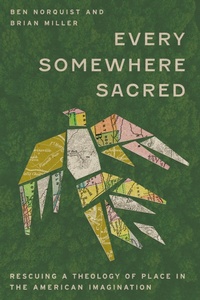
Every Somewhere Sacred
Description

Become Stewards of God's Vision Where You're Placed
It's possible for American Christians to live everywhere and nowhere at the same time. We're often disconnected from the places we inhabit-cut off from nature, our neighbors, people different from us, and a sense of rootedness. It's time to imagine a better way.
Each of us is placed by God in a specific "somewhere." Drawing on social science research and their experiences across American landscapes and the Middle East, Ben Norquist and Brian Miller show how Christians in the US can develop a redemptive imagination for place. Many people have uncritically accepted American cultural assumptions about land, property, home ownership, and the good life. Yet our identity as followers of Jesus should transform how we live in the physical world, even as we recognize how places shape their inhabitants.
Every Somewhere Sacred explores
- tools for deeply understanding or "reading" places;
- interdisciplinary scholarship from Scripture, sociology, and theology on land and place; and
- connections between colonialism, race, social class, and American landscapes.
Norquist and Miller offer avariety of personal and corporate practices including land research, reassessing priorities and habits, advocating for others, and reconsidering the nature of sacred space, prompting us toward a broader vision for how God works through space, usingbiblical lenses of landscape as gift, sacrament, kin, and home.
Are you seeking a rooted, meaningful faith that responds to the needs of your community? If you want to dive deeper into a theology of place, Every Somewhere Sacred willhelp you connect to your own "somewhere" and offer guidance for becoming a steward of God's vision where you are.
More details
Other editions
Additional editions
Persons
Brian Miller (PhD, University of Notre Dame) is professor of sociology at Wheaton College and regularly teaches about and publishes on Christian residential and cultural patterns. His books include Sanctifying Suburbia: How the Suburbs Became the Promised Land for American Evangelicals and Building Faith: A Sociology of Religious Structures, coauthored with Robert Brenneman.
Ben Norquist (PhD, Azusa Pacific University) has served as director of grants and academics for Churches for Middle East Peace and as director of the Network of Evangelicals for the Middle East, where he helped American Christians pursue holistic peace with their neighbors around the world. Previously he also worked as a leader on the spiritual formation and community engagement team at Bryan College (Dayton, Tennessee) and with the Center for Faith and Innovation at Wheaton College (Illinois).
Content
Introduction: Why American Christians Need a New Way to Live in Place
Part 1: Where Do We Think We Are?
1. Spatial Texts: Tools for Reading Places
2. American Land Stories
Part 2: How Did We Get Here?
3. Settler Places on Indigenous Land
4. Race and Class
5. Types of Space
Part 3: Is There a Better Story?
6. Four Themes for Rereading Bible Stories about Land
7. Swords into Plowshares: Revising Christian Land Stories
8. Living Out the Better Stories as Individuals
9. Living Out the Better Stories Together
Conclusion: A Renewed Approach to the Landscape
Acknowledgments
General Index
Scripture Index
