

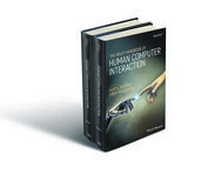
The Wiley Handbook of Human Computer Interaction Set
Description

Once, human-computer interaction was limited to a privileged few. Today, our contact with computing technology is pervasive, ubiquitous, and global. Work and study is computer mediated, domestic and commercial systems are computerized, healthcare is being reinvented, navigation is interactive, and entertainment is computer generated. As technology has grown more powerful, so the field of human-computer interaction has responded with more sophisticated theories and methodologies. Bringing these developments together, The Wiley Handbook of Human-Computer Interaction explores the many and diverse aspects of human-computer interaction while maintaining an overall perspective regarding the value of human experience over technology.
More details
Other editions
Additional editions

Persons
KENT L. NORMAN, PHD, is an Associate Professor in the Cognitive and Neural Systems Area in the Department of Psychology at the University of Maryland. He is the director of the Laboratory for Automation Psychology and Decision Processes (LAPDP) and is a founding member of the Human/Computer Interaction Laboratory (HCIL) in the University of Maryland.
JUREK KIRAKOWSKI, PHD, retired from his post as Statutory Lecturer in the School of Applied Psychology at University College Cork, Ireland in 2014. He continues his interest in Statistics and Human-Computer Interaction studies and now runs the User Experience Solutions web site. He is also involved in professional standards and ethics in HCI.
Content
Notes on Contributors vii
Acknowledgments xix
Introduction: Human-Computer Interaction Yesterday, Today, and Tomorrow 1 Kent L. Norman and Jurek Kirakowski
Part I Design Issues 7
1 Interactive Critical Systems and How to Build Them 9 Harold Thimbleby
2 Semiotics and Human-Computer Interaction 33 Clarisse Sieckenius de Souza
3 Benefiting from ISO Standards 51 Nigel Bevan and Jonathan Earthy
4 Gender and Human-Computer Interaction 71 Samantha Breslin and Bimlesh Wadhwa
5 Usability and Digital Typography 89 Peter Flynn
Part II Design Process 109
6 Agile User-Centered Design 111 Gabriela Jurca, Theodore D. Hellmann, and Frank Maurer
7 Ethnographic Approach to Design 125 Dave Randall and Mark Rouncefield
8 User Modeling 143 Pradipta Biswas and Mark Springett
9 Kids and Design 171 Mona Leigh Guha and Jerry Alan Fails
Part III Evaluation Factors 191
10 User Experience 193 Jakob Grue Simonsen
11 Task Load and Stress 207 Julien Epps
12 Comparing Mobile Experience 225 Xiaoge Xu
13 Factors of Immersion 239 Noirin Curran
Part IV Evaluation Methods 255
14 Usability Testing 257 Sirpa Riihiaho
15 Remote Usability Testing 277 John Black and Marc Abrams
16 Applied User Research in Games 299 Randy J. Pagulayan, Daniel V. Gunn, Jerome R. Hagen, Deborah J. O. Hendersen, Todd A. Kelley, Bruce C. Phillips, J. J. Guajardo, and Tim A. Nichols
Part V Input / Output 347
17 Fitts' Law 349 I. Scott MacKenzie
18 Principles for Designing Body-Centered Auditory Feedback 371 Ana Tajadura-Jimenez, Aleksander Valjamae, Frederic Bevilacqua, and Nadia Bianchi-Berthouze
19 Input Device-Motion Capture 405 Atsushi Nakazawa and Takaaki Shiratori
20 Applications of Intelligent and Multimodal Eye-Gaze Controlled Interfaces 421 Pradipta Biswas and Pat Langdon
21 Corneal Imaging 445 Christian Nitschke and Atsushi Nakazawa
Part VI Interfaces 515
22 Multisurface Environments 517 Teddy Seyed and Frank Maurer
23 A Natural Language Interface for Mobile Devices 539 Boris Katz, Gary Borchardt, Sue Felshin, and Federico Mora
24 Visual Query Interfaces 561 Tiziana Catarci, Massimo Mecella, Stephen Kimani, and Giuseppe Santucci
25 Interfaces for Music 579 Ben Challis
Part VII Interaction 599
26 Embodied Conversational Agents 601 Hung-Hsuan Huang
27 Interacting with Mobile Media 615 S. Shyam Sundar, Eugene Cho, and Jinping Wang
28 Natural Human-Robot Interaction 641 Yasser Mohammad
29 A Quick Look at Game Engagement Theories 657 Chaklam Silpasuwanchai and Xiangshi Ren
Part VIII Accessibility 681
30 Accessibility 683 Alistair Edwards
31 Designing for and with People Living with Challenging Circumstances 697 Kellie Morrissey and John McCarthy
32 Innovative Accessible Interfaces 715 Carlos Duarte, David Costa, and Luís Carriço
33 A Concrete Example of Inclusive Design: Deaf-Oriented Accessibility 731 Claudia Savina Bianchini, Fabrizio Borgia, and Maria De Marsico
Part IX Social 757
34 Social Networking 759 Jennifer Golbeck
35 Measuring Attitudes Online: Social Interaction and the Internet 769 Mary Joyce and Eve Griffin
36 Munchausen by Internet 787 Aideen Lawlor
Part X Communities 803
37 The Viability of Online Communities and Virtual Teams for Enterprise Clients 805 Tharon Howard
38 Human-Computer Interaction and Education: Designing for Technology-Enhanced Learning Experiences 821 June Ahn and Tamara Clegg
39 Digital Citizen Science and the Motivations of Volunteers 831 Charlene Jennett and Anna L. Cox
Part XI Applications 843
40 Motor Vehicle Driver Interfaces 845 Paul A. Green
41 Improving Ad Interfaces with Eye Tracking 889 Michel Wedel
42 The Quantified Self 909 Jeong-Ki Hong and Jun-Dong Cho
43 An HCI Approach in Contemporary Healthcare and (Re)habilitation 923 Anthony Brooks
44 Visual Analytics for Comparing Multiple Clustering Results of Bioinformatics Data 945 Sehi L'Yi, Bongkyung Ko, DongHwa Shin, Young-Joon Cho, Jaeyong Lee, Bohyoung Kim, and Jinwook Seo Index 967
