

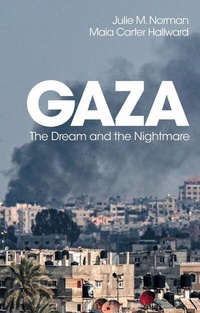
Gaza
Description

In this urgent and compelling book, Julie M. Norman and Maia Carter Hallward tell the story of Gaza from its early foundations, across decades of occupation, to the devastation of the ongoing war. Rather than focusing on elites or abstract politics, at the book's heart are ordinary Gazans - students, aid workers, journalists, and teachers - whose first-hand testimonies vividly illuminate the realities behind the headlines. Refusing to sensationalize or oversimplify, the book reckons with the legal, moral, and humanitarian deabtes surrounding Gaza, from war crimes investigations to the contested meaning of resistance and the politicization of aid. Combining a nuanced narrative with hard-hitting reflections from everyday Gazans, the book serves as a timely and necessary disruption of media cliches and political binaries, and from the perspectives of its own people.
More details
Other editions
Persons
Julie M. Norman is Associate Professor of Politics and International Relations at University College London, and an Associate Fellow at Chatham House. Maia Carter Hallward is Director of the PhD Program in International Conflict Management and Professor of Middle East Politics at Kennesaw State University.
Content
Illustrations
Acknowledgments
Introduction
1. How Gaza Became "The Strip"
2. Gaza Under Occupation
3. Gaza Rises Up
4. Israel's Disengagement
5. The Rise of Hamas
6. Hamas in Government
7. Israel, Hamas, and the Gaza Wars (2008-2021)
8. October 7
9. The Gaza War Begins
10. The Gaza War Continues
11. Regional Escalations
12. International Responses
Conclusion: What Next for Gaza?
Chronology
Notes
Index
Introduction
"Living in Gaza was like a dream and a nightmare at the same time."
Ahmed1
When Mustafa, a university student from Gaza City, is asked about his favorite place in Gaza, he remembers the view from his bedroom window:
I don't have a favorite place, but I can say the view from my room gave me the best feeling I've ever had in my life. I could see the neighbors on our small street, and I could see Salah al-Din Street, Gaza's main north-south highway, stretching into the distance. The feeling I had looking out that window was always the feeling of relief and the feeling of being safe.
Map 0.1 Gaza Strip
Like many young Gazans, Mustafa had lived his entire life inside the 140-square-mile Strip with no travel access to the West Bank, Israel, or neighboring Egypt. When he was finally awarded a rare opportunity to study abroad, he spent the first year aching for the home and community he had left behind, sustained by the memory of the view from his window. But that view no longer exists. "My parents sent me a photograph from the window after the war started," he told us in 2024. "It was just destruction."2
On October 7, 2023, Hamas launched a brutal attack on Israel, reshaping the future of Gaza, the Israel-Palestine conflict, and the Middle East region for years to come. The attack was unprecedented in its scale and scope, with approximately 1,200 Israelis and foreign nationals killed and 251 others taken hostage. Israel's subsequent war on Gaza was likewise unparalleled in its intensity, with over 55,000 Palestinians killed, over 90 percent of the population displaced, and approximately two-thirds of structures destroyed or damaged.3 The events of 2023-5 thrust Gaza to the forefront of the world's attention, and underscored the centrality of Gaza as a critical flashpoint in the region. But how did Gaza get to this point? What makes this tiny sliver of land so important? And what kind of future might be envisioned? The aim of this book is to tell the story of Gaza grounded in historical context, regional relevance, and, most importantly, the voices of Gazans.
Gaza is often framed solely as a place of suffering, where even before the recent war, 2.2 million people lived in an "open air prison,"4 with movement in and out of the Strip strictly regulated by Israel in the north and Egypt in the south. Similarly, Gaza is often discussed purely in terms of the latest conflict dynamics, or analyzed as a hotbed for terrorism. But for Gazans, and most Palestinians, the Strip represents much more than that. Gaza's history goes back centuries, if not millennia, and far predates the current Israel-Palestine conflict. As such, Gazans' recollections of the Strip are replete with descriptions of the vibrant culture of Gaza City, the beauty and promise of the Mediterranean coastline, and the tight-knit social fabric of Gaza's neighborhoods. These memories represent more than mere nostalgia. Rather, they comprise a historical record of what has been lost in the recent war - a living archive that itself has been depleted over months of widespread death and destruction.
Prior to October 2023, Gaza City was the urban heart of the Strip. Omar Mukhtar Street, a broad avenue, ran through the center of the city, lined with restaurants, shops, and banks. The two directions of travel were divided by the trees and gardens of Aljondy Almajhool Park, comprising a rare green space down the middle of the thoroughfare. If you followed the road in the northwest direction, you would reach the sea, where a recently refurbished corniche was embraced as a popular spot for walking, jogging, and socializing. The port area was also home to long-standing restaurants, hotels, and sports clubs, overlooking wide sandy beaches that stretched in both directions. Following Omar Mukhtar Street in the other direction, southeast, you would come to Palestine Square, also known as Al-Saha, or "the Square," where you would find a fruit market, bus station, taxi station, and various shops and vendors. Continuing east past the square was the minaret of the Great Omari Mosque, built on an ancient holy site dating back to the fifth century, which stood as one of Gaza's prized historical and architectural landmarks. By 2024, however, the mosque, the square, the port, the park, Omar Mukhtar Street, and countless buildings and homes had been destroyed by Israeli airstrikes. Gazans who managed to return to their neighborhoods told us they could not recognize anything from their former lives.
"We tried our best to dig deeper and find joy. We didn't find it in the usual places. We found it in the rhythm of Gaza."
Noor5
In this book, we trace the historical timelines and political developments of Gaza by highlighting the human voices that have shaped the Strip through the years. Rather than profiling political elites, we focus on the experiences of everyday Gazans, including students, teachers, journalists, and aid workers, infusing the narrative with first-person reflections on activism, education, and daily life in Gaza. These quotes and anecdotes are based on over 50 original interviews conducted by the authors, as well as on secondary sources including newspaper articles, archived testimonies, and oral histories. Quotes from original interviews with Gazans have been anonymized. We also include pop-out boxes throughout the text that offer more detailed anecdotes from individuals' lived experiences. Our primary aim with this approach is to shift from the passive account of Palestinian experiences in most mainstream media and instead to highlight the agency and humanity of everyday Gazans in recounting their own stories.
While much of Gaza's story is often reduced to broad generalizations, we amplify personal stories and perspectives to enrich the historical narrative, and also to reflect the diversity within Gaza. For example, many Gazans from the southern cities of Rafah and Khan Younis viewed themselves as geographically and culturally distinct from Gaza City in the north, and vice versa. Within the cities, daily life in prosperous areas such as Gaza City's Rimal neighborhood differed significantly from working-class areas, and there was even more disparity between urban centers and Gaza's eight refugee camps. According to the United Nations Relief and Works Agency (UNRWA), the main body supporting Palestinian refugees, 1.58 million of Gaza's total population of 2.2 million in 2023 were registered refugees, with slightly less than half of those refugees living in UN-administered camps. The largest camp - destroyed by Israel in a 2024 offensive - was Jabalya Camp, located north of Gaza City, with 119,540 refugees living in a 1.4-square-kilometer area of tight alleyways and concrete structures.6
Whether north or south, refugee or indigenous, middle-class or working-class, nearly all Gazans spoke about the strong social fabric in their communities. If a family had food left over after a meal, they would pack it up and share it with another family who were struggling. If someone was riding in a shared taxi after buying a bag of strawberries, they readily shared the fruit with their fellow passengers. If you walked down your street, you were bound to stop several times to talk with neighbors who knew you and your family. Nearly all Gazans acknowledged, however, that this social fabric, along with Gaza's infrastructure, was largely destroyed in the war, as families became increasingly desperate to survive.
"If you survive in Gaza, if you lived here at any time, you know that the situation is explosive. It's not sustainable, it's bound to explode at any moment."
Manar7
While Gaza's rich history should not be reduced to the Israel-Palestine conflict, it is undeniable that the conflict has been the primary force shaping contemporary Gaza, and, in turn, Gaza has at many times exemplified the epicenter of the broader conflict. As such, we start our chronological narrative in the early twentieth century in the aftermath of World War I, when the lines of the contemporary Middle East were initially drawn, and when the question of Palestine emerged as an international issue. We then trace Gaza's trajectory through the British Mandate, the War of 1948 (Israel's War of Independence), Egypt's administration of Gaza, the Israeli occupation, the first and second intifadas, the ascendance of Hamas, and a series of Gaza wars, culminating in the crisis of 2023-5. In each period, we look not only at the major confrontations and escalations, but also at the political, economic, and social dimensions that shaped Gaza more broadly.
Throughout the book, we situate developments in Gaza in the context of local, regional, and global dynamics. At the local level, we consider the variety of actors and interests within Gaza itself, as well as intra-Palestinian relations between Gaza and the West Bank, and, in recent years, between Hamas and Fatah. We also explore the changing roles of states in the region in influencing Gaza's trajectory, including both the historical and contemporary influence of Egypt and the more recent impact of Qatar and Iran. We also consider the role of regional non-state actors that have affected Gaza's political dynamics, including the Muslim Brotherhood (from which Hamas emerged), Hezbollah (in...
