

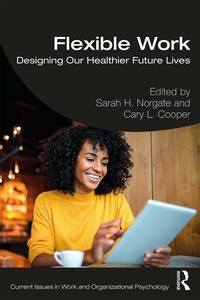
Flexible Work
Designing our Healthier Future Lives
1st Edition
Published on 27. March 2020
268 pages
978-1-000-04269-6 (ISBN)
Description

Flexible Work: Designing Our Healthier Future Lives examines flexible working through the lens of social science, in particular using psychological perspective to address not only what forms of flexible working there are and how they are evolving but also their prospect in the future of work. Bringing together views from thought-leaders and underpinned by research evidence, this book addresses two of the most fundamental business challenges for large and medium organisations - mental health and productivity - calling for the bridging of science and policy to design flexible working for our future healthier lives.
Growing from these foundations, this book explains the latest landscape in flexible working, looking at employee psychological health and productivity, including showing up for work sick. Perspectives are provided from around the world on leadership, line management, 'over attachment' with technology, commuting, skill-based inequality and control over working time. Readers are offered insights into the relevance of flexible working for a diverse workforce - invisible disabilities, disabilities, older workers and blended families. Throughout, the book offers suggestions for shaping future policy, practice and research.
Each chapter concludes with recommendations, making this essential reading for students, academics, human resource practitioners, policy-influencers, policymakers and professionals interested in flexible work.
Growing from these foundations, this book explains the latest landscape in flexible working, looking at employee psychological health and productivity, including showing up for work sick. Perspectives are provided from around the world on leadership, line management, 'over attachment' with technology, commuting, skill-based inequality and control over working time. Readers are offered insights into the relevance of flexible working for a diverse workforce - invisible disabilities, disabilities, older workers and blended families. Throughout, the book offers suggestions for shaping future policy, practice and research.
Each chapter concludes with recommendations, making this essential reading for students, academics, human resource practitioners, policy-influencers, policymakers and professionals interested in flexible work.
Reviews / Votes
'We all want happier, healthier and more productive working lives and two-way flexibility is a key part of the answer. A driving force in this book is the compelling argument around how we make flexible working work to give workers more control over where and how they work. This is essential reading for anyone who wants to build better, fairer and more humane workplaces.' - Frances O'Grady, General Secretary, Trades Union Congress (TUC), UK'Disruptive changes in the nature of work and of working life have far-reaching implications for human and economic health and wellbeing across society. This book provides essential foundations for wise and well-informed discussions to guide the actions now necessary.' - Professor Dame Carol Black, Advisor on Health and Work to Public Health England and UK National Health Service Improvement 'We all want happier, healthier and more productive working lives and two-way flexibility is a key part of the answer. A driving force in this book is the compelling argument around how we make flexible working work to give workers more control over where and how they work. This is essential reading for anyone who wants to build better, fairer and more humane workplaces.' - Frances O'Grady, General Secretary, Trades Union Congress (TUC), UK
'Disruptive changes in the nature of work and of working life have far-reaching implications for human and economic health and wellbeing across society. This book provides essential foundations for wise and well-informed discussions to guide the actions now necessary.' - Professor Dame Carol Black, Advisor on Health and Work to Public Health England and UK National Health Service Improvement
More details
Series
Edition
1. Auflage
Language
English
Place of publication
London
United Kingdom
Publishing group
Taylor & Francis Ltd
Target group
College/higher education
Professional and scholarly
Product notice
Reflowable
Illustrations
2 Tables, black and white; 7 Line drawings, black and white; 9 Illustrations, black and white
ISBN-13
978-1-000-04269-6 (9781000042696)
Copyright in bibliographic data and cover images is held by Nielsen Book Services Limited or by the publishers or by their respective licensors: all rights reserved.
Schweitzer Classification
Other editions
Additional editions
Book
04/2020
1st Edition
Routledge
€54.30
Shipment within 15-20 days

Book
04/2020
1st Edition
Routledge
€206.60
Shipment within 15-20 days
Persons
Dr Sarah H. Norgate was formerly a Reader in Applied Developmental Psychology at the University of Salford, UK, and is a popular science author. Since completing her PhD at the University of Warwick, UK, she has widely published in both academic and practitioner journals and has enjoyed collaborating with diverse stakeholders on award-winning research. Sarah is also a fellow for life with the Winston Churchill Memorial Trust.
Sir Cary L. Cooper is the 50th Anniversary Professor of Organizational Psychology and Health at the ALLIANCE Manchester Business School, University of Manchester, UK, President of the CIPD and Co-Chair of the National Forum for Health and Wellbeing at Work.
Sir Cary L. Cooper is the 50th Anniversary Professor of Organizational Psychology and Health at the ALLIANCE Manchester Business School, University of Manchester, UK, President of the CIPD and Co-Chair of the National Forum for Health and Wellbeing at Work.
Content
List of figures
List of tables
Contributors
PART I - Introduction
Designing our Healthier Future Lives: Bridging Science and Policy for Flexible Work: The Pervasion of 'cog in the wheel' workplaces across time
Sarah H. Norgate & Cary L. Cooper
A Flexible Working Future - The Opportunities and Challenges
Peter Cheese
PART II - The Impact of Flexible Working on Health and Productivity
Employees' Psychological Health and The Impact of Flexible Working Arrangements
Carolyn Timms, Paula Brough & Xi Wen (Carys) Chan
Workplace Flexibility Increases Productivity Throughout Presenteeism: A Conceptual Framework
Sara L. Lopes & Aristides I. Ferreira
Flexible Working and Quality of Life: Compatible?
Sarah Jackson & Jonathan Swan
PART III - What Makes Flexible Working Work?
Leadership in Flexible Work Systems
Anika Cloutier & Julian Barling
Line Managers and Flexible Working
Sharon Clarke
The Balanced Communications Diet for Business: Principles for Working Smarter, Not Harder in A Connected World
Nicola J. Millard
The Impact of The Commute on Our Mental Health and Physical Health Within the Context of Flexible and Non-Flexible Working
Anna Mary Cooper-Ryan, Charlotte Stonier & Abolanle Gbadamosi
Flexible Working and Skill-Biased Inequality: Causes and Consequences
Egidio Riva & Marcello Russo
Control Over Working Time - A Twenty-First-Century Issue
Kate Bell
PART IV - Flexible Working for Particular Groups of Workers
Supporting Employees with Invisible Disabilities via Flexible Work
Alexandra Duval, Duygu Gulseren & E. Kevin Kelloway
Workers with Disabilities: The Role of Flexible Employment Schemes
Eleftherios Giovanis & Oznur Ozdamar
Lone Parents and Blended Families: Advocating Flexible Working to Support Families in Transition
Anneke Schaefer, Caroline Gatrell & Laura Radcliffe
Employee FWA Needs and Requests and Employer Provisions across Age Groups
Bernice Kotey & Stuart Wark
Flexible Working for Older Workers
Carol Atkinson
Index
List of tables
Contributors
PART I - Introduction
Designing our Healthier Future Lives: Bridging Science and Policy for Flexible Work: The Pervasion of 'cog in the wheel' workplaces across time
Sarah H. Norgate & Cary L. Cooper
A Flexible Working Future - The Opportunities and Challenges
Peter Cheese
PART II - The Impact of Flexible Working on Health and Productivity
Employees' Psychological Health and The Impact of Flexible Working Arrangements
Carolyn Timms, Paula Brough & Xi Wen (Carys) Chan
Workplace Flexibility Increases Productivity Throughout Presenteeism: A Conceptual Framework
Sara L. Lopes & Aristides I. Ferreira
Flexible Working and Quality of Life: Compatible?
Sarah Jackson & Jonathan Swan
PART III - What Makes Flexible Working Work?
Leadership in Flexible Work Systems
Anika Cloutier & Julian Barling
Line Managers and Flexible Working
Sharon Clarke
The Balanced Communications Diet for Business: Principles for Working Smarter, Not Harder in A Connected World
Nicola J. Millard
The Impact of The Commute on Our Mental Health and Physical Health Within the Context of Flexible and Non-Flexible Working
Anna Mary Cooper-Ryan, Charlotte Stonier & Abolanle Gbadamosi
Flexible Working and Skill-Biased Inequality: Causes and Consequences
Egidio Riva & Marcello Russo
Control Over Working Time - A Twenty-First-Century Issue
Kate Bell
PART IV - Flexible Working for Particular Groups of Workers
Supporting Employees with Invisible Disabilities via Flexible Work
Alexandra Duval, Duygu Gulseren & E. Kevin Kelloway
Workers with Disabilities: The Role of Flexible Employment Schemes
Eleftherios Giovanis & Oznur Ozdamar
Lone Parents and Blended Families: Advocating Flexible Working to Support Families in Transition
Anneke Schaefer, Caroline Gatrell & Laura Radcliffe
Employee FWA Needs and Requests and Employer Provisions across Age Groups
Bernice Kotey & Stuart Wark
Flexible Working for Older Workers
Carol Atkinson
Index
