

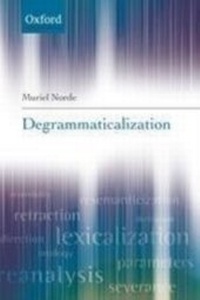
Degrammaticalization
1st Edition
Published on 17. September 2009
289 pages
978-0-19-154893-2 (ISBN)
Description

Grammaticalization is a well-attested process of linguistic change in which a lexical item becomes a function word, which may be further reduced to a clitic or affix. Proponents of the universality of grammaticalization have usually argued that it is unidirectional and have thus found it a useful tool in linguistic reconstruction. In this book Prof Norde shows that change is reversible on all levels: semantic, morphological, syntactic, and phonological. As a consequence, the alleged unidirectionality of grammaticalization is not a reliable reconstructional tool, even if degrammaticalization is a rare phenomenon. Degrammaticalization, she argues, is essentially different from grammaticalization: it usually comprises a single change, examples being shifts from affix to clitic, or from function word to lexical item. And where grammaticalization can be seen as a process, degrammaticalization is often the by-product of other changes. Nevertheless, she shows that it can be described, like grammaticalization, in a principled way, in order to establish whether a change in a word has been from more to less grammatical or vice versa, and the stages by which it has become so. Using data from different languages she constructs a typology of degrammaticalization changes. She explains why degrammaticalization is so rare and why some linguists have such strongly negative feelings about the possibility of its existence. She adds to the understanding of grammaticalization and makes a significant contribution to methods of linguistic reconstruction and the study of language change. She writes clearly, aiming to be understood by advanced undergraduate students as well as appealing to scholars and graduate researchers in historical linguistics.
More details
Other editions
Additional editions
Muriel Norde
Degrammaticalization
Book
09/2009
Oxford University Press
€58.20
Shipment within 15-20 days
Muriel Norde
Degrammaticalization
Book
09/2009
Oxford University Press
€145.47
Shipment within 15-20 days
Content
- Intro
- Contents
- Acknowledgments
- List of Tables
- Abbreviations
- List of Swedish sources referred to in the text
- 1 Introduction
- 1.1 Downs and ups in the history of degrammaticalization
- 1.2 Aims and outline
- 1.3 Preliminary definitions and observations
- 1.3.1 Grammaticalization
- 1.3.2 Degrammaticalization
- 1.3.3 Lexicalization
- 1.3.4 Areas of overlap
- 1.3.5 Diachronic gradualness and synchronic gradience
- 1.3.6 Reanalysis and analogy
- 1.4 Controversial types of grammaticalization
- 1.4.1 'Secondary' grammaticalization
- 1.4.2 Pragmaticalization
- 1.4.3 Clause combining
- 1.5 Context and constructions
- 1.6 Methodological issues
- 1.6.1 Processes versus results
- 1.6.2 Grammaticalization as a 'theory'
- 1.6.3 Changes and correspondences
- 1.6.4 Reconstruction as evidence
- 1.6.5 Case study: Romance MENTE
- 1.7 Summary
- 2 Unidirectionality
- 2.1 Introduction
- 2.2 Conceptualizations of language change
- 2.2.1 Clines
- 2.2.2 Cycles
- 2.3 Irreversibility
- 2.4 Non-directional change: lateral shifts
- 2.5 Alternative sources of grammatical markers
- 2.6 Allegedly irreversible changes
- 2.6.1 Desemanticization
- 2.6.2 Decategorialization
- 2.6.3 Univerbation
- 2.6.4 Phonological attrition
- 2.6.5 Subjectification
- 2.6.6 Summary
- 2.7 Explaining directional tendencies
- 2.7.1 Usage-based approaches
- 2.7.2 A psycholinguistic approach
- 2.7.3 Generative approaches
- 2.7.4 Other formal explanations
- 2.8 Summary
- 3 Defining degrammaticalization
- 3.1 Introduction
- 3.2 Regrammaticalization and antigrammaticalization
- 3.3 Terminological proliferation and confusion
- 3.3.1 Loss of grammatical meaning
- 3.3.2 Mirror image reversal
- 3.3.3 Lexicalization of function words and affixes
- 3.3.4 Euphemism
- 3.3.5 Adaptation and exaptation
- 3.3.6 Replacement
- 3.4 A generic definition
- 3.5 Classifying degrammaticalization
- 3.5.1 Lehmann's parameters
- 3.5.2 Some notes on the parameter of structural scope
- 3.5.3 Parameters of degrammaticalization
- 3.5.4 Andersen's levels of observation
- 3.5.5 Three types of degrammaticalization
- 3.6 Summary
- 4 Degrammation
- 4.1 Introduction
- 4.2 From modal auxiliary to lexical verb
- 4.3 Bulgarian nesto: from indefinite pronoun to noun 'thing'
- 4.4 Welsh eiddo: from possessive pronoun to noun 'property'
- 4.5 Middle Welsh yn ol: from preposition to Modern Welsh full verb nôl 'to fetch'
- 5 Deinflectionalization
- 5.1 Introduction
- 5.2 Classifying bound morphemes
- 5.2.1 Inflectional versus derivational affixes
- 5.2.2 Inflectional affixes versus clitics
- 5.2.3 Continua
- 5.3 The s-genitive (English and Mainland Scandinavian)
- 5.3.1 Introduction
- 5.3.2 The s-genitive in Swedish
- 5.3.3 The s-genitive in English
- 5.3.4 Alternative analyses
- 5.4 Swedish -er: from case suffix to nominalization suffix
- 5.5 Swedish -on: from number suffix to 'berry-name suffix'
- 5.6 From inflection to derivation in Kwaza quotative constructions
- 6 Debonding
- 6.1 Introduction
- 6.2 Replacement and retraction
- 6.3 Infinitival markers
- 6.3.1 English
- 6.3.2 Scandinavian
- 6.4 Japanese connectives
- 6.5 Old Estonian emphatic ep and interrogative es: from clitic to free particle
- 6.6 Irish muid: from verb suffix to pronoun
- 6.7 Northern Saami haga: from case suffix to postposition
- 6.8 Deaffixation in the Hup verbal compound
- 6.9 Dutch/Frisian/German tig/tich/zig: from suffix to quantifier
- 6.10 Northern Swedish bö-: from prefix to lexical verb
- 6.11 English -ish: from suffix to free morpheme
- 6.12 Tura LÁ: from bound to free derivational marker
- 7 Conclusions
- 7.1 Lehmann's parameters revisited
- 7.2 Defining characteristics of the three types of degrammaticalization
- 7.3 Mechanisms and motivating forces
- 7.4 Outlook
- References
- Author Index
- A
- B
- C
- D
- E
- F
- G
- H
- I
- J
- K
- L
- M
- N
- O
- P
- R
- S
- T
- V
- W
- Y
- Z
- Subject Index
- A
- B
- C
- D
- E
- F
- G
- H
- I
- J
- K
- L
- M
- N
- O
- P
- Q
- R
- S
- T
- U
- V
- W
- Z
