

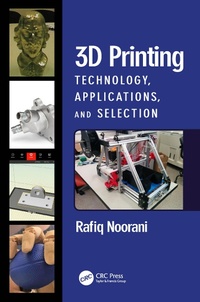
3D Printing
Technology, Applications, and Selection
Published on 25. August 2017
293 pages
978-1-351-65154-7 (ISBN)
Description

3D Printing is a faster, more cost-effective method for building prototypes from three-dimensional computer-aided design (CAD) drawings. 3D Printing provides a fundamental overview of the general product design and manufacturing process and presents the technology and application for designing and fabricating parts in a format that makes learning easy. This user-friendly book clearly covers the 3D printing process for designers, teachers, students, and hobbyists and can also be used as a reference book in a product design and process development.
Reviews / Votes
"This text provides foundational education to the reader on the implementation of printing as well as on the technical skills required to use the latest generation of printers. I recommend this book as a monograph that goes beyond the textbook material for any individual currently looking into or working toward using 3D Printing."-Jeffrey Agular, Idaho National Laboratory, USA, MRS Bulletin, June Issue 2018
More details
Language
English
Place of publication
London
United Kingdom
Publishing group
Taylor & Francis Ltd
Target group
Professional and scholarly
Product notice
Reflowable
Illustrations
36 Line drawings, black and white; 20 Halftones, color; 107 Halftones, black and white
File size
9,92 MB
ISBN-13
978-1-351-65154-7 (9781351651547)
Copyright in bibliographic data and cover images is held by Nielsen Book Services Limited or by the publishers or by their respective licensors: all rights reserved.
Schweitzer Classification
Other editions
Additional editions
Book
03/2021
1st Edition
CRC Press
€61.99
Shipment within 15-20 days
Book
08/2017
1st Edition
CRC Press
€186.01
Shipment within 15-20 days
Person
Rafiq Noorani received his B.Sc. degree in Mechanical Engineering from Bangladesh University of Engineering and Technology (BUET), a M. Engr. in Nuclear Engineering and a Ph.D. in Mechanical Engineering from Texas A&M University.
He is currently a tenured Professor of Mechanical Engineering at Loyola Marymount University in Los Angeles, California. He previously taught engineering at Texas A&M University, the University of Louisiana at Lafayette and Gonzaga University in Spokane, Washington before joining Loyola Marymount University in 1989. His teaching interests
include CAD/CAM, Rapid Prototyping, 3D Printing and Robotics. He has received over 35 external grants totaling over $2 million including 6 grants from National Science Foundation (NSF). He has published 12 journal papers and 76 conference papers in national and international journals and conferences. With the help of a recent NSF grant, he has worked with his colleagues to develop an undergraduate program in Nanotechnology at LMU.
Dr. Noorani published the first textbook on Rapid Prototyping from North America in 2006 titled: Rapid Prototyping - Principles and Applications. The book was published by John Wiley & Sons. He also became a Fellow of American Society of Mechanical Engineers (ASME). According to ASME guidelines, the fellow grade of membership recognizes exceptional engineering achievements and contributions to the engineering profession.
As an international professor, he teaches and lectures on CAD/CAM, 3D Printing and Robotics in many countries including Japan, South Korea and Bangladesh. Dr. Noorani is a professional member of American Society of Mechanical Engineers (ASME), Society of Manufacturing Engineers (SME) and American Society for Engineering Education (ASEE).
He is currently a tenured Professor of Mechanical Engineering at Loyola Marymount University in Los Angeles, California. He previously taught engineering at Texas A&M University, the University of Louisiana at Lafayette and Gonzaga University in Spokane, Washington before joining Loyola Marymount University in 1989. His teaching interests
include CAD/CAM, Rapid Prototyping, 3D Printing and Robotics. He has received over 35 external grants totaling over $2 million including 6 grants from National Science Foundation (NSF). He has published 12 journal papers and 76 conference papers in national and international journals and conferences. With the help of a recent NSF grant, he has worked with his colleagues to develop an undergraduate program in Nanotechnology at LMU.
Dr. Noorani published the first textbook on Rapid Prototyping from North America in 2006 titled: Rapid Prototyping - Principles and Applications. The book was published by John Wiley & Sons. He also became a Fellow of American Society of Mechanical Engineers (ASME). According to ASME guidelines, the fellow grade of membership recognizes exceptional engineering achievements and contributions to the engineering profession.
As an international professor, he teaches and lectures on CAD/CAM, 3D Printing and Robotics in many countries including Japan, South Korea and Bangladesh. Dr. Noorani is a professional member of American Society of Mechanical Engineers (ASME), Society of Manufacturing Engineers (SME) and American Society for Engineering Education (ASEE).
Content
Book Organization
Preface
Acknowledgments
About the Author
1. Introduction
2. How Does 3D Printing Work?
3. Design of a 3D Printer
4. Calibrating the 3D Printer
5. Materials for 3D Printing
6. Classifications of Rapid Prototyping and 3D Printing Systems
7. Scanning and Reverse Engineering
8. Common Applications of 3D Printers
9. 3D Printing in Medicine
10. How to Select Rapid Prototyping and 3D Printer
Appendix A: Glossary of Terms
Appendix B: List of Abbreviations
Appendix C: MATLAB Program for Expert System
Index
Preface
Acknowledgments
About the Author
1. Introduction
2. How Does 3D Printing Work?
3. Design of a 3D Printer
4. Calibrating the 3D Printer
5. Materials for 3D Printing
6. Classifications of Rapid Prototyping and 3D Printing Systems
7. Scanning and Reverse Engineering
8. Common Applications of 3D Printers
9. 3D Printing in Medicine
10. How to Select Rapid Prototyping and 3D Printer
Appendix A: Glossary of Terms
Appendix B: List of Abbreviations
Appendix C: MATLAB Program for Expert System
Index
