

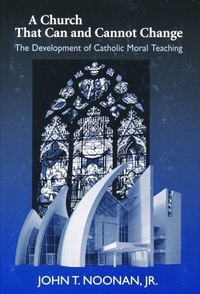
A Church That Can and Cannot Change
The Development of Catholic Moral Teaching
1st Edition
Published on 30. August 2020
277 pages
978-0-268-20090-9 (ISBN)
Description

Using concrete examples, John T. Noonan, Jr., demonstrates that the moral teaching of the Catholic Church has changed and continues to change without abandoning its foundational commitment to the Gospel of Jesus Christ. Specifically, Noonan looks at the profound changes that have occurred over the centuries in Catholic moral teaching on freedom of conscience, lending for a profit, and slavery. He also offers a close examination of the change now in progress concerning divorce.
In these changes Noonan perceives the Catholic Church to be a vigorous, living organism answering new questions with new answers, and enlarging the capacity of believers to learn through experience and empathy what love demands. He contends that the impetus to change comes from a variety of sources, including prayer, meditation on Scripture, new theological insights and analyses, the evolution of human institutions, and the examples and instruction given by persons of good will.
Noonan also states that the Church cannot change its commitment to preaching the Gospel of Jesus Christ. Given this absolute, how can the moral teaching of the Church change? Noonan finds this question unanswerable when asked in the abstract. But in the context of the specific facts and events he discusses in this book, an answer becomes clear. As our capacity to grasp the Gospel grows, so too, our understanding and compassion, which give life to the Gospel commandments of love, grow.
In these changes Noonan perceives the Catholic Church to be a vigorous, living organism answering new questions with new answers, and enlarging the capacity of believers to learn through experience and empathy what love demands. He contends that the impetus to change comes from a variety of sources, including prayer, meditation on Scripture, new theological insights and analyses, the evolution of human institutions, and the examples and instruction given by persons of good will.
Noonan also states that the Church cannot change its commitment to preaching the Gospel of Jesus Christ. Given this absolute, how can the moral teaching of the Church change? Noonan finds this question unanswerable when asked in the abstract. But in the context of the specific facts and events he discusses in this book, an answer becomes clear. As our capacity to grasp the Gospel grows, so too, our understanding and compassion, which give life to the Gospel commandments of love, grow.
Reviews / Votes
"In "A Church That Can and Cannot Change," Noonan drives home the point that some Catholic moral doctrines have changed radically. History, he concludes, does not support the comforting notion that the church simply elaborates on or expands previous teachings without contradicting them."-The New York Times"John T. Noonan's writing is tight, the examples are striking, the one-liners abundant, and the treasure-trove of amazing (and egregious) ecclesial statements is eye-popping. . . excellent book. . . " -Catholic Library World
"Noonan's works on usury, contraception, religious freedom, abortion, divorce, and bribery have set the gold standard for research in theological ethics. His research is especially compelling for Roman Catholic ethics shaped to some degree by magisterial teachings that often make the claim of inerrancy precisely through another claim: that its utterances are continuously the same and resist change, despite evidence to the contrary. . . . This brilliant book teaches us that, if we appreciate history, inevitably we are called to understand more than we presently know." -The Journal of Religion
"Noonan offers an intrepid analysis of unambiguous development in Catholic moral teaching that should cause the Church to celebrate rather than diminish the dynamic process of development . . . This enlightening, challenging, and hopeful book should contribute substantively to an appreciation of the constructive role of the development of moral doctrine in Catholic theology." -The Heythrop Journal
"Long curious about the absence of a body of writing on the development of the Church's moral doctrine to match the copious treatment of the development of the doctrines of faith, he set himself to the present inquiry. . . . Noonan chose as the areas of development to explore slave-holding, usury, religious freedom, and the second marriage of a Catholic who has been married to an unbaptized person. . . . The book is a remarkably welcome resource in an important theological matter." -Horizons
"John Noonan wants to do for the commandments what John Newman did for the creed. Just as Newman showed there have been developments in the Church's understanding of the creed, so Noonan wants to show there have been developments in the church's understanding of morals. As Newman had his test cases, things like Nicea and devotion to the saints and the papacy, so Noonan has his test cases. He treats Church teaching on slavery, usury, religious freedom, and divorce." -The Thomist
"Noonan's thesis is that while the Catholic Church cannot change in holding to the deposit of faith, its moral doctrine has changed with regard to slavery, usury, and religious liberty, and it is in process of changing with regard to the dissolving of non-sacramental marriages. . . This is a thoughtful and scholarly work, which raises questions for both moral and systematic theologians." -The Catholic Historical Review
"Anyone looking for a comprehensive and insightful read on church history need look no further than John T. Noonan Jr.'s A Church That Can and Cannot Change. In short, to-the-point chapters Noonan, an accomplished historian and a judge on the U.S. Court of Appeals, leads the reader by the nose through his argument that the church's moral teaching can and does change-and probably will again. The heart of his case is his unflinching account of the church's relationship with slavery. Meticulously presenting the evidence, Noonan demonstrates beyond any reasonable doubt the church's move from acceptance of human slavery to eventual condemnation." -U.S. Catholic
"Noonan's real intent is to craft an argument. It is, roughly, this: Change is healthy, and the Church should abandon what is untenable; each age helps forge deeper understanding; though a revised doctrine may itself be wrong, we needn't worry because people of the future will fix such problems." -New Oxford Review
"Crisply written and immensely learned, [A Church That Can and Cannot Change] documents profound change in Catholic teaching on three topics-slavery, usury, religious liberty-and significant development with regard to a fourth, the dissolution of marriage." -Commonweal
"What might at first glance seem to be a problematic piling up of disparate answers . . . actually helps to seal Noonan's case. The multiple interwoven issues lead one toward the realization that there has been a certain heterogeneous inconsistency, even not excluding the church's determination of what is unnatural or intrinsically evil." -American Catholic Studies
More details
Series
Language
English
Place of publication
Notre Dame IN
United States
Target group
College/higher education
Professional and scholarly
Illustrations
1 halftone - 1 Halftones, unspecified
ISBN-13
978-0-268-20090-9 (9780268200909)
Copyright in bibliographic data and cover images is held by Nielsen Book Services Limited or by the publishers or by their respective licensors: all rights reserved.
Schweitzer Classification
Other editions
Additional editions
Book
01/2005
University of Notre Dame Press
€115.90
Shipment within 10-20 days
Book
10/2004
University of Notre Dame Press
€116.30
Shipment within 10-20 days
Person
John T. Noonan, Jr., is a judge of the United States Court of Appeals for the Ninth Circuit in San Francisco, California. He is a historian of ideas, distinguished lecturer, and author of thirteen books.
Content
- Cover
- Half title
- Series page
- Title page
- Copyright
- Dedication
- Contents
- Preface
- Three Unavoidable Issues
- 1. Father Newman Startles
- 2. Concubines, Castrati, Concordats-Is There Teaching There?
- 3. Morals without Experience and Empathy Are like Sundaes without Ice Cream or Sauce
- The Unknown Sin
- 4. God's Slaveowners
- 5. God's Slaves
- 6. The Pope's Slaves
- 7. Human Slaves as God's Slaves
- 8. A Girl Named Zita and Other Commodities
- 9. Moral Masters
- 10. How the Portuguese Got the Guinea Trade
- 11. If John Major Were an Indian
- 12. Conventions, Cries and Murmurs, Repressions
- 13. Advice to the Missions
- 14. Only if Christianity Is a Lye
- 15. The Pope Is Prompted
- 16. Emancipators' Éclat
- 17. The Sin Perceived, Categorized, Condemned
- Intrinsic Evil
- 18. Unnatural Reproduction
- 19. In Your City You Say It Often Happens
- 20. The Custom of the Country
- Folly, Championed
- 21. The Future Is Put Off
- 22. With Words for Infidels, with Fire for the Faltering Baptized
- 23. The Requirements of the Human Person
- Conjoined by God, Disjoined by God
- 24. If the Unbeliever Separates
- 25. If Necessity Urges
- 26. Out of Deeds Comes Law
- 27. Out of Difficulties Comes Development
- The Test of the Teaching
- 28. How Development Can Be Dated, Cannot Be Denied, and Should Neither Be Exaggerated Nor Ignored
- 29. How We Are Innocent Despite the Development of Our Descendants
- 30. How Precedent Deters but Does Not Defeat Development
- 31. That Form and Formula Fail to Foil Development
- 32. That Development Cannot Exceed Capacity
- 33. That Development Runs by No Rule Except the Rule of Faith
- Abbreviations
- Notes
- Index
