

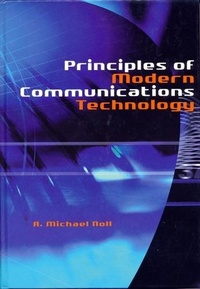
Principles of Modern Communications Technology
1st Edition
Published on 1. January 2000
304 pages
978-1-60807-181-4 (ISBN)
Description

Here's an easy-to-comprehend book that gives you a complete introduction to communication technologies and systems, offering you a solid understanding of the fundamentals, history and future direction of this ever-changing field. Geared towards non-technical business professionals and students, this unique resource integrates human physiology and factors, important inventors and business people, and basic technological principles to explain the key concepts and developments of modern communications.
More details
Other editions
Additional editions
Book
04/2001
Artech House Publishers
€91.80
Shipment within 10-20 days
Content
- Principles of Modern Communications Technology
- Contents i
- Preface xv
- Introduction xvii
- Structure of This Book xvii
- Integrative Convergence xix
- The People xix
- The Environment xx
- Part I: Audio Technology 1
- 1 The Physiology of Human Hearing 3
- The Human Ear 3
- Basilar Membrane: Sound to Neural Signals 5
- Neural Signals 7
- 2 EdisonTs Wonderful Invention: The Phonograph 11
- EdisonTs Invention 11
- Thomas Alva Edison 12
- BerlinerTs Disc 14
- Beyond EdisonTs Phonograph 14
- 3 Sound 17
- Sound Waves 17
- Diffraction, Refraction, and Reflection 19
- Musical Acoustics 20
- Architectural Acoustics 22
- 4 Signals 25
- Waveforms 25
- Engineering Notation 27
- Sine Waves 27
- Fourier Analysis and Synthesis 29
- Spectrum 30
- Bandwidth 31
- Spectrograms 34
- 5 Electricity 37
- What Is Electricity? 37
- Symbols 39
- Nikola Tesla 40
- Ohm's Law 42
- Series and Parallel Circuits 43
- Electromagnetism 44
- Distribution of AC Power 46
- Electric Safety 46
- Root Mean Square 47
- Power 48
- Frequency-Dependent Effects 48
- 6 Electronics 51
- Transducers 51
- Lee de Forest 52
- Conversion of AC to DC 55
- Amplification 57
- Vacuum Tube Triode 57
- Transistors 59
- Decibels 60
- Logarithms 62
- Magnetic Tape Recording 64
- Audio Systems 66
- 7 Digital Audio 69
- Sampling 69
- Analog-to-Digital Conversion 71
- Digital Bandwidth 73
- Binary Numbers 74
- Noise Immunity 74
- Compact Discs 75
- Part II: Video Technology 79
- 8 Human Vision 81
- The Human Eye 81
- Psychophysics and Human Vision 84
- Color Theory 86
- Motion Pictures 88
- 9 Television Basics 91
- Background 91
- Zworykin and Farnsworth 92
- Scanning 93
- Specifications 96
- Display Technology 97
- Television Receivers 98
- 10 Modulation Theory and Radio 101
- The History of Radio 101
- Guglielmo Marconi 102
- Radio Waves 103
- Edwin Armstrong 104
- David Sarnoff 106
- Frequency Shifting 108
- Amplitude Modulation 109
- Frequency Modulation 112
- Quadrature Modulation 113
- 11 Broadcast Television 115
- The Television Channel 115
- VHF/UHF Broadcast Television 116
- Cable Television 117
- Satellite and Other Television 119
- 12 Color Television 121
- The Challenge 122
- Time Domain 122
- Frequency Domain 124
- Color Television Receivers 126
- 13 Video Media 129
- Videotapes 129
- Videodiscs 132
- HDTV 133
- Digital Television 133
- Compression 134
- The Future of Television 135
- Part III: Speech Telecommunication 137
- 14 Human Speech 139
- Speech Production 140
- Mechanical Speaking Machines 142
- Vocoders 142
- Speech Processing 144
- 15 The Telephone 147
- Invention of the Telephone 147
- Alexander Graham Bell 149
- Elisha Gray 151
- Service Expansion 153
- Telephone Instruments 154
- 16 Networks 159
- A Network of Networks 160
- Local Networks 161
- Long-Distance Networks 164
- Traffic 164
- 17 Transmission Technologies 167
- Multiplexing 167
- Copper Transmission Media: Twisted Pair 170
- Copper Transmission Media: Coaxial Cable 171
- Terrestrial Microwave Radio 172
- Communications Satellites 173
- Optical Fiber 175
- Undersea Cable 177
- Impairments 178
- 18 Switching Systems 179
- Switching Machines 179
- Space-Division Switching 180
- Time-Division Switching 182
- Specific Switching Systems 183
- Ancillary Switching Topics 188
- 19 Services 191
- Wireless 191
- Satellite Mobile Telephony 194
- Facsimile 195
- Video Telephones 195
- Teleconferencing 196
- Data over the Local Loop 197
- Part IV: Written Communication 199
- 20 Human Written Communication 201
- Clay Tablets and Cuneiform 202
- Hieroglyphics 202
- Chinese 203
- Alphabets 204
- Printing 205
- 21 The Telegraph 207
- The Electric Telegraph 207
- The Telegraph's Legacy 209
- Samuel Morse 210
- Alfred Vail 211
- Communication Theory 213
- 22 The Computer 217
- Computer History 217
- Computer Systems 220
- Social and Societal Effects 221
- Computer Art and Music 222
- Digital Filters and Signal Processing 223
- Personal Encounters with Computers 224
- 23 Computer Hardware 227
- Computer Systems 227
- The CPU 228
- Boolean Logic Gates 229
- Memory 231
- Internal Communication 233
- Input and Output 233
- Performance 235
- 24 Computer Software 237
- Computer Programs 237
- Information Structure 238
- Programming Languages 240
- Application Programs 243
- Operating Systems 244
- User Interface 244
- 25 Data Communication 247
- Data Modulation 247
- Quadrature Amplitude Modulation 248
- Bit Rate and Baud Rate 249
- Directionality 249
- Topologies of Local Area Networks 251
- Packet Switching 252
- The Internet 253
- The World Wide Web 254
- Local Access 256
- Data Versus Voice 257
- History Lessons 257
- An Example 258
- Afterword 261
- The Future of Communication 261
- Factors that Shape the Future 263
- A Look Back 265
- A Glimpse Forward 268
- Advice for the Millenium 271
- Glossary 275
- About the Author 281
- Index 283
