

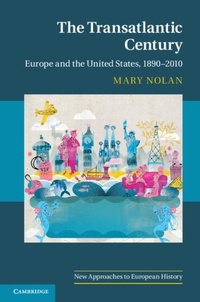
The Transatlantic Century
Europe and America, 1890-2010
1st Edition
Published on 17. October 2012
978-1-139-57490-7 (ISBN)
Description

This is a fascinating new overview of European-American relations during the long twentieth century. Ranging from economics, culture and consumption to war, politics and diplomacy, Mary Nolan charts the rise of American influence in Eastern and Western Europe, its mid-twentieth century triumph and its gradual erosion since the 1970s. She reconstructs the circuits of exchange along which ideas, commodities, economic models, cultural products and people moved across the Atlantic, capturing the differing versions of modernity that emerged on both sides of the Atlantic and examining how these alternately produced co-operation, conflict and ambivalence toward the other. Attributing the rise and demise of American influence in Europe not only to economics but equally to wars, the book locates the roots of many transatlantic disagreements in very different experiences and memories of war. This is an unprecedented account of the American Century in Europe that recovers its full richness and complexity.
Reviews / Votes
'In a century-long analytical survey blending economics and culture, ideas and diplomacy, Mary Nolan brings enviable breadth of knowledge and depth of thought to the full complexity of the transatlantic exchange. Throughout their varying encounters with modernity, she shows, Europe and the United States could never be disconnected, even as the discords and dissonances have grown.' Geoff Eley, University of Michigan 'Nolan's [The] Transatlantic Century is a masterful work of synthesis: breathtaking in its scope and precise in its rich detail. It is the foundation from which every effort to understand the place of the United States in the economic and political revolutions of the twentieth century must now proceed.' Daniel T. Rodgers, Princeton University 'The Transatlantic Century will become a standard work on the changing relations between the US and Europe in the twentieth century. It is synthetic, wide ranging, and important.' Ruth Oldenziel, Eindhoven University of Technology 'A stimulating and readable overview that shows the complexities of the era often stereotyped as the American Century.' David Reynolds, University of Cambridge 'With incisive prose and acuity of judgment Nolan offers a more comprehensive overview of European-American transatlantic relations than hitherto available.' Ian Tyrrell, Journal of American History 'In [this book], Mary Nolan has drawn on her expertise as an historian of the Atlantic world to produce a work that challenges the belief that the twentieth century was the American Century ... [this] is an excellent resource for any upper-year undergraduate history or political science course that examines the United States, Europe, or the relations between the two regions. By questioning the traditional narrative offered by many textbook-style works and challenging the belief in American exceptionalism, [Nolan] forces readers to question their own views on the relationship between the United States and Europe ... her work stimulates the discussion not only about transatlantic history but also the history of empires and transnational history. [Her] ability to shift seamlessly from a macrocosmic perspective to a microcosmic perspective is impressive and it is also refreshing to see the inclusion of Eastern Europe in her analysis.' Gregg French, H-Empire 'In this well-crafted, learned survey of US-European relations in the long twentieth century, Mary Nolan makes a valuable contribution to international history ... Nolan's work is a successful, readable synthesis. It wears its erudition lightly, is well constructed, and manages to integrate cultural and intellectual trends into the broader political-economic narrative, which is no small feat.' Gabriel Paquette, European History QuarterlyMore details
Series
Language
English
Place of publication
Cambridge
United Kingdom
Publishing group
Cambridge University Press
Target group
College/higher education
Professional and scholarly
Illustrations
4 Tables, black and white; 3 Maps; 26 Halftones, unspecified
File size
10536,88 MB
ISBN-13
978-1-139-57490-7 (9781139574907)
Copyright in bibliographic data and cover images is held by Nielsen Book Services Limited or by the publishers or by their respective licensors: all rights reserved.
Schweitzer Classification
Other editions
Additional editions
Book
10/2012
Cambridge University Press
€70.80
Shipment within 15-20 days
Book
10/2012
Cambridge University Press
€42.40
Shipment within 15-20 days
Person
Mary Nolan is Professor of History at New York University. She is the author of Visions of Modernity: American Business and the Modernization of Germany (1994) and co-editor of Crimes of War: Guilt and Denial in the Twentieth Century (2002).
Content
Introduction; 1. An uncertain balance, 1890-1914; 2. World War I: European crisis and American opportunity; 3. Ambivalent engagement; 4. The Great Depression and transatlantic new deals; 5. Strange affinities, new enemies; 6. From World War to Cold War; 7. Cooperation, competition, containment; 8. Culture wars; 9. The American century erodes, 1968-79; 10. Renewed conflict and surprising collapse; 11. A widening Atlantic; 12. Imperial America, estranged Europe.
