

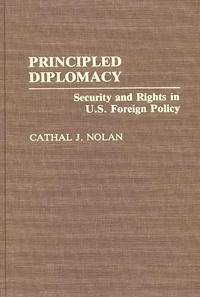
Principled Diplomacy
Security and Rights in U.S. Foreign Policy
1st Edition
Published on 30. January 1993
312 pages
978-1-57356-900-2 (ISBN)
Description

This new analysis of governing ideas in U.S. foreign policy shows how they arise, are sustained and challenged both domestically and internationally, and become part of the world order. Nolan assesses the problems of reconciling concerns for individual rights and liberal principles with national security interests in U.S. foreign policy over the course of the twentieth century. This interpretive survey redefines the key components in the make-up of U.S. diplomacy and provides good reading for students of American government, international relations and U.S. foreign policy, American and world history, defense, and human rights policy.
This short history traces the notions that liberty is indivisible and that security depends ultimately on the establishment and success of liberal-democratic norms between and within states. It shows how U.S. policy vacillates between giving active or passive expression to these ideas, always relying on a basic assumption about the presumed pacific character of democracy. Utilizing a wide variety of primary and secondary sources, it looks at how these ideas became manifest in two major policy settings---those affecting the Soviet Union and the UN. Through these case studies, the book shows how these ideas become progressively embedded in U.S. policy; how they have been challenged by different interests and events; how they were disseminated among and accepted by allies (and even several former adversaries); and how, as a result, they now permeate the structures of major international organizations, and even underlie the emerging post-Cold War international system as a whole. The conclusion offers an interesting perspective for the future.
This short history traces the notions that liberty is indivisible and that security depends ultimately on the establishment and success of liberal-democratic norms between and within states. It shows how U.S. policy vacillates between giving active or passive expression to these ideas, always relying on a basic assumption about the presumed pacific character of democracy. Utilizing a wide variety of primary and secondary sources, it looks at how these ideas became manifest in two major policy settings---those affecting the Soviet Union and the UN. Through these case studies, the book shows how these ideas become progressively embedded in U.S. policy; how they have been challenged by different interests and events; how they were disseminated among and accepted by allies (and even several former adversaries); and how, as a result, they now permeate the structures of major international organizations, and even underlie the emerging post-Cold War international system as a whole. The conclusion offers an interesting perspective for the future.
More details
Series
Edition
1. Auflage
Language
English
Place of publication
New York
United States
Publishing group
Bloomsbury Publishing Plc
Target group
Interest Age: From 7 to 17 years
ISBN-13
978-1-57356-900-2 (9781573569002)
Copyright in bibliographic data and cover images is held by Nielsen Book Services Limited or by the publishers or by their respective licensors: all rights reserved.
Schweitzer Classification
Other editions
Additional editions
Book
01/1993
Praeger Publishers Inc
€98.60
Shipment within 15-20 days
Person
CATHAL J. NOLAN is Associate Professor of History and Executive Director of the International History Institute at Boston University. His numberous books include the award-winning, four-volume Greenwood Encyclopedia of International Relations (Greenwood, 2002), Power and Responsibility in World Affairs (Praeger, 2004), Ethics and Statecraft (Praeger, 2004), Principled Diplomacy: Security and Rights in U.S. Foreign Policy (Greenwood, 1993), Shepherd of Democracy? America and Germany in the 20th Century (Greenwood, 1992), and the award-winning Notable U.S. Ambassadors Since 1775 (Greenwood, 1997). He also edits the Praeger series Humanistic Perspectives on International Relations, and co-edits the Praeger series International History.
Content
Preface
Introduction
The Soviet Union
Responding to Revolution
From Recognition to Alliance
The Great Divide
Rhetoric and Realism
Human Rights and Detente
Beyond Containment
The United Nations
Active at the Creation
An End to Leadership
Congress vs. The President
Conclusions
Select Bibliography
Index
Introduction
The Soviet Union
Responding to Revolution
From Recognition to Alliance
The Great Divide
Rhetoric and Realism
Human Rights and Detente
Beyond Containment
The United Nations
Active at the Creation
An End to Leadership
Congress vs. The President
Conclusions
Select Bibliography
Index
