

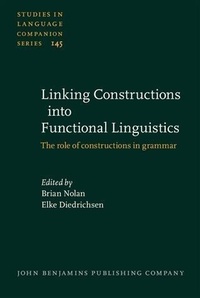
Linking Constructions into Functional Linguistics
The role of constructions in grammar
1st Edition
Published on 6. December 2013
XIX, 335 pages
978-90-272-7108-2 (ISBN)
Description

There is a growing awareness of the significance of constructions in grammar in the world's languages. To date there has not been a single volume that addresses the issues of constructions within a functional Role and Reference Grammar (RRG) account. The book is a collection of articles that will serve the scholarly community as a reference work on the role, place and significance of constructions within this functional model of grammar. As a result, this volume represents the first instance of cross-linguistic comparison of these important discourse and syntax-related phenomena. The articles cover a variety of typologically different languages including German, Irish, Spanish, French, Japanese, Yaqui, Tepehua (Totonacan), Persian, and English, and they offer new data on the role of constructions, within the RRG theory, in these languages. Further, this volume contributes towards providing a comprehensive overview of grammatical constructions which are central to our understanding of how human languages function, in a functional linguistics perspective. This scholarly work is grounded in a functionally oriented model that makes strong claims of descriptive and typological adequacy. The book will represent a valuable step forward in linguistics research as it applies the RRG theoretical framework to the analyses of constructions.
More details
Other editions
Additional editions
Brian Nolan | Elke Diedrichsen
Linking Constructions into Functional Linguistics
The role of constructions in grammar
Book
12/2013
John Benjamins Publishing Co
€100.70
Shipment within 10-15 days
Persons
Content
- Linking Constructions into Functional Linguistics
- Editorial page
- Title page
- LCC data
- Table of contents
- Introduction
- References
- Controller-controllee relations in purposive constructions
- 1. Introduction
- 2. Defining purpose and rationale clauses
- 3. Purposive constructions within RRG revisited
- 3.1 Tendencies for the controller-controllee relations
- 3.2 The lexical manifestation of the controllee
- 3.3 Structural and inherent control relations
- 4. A constructional schema for purpose clauses
- 5. Final remarks
- References
- Transitivity, constructions, and the projection of argument structure in RRG
- 1. Introduction
- 2. Transitivity in English and Tepehua
- English: Underspecified transitivity
- Tepehua: Fully specified transitivity
- Transitivity of borrowed forms
- 3. Accommodating argument structure
- Dative construction
- Verb-verb compound construction
- 4. Conclusion
- References
- Constructions in RRG
- 1. Introduction
- 2. Previous studies
- 2.1 Tsujimura (2005)
- 2.2 Kageyama (2007)
- 3. Intransitive mimetic verbs
- 3.1 Constructions in RRG
- 3.2 Semantics-to-syntax linking
- 4. Transitive mimetic verbs
- 4.1 Transitivity of mimetic verbs
- 4.2 The body-part + mimetic-sase construction
- 4.3 The colloquial mimetic-suru construction
- 4.4 Syntax-to-semantics linking
- 5. Conclusion
- References
- A constructional perspective on clefting in Persian
- 1. Introduction
- 2. A survey of cleft literature
- 3. RRG treatment of clefts in Persian
- 4. Extraposition vs. clefting
- 5. Grammatical relations in cleft constructions
- 6. Conclusion
- Abbreviations
- References
- Radical Role and Reference Grammar (RRRG)
- 0. Introduction
- 1. Theoretical and methodological considerations
- 2. Consequences for the organization of RRG
- 3. Towards a radical role and reference grammar
- 4. The activity hierarchy
- 4.1 The activity hierarchy at the lexical level
- 4.2 Activity hierarchy and constructional schemas
- 5. Conclusion and outlook
- References
- Constructions as grammatical objects
- 1. Introduction
- 2. The role of constructions in RRG
- 3. Viewing a construction in a construction repository
- 3.1 Construction internal architecture
- 3.2 Construction internal processing workspace
- 4. Case study: The modern irish prepositional ditransitive constructions
- 5. The factors that influence word order
- 5.1 Syntactic weight
- 5.2 Information structure
- 5.3 Animacy and definiteness of referents
- 5.4 The animacy, thematic and nominal hierarchies
- 6. The Irish prepositional ditransitive constructions
- 6.1 Characterising the ditransitive constructions of modern irish
- 6.2 The verb thug 'give'
- 6.3 Other three-place causative predicates
- 6.4 What about 1.person or 2.person PN themes?
- 6.5 Evidence from the topicalisation processes in Irish
- 6.6 Other clause types with clause final theme
- 7. Discussion and conclusions
- References
- Constructions in Role and Reference Grammar
- 1. Introduction
- 2. A brief overview of the status of constructions within RRG: The case of the resultative
- 3. An RRG enriched constructional schema for the English resultative
- 4. A family of constructions: A preliminary proposal
- 5. Concluding remarks
- References
- WTowards a model of constructional meaning for natural language understanding
- 1. Introduction
- 2. Role and reference grammar and the lexical-constructional model
- 3. FunGramKB
- 3.1 Thematic frames and meaning postulates
- 3.2 Lexical entries
- 3.3 Constructional schemata
- 4. Building constructional meaning in RRG with FunGramKB
- 5. Conclusions and future research
- 6. Acknowledgments
- References
- Meaning construction, meaning interpretation and formal expression in the Lexical Constructional Model
- 1. Introduction
- 2. What is a construction in the LCM?
- 3. Mediated compositionality
- 4. Descriptive tools
- 4.1 A typology of cognitive models
- 4.2 Argument-structure lexical and constructional templates
- 4.3 Idiomatic constructions
- 4.4 Summary
- 5. Explanatory tools
- 5.1 Constraints of subsumption
- 5.1.1 Vertical constraints
- 5.1.2 Horizontal constraints
- 5.2 Amalgamation
- 5.3 Saturation of constructional variables
- 6. Meaning construction, meaning interpretation and formal expression
- 7. Conclusion
- References
- Constructions in the Lexical Constructional Model
- 1. Introduction: Aims*
- 2. A brief introduction to the LCM and its history
- 3. A cognitively-oriented functionalist precursor: The lexical grammar model
- 4. Further semantic enrichment
- 5. Synthesis with cognitive/constructionist approaches: The LCM
- 6. The computational strand of the model: FunGramKB
- 7. Discussion: A possible way forward
- References
- From idioms to sentence structures and beyond
- 1. Introduction
- 2. Role and reference grammar: A lexical approach to linguistic structure
- 3. Constructional schemas
- 4. A lexical-constructional account of the German bekommen-passive
- 4.1 Lexical constraints for the bekommen-passive
- 4.2 Conclusion
- 5. The German bracket structure as a construction
- 5.1 The German bracket structure as a word order rule
- 5.2 The RRG word order rule for German main declarative clauses in the Semantics to Syntax linking
- 5.3 The German bracket structure as a construction
- 5.4 The bracket structure as a grammatical object
- 5.5 Conclusion
- 6. Cultural objects/memes: On Constructions that require cultural knowledge
- 6.1 Cultural objects = memes for interaction
- 6.2 Three examples
- 6.3 Conclusion
- 7. Summary and conclusion of the paper
- References
- Web sources
- Index
