

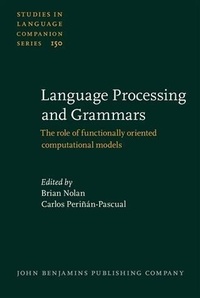
Language Processing and Grammars
The role of functionally oriented computational models
1st Edition
Published on 1. April 2014
VI, 396 pages
978-90-272-7064-1 (ISBN)
Description

There is a growing awareness of the significance and value that modelling using information technology can bring to the functionally oriented linguistic enterprise. This encompasses a spectrum of areas as diverse as concept modelling, language processing and grammar modelling, conversational agents, and the visualisation of complex linguistic information in a functional linguistic perspective. This edited volume offers a collection of papers dealing with different aspects of computational modelling of language and grammars, within a functional perspective at both the theoretical and application levels. As a result, this volume represents the first instance of contemporary functionally oriented computational treatments of a variety of important language and linguistic issues. This book presents current research on functionally oriented computational models of grammar, language processing and linguistics, concerned with a broadly functional computational linguistics that also contributes to our understanding of languages within a functional and cognitive linguistic, computational research agenda.
More details
Other editions
Additional editions
Brian Nolan | Carlos Perinan-Pascual
Language Processing and Grammars
The role of functionally oriented computational models
Book
04/2014
John Benjamins Publishing Co
€104.94
Shipment within 10-15 days
Persons
Content
- Language Processing and Grammars
- Editorial page
- Title page
- LCC data
- Table of contents
- Introduction
- References
- From the extraction of continuous features in parallel texts to visual analytics of heterogeneous areal-typological datasets
- 1. Introduction
- 2. Algorithmic typology
- 2.1 Degree of synthesis
- 2.2 Amount of prefixing and suffixing
- 2.3 Amount of case marking
- 2.4 Synthetic vs. analytic negation marking
- 3. Visual analytics
- 4. Combining genealogical and areal information in a single visualization
- 4.1 The extended sunburst display
- 4.2 User interaction
- 4.3 Design decisions
- 4.4 Meta-information
- 5. Case studies
- 5.1 Case study 1: Indo-European languages
- 5.2 Case study 2: Languages of Papua New Guinea
- 6. Conclusions and outlook
- Acknowledgments
- References
- Lexical-syntactic analysis model of Spanish multi-word expressions
- 1. Introduction
- 2. Lexicon and syntactic phenomena
- 2.1 The Lexicon
- 2.2 Lexical and syntactic phenomena
- 3. Combinatorial interdependencies
- 3.1 Syntagmatic relations
- Addition
- Ellipsis
- Permutation
- Versification
- 3.2 Paradigmatic relations
- Commutation
- Deautomatization
- Morpho-syntactic invariability features
- 3.3 Inflectional morphology of complex lexical units
- 3.4 Formal definitions
- 3.5 Typology of multi-member lexical units
- 4. Formal representation
- 5. Conclusions
- References
- Three-place predicates in RRG
- 1. Introduction
- 2. RRG accounts to three-place predicates
- 3. A new computational model to RRG
- 4. Conclusion
- References
- A Role and Reference Grammar parser for German
- 1. Introduction
- 1.1 Grammatical features of German
- 1.2 The grammar model
- 2. German sentence structure in a RRG construction representation
- 3. Functional and technical requirements
- 4. The constructions used for the parser
- 4.1 Construction 1: Die Katze trinkt die Milch
- 4.2 Construction 2: Die Katze trank die Milch
- 4.3 Construction 3: Die Katze ist auf dem Tisch
- 4.4 Construction 4: Trinkt die Katze die Milch
- 4.5 Construction 5: Die Katze hat die Milch getrunken
- 4.6 Construction 6: Getrunken hat die Katze die Milch
- 4.7 Construction 7: Die Milch wird von der Katze getrunken
- 4.8 Construction 8: Die Katze hat die Milch auf dem Tisch getrunken
- 5. Functional requirements of the parser
- 5.1 Sentence structure
- 5.2 The lexicon
- 5.3 The layout of the Role and Reference Grammar structure representation
- 6. Testing and results
- 6.1 Testing of construction 1
- 6.2 Testing of construction 2
- 6.3 Testing of construction 3
- 6.4 Testing of construction 4
- 6.5 Testing of construction 5
- 6.6 Testing of construction 6
- 6.7 Testing of construction 7
- 6.8 Testing of construction 8
- 7. Discussion
- 7.1 Purpose
- 7.2 Significance of this work
- 7.3 Future enhancements
- References
- Extending a lexicalist functional grammar through speech acts, constructions and conversational software agents
- 1. Introduction
- 2. Intelligent conversational agents
- 3. Role and reference grammar as the linguistic engine
- 4. Constructions as grammatical objects in RRG
- 4.1 Construction internal architecture
- 4.2 Construction internal processing workspace
- 5. Motivations for use of RRG in the agent framework
- 5.1 The UniArab machine translation system
- 5.2 Computing FunGramKB
- 5.3 Supporting the grammar-lexicon-construction continuum
- 6. The dialogue management framework for conversational agents
- 6.1 Generic conversational architecture for language aware software agents
- 6.2 The structure of a speech act for a conversational agent
- 7. Conversational agent - Human actor: Dialogue steps as pseudo code
- 8. Discussion
- References
- The implementation of the CLS constructor in ARTEMIS
- 1. Introduction
- 2. FunGramKB
- 3. Role and Reference Grammar
- 3.1 The standard model
- 3.2 The computational model
- 4. The CLS constructor in ARTEMIS
- 4.1 Pre-processing
- 4.2. Grammar building
- 4.3 Syntactic parsing
- 4.4 Parse tree refinement
- 4.5 CLS extraction
- 4.6 Final remark
- 5. Conclusions
- 6. Acknowledgments
- References
- Appendix 1. XML-formatted parse tree
- Appendix 2. XSD schema for the validation of XML-formatted parse trees
- Appendix 3. Context-free grammar for the CLS (EBNF and graphical representation)
- Appendix 4. Activity diagram for the construction of the CLS in ARTEMIS
- FrameNet and FunGramKB
- 1. Introduction
- 2. Main tenets of FN and FunGramKB
- 2.1 FN
- 2.2 FunGramKB
- 3. Comparing a lexically-oriented and a conceptually-driven approach
- 3.1 Methodology
- 3.2 Lexical and conceptual information
- 3.3 Relations between frames and concepts
- 3.4 Information management
- 3.5 Multilingualism
- 4. Conclusion
- References
- Exploring the thematic-frame mapping in FunGramKB
- 1. Introduction
- 2. The Lexicon editor
- 3. Thematic-frame mapping
- 3.1 Thematic roles
- 4. Cases of thematic-frame mapping
- 4.1 Perfect mapping
- 4.2 Imperfect mapping
- 5. Conclusions
- References
- Appendix 1. Semantic Interpretation of the Thematic Roles of Arguments
- FunGramKB term extractor
- 1. Introduction
- 2. Corpus compilation
- 3. FunGramKB term extractor
- 4. FGKBTE's main functions
- 5. Conclusions
- References
- Deep semantic representation in a domain-specific ontology
- 1. Introduction
- 2. Linking EcoLexicon to FunGramKB
- 2.1 Syntactic heterogeneity
- 2.2 Terminological heterogeneity
- 2.3 Conceptual heterogeneity
- 2.4 Phases of the process
- 3. The case of RAIN
- 3.1 +RAIN_00 in FunGramKB
- 3.2 RAIN in EcoLexicon
- 3.3 Identification of overlapping concepts and hierarchical rearrangement
- 3.4 Conceptual modeling and mapping: Deep semantic representation in EcoLexicon
- 4. Conclusions
- Acknowledgements
- References
- A functional and constructional approach for specialized knowledge resources
- 1. Terminological knowledge bases and linguistic theory
- 2. Verbs in terminology
- 3. Lexical domains in terminology
- 4. Lexical domains through semantic deconstruction
- 5. Hierarchical organization through semantic dependency properties
- 6. Towards a lexical entry
- 6.1 Aktionsart classes
- 6.2 Semantic roles and macroroles
- 6.3 Lexical restrictions in verbs arguments
- 7. Conclusion
- Acknowledgements
- References
- Applying the lexical constructional model to ontology building
- 1. Introduction
- 2. Pattern-based approaches for knowledge acquisition
- 2.1 Verb-centred patterns for knowledge acquisition
- 2.2 Main Limitations of pattern-based approaches for knowledge acquisition
- 3. Ontology design patterns
- 4. The lexical constructional model
- 4.1 The Generative Lexicon
- 5. Analyzing LSPs with the LCM lexical templates
- 5.1 Lexical template for classify
- 5.2 Lexical template for classify into
- 5.3 Lexical template for classify as
- 5.4 Lexical template for include
- 5.5 Lexical template for contain
- 6. From linguistic patterns to ontological constructs: A user-centred approach
- 7. Conclusions
- Acknowledgements
- References
- The interaction of non-linguistic and linguistic knowledge in FunGramKB
- 1. Introduction
- 2. An overview of FGKB
- 3. FGKB's Ontology
- 3.1 Ontological conceptual information
- 4. The FGKB lexicon
- 5. The FGKB grammaticon
- 6. Talmy's theory of lexicalization patterns
- 7. Beyond ontological postulates
- 5.1 Concepts with path specifications in the MPs
- 5.2 Concepts with manner semantics in the MPs
- 8. Conclusions
- References
- Low-level situational cognitive models within the Lexical Constructional Model and their computational implementation in FunGramKB
- 1. Introduction
- 2. Cognitive modeling in the LCM
- 3. Towards a typology of low-level situational schemata
- 4. The framework: FunGramKB
- 4.1 The representation of low-level situational schemata in the cognicon
- 5. Conclusion
- References
