

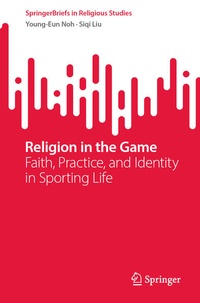
Religion in the Game
Description

This book offers a groundbreaking psychological exploration of how religion influences sport performance, motivation, injury recovery, and interpersonal dynamics in athletic settings. Bridging sport psychology and religious studies, it introduces two original models - the Religion and Sport Performance (RSP) Model and the Religious-Psychological Adaptation to Sports Injury (RPASI) Model - to explain how faith shapes athletes' cognitive, emotional, and behavioral responses on and off the field. Rather than treating religion as a cultural backdrop, the book positions it as a powerful psychological force that can enhance concentration, resilience, and identity. Drawing on diverse religious traditions and supported by real-world case examples, it examines how athletes integrate prayer, ritual, and belief into performance preparation and injury recovery. It also explores how religion influences team dynamics, coach-athlete relationships, and ethical decision-making in multicultural sport contexts. This concise yet comprehensive book is ideal for sport psychologists, coaches, researchers, and undergraduate and graduate students interested in the intersection of mental performance and religious belief. It offers both theoretical insight and practical guidance for applying religion-informed psychological strategies in sport environments.
More details
Other editions
Additional editions
Persons
Dr. Young-Eun Noh is a Senior Lecturer in the Faculty of Sports and Exercise Science at the University of Malaya. She earned her doctoral degree in Sport and Exercise Psychology from Victoria University, Australia. She completed her Master of Physical Education in Sport and Exercise Psychology at Chonnam National University and her Bachelor's degree in Dance at Chosun University, Republic of Korea. Her research primarily focuses on designing intervention programs for mental health in sports and dance. Her current research examines the complex interplay between religion and sport, with a specific focus on how athletes' religious beliefs and practices intersect with their sporting experiences. Additionally, she is interested in investigating the role of meditation in promoting resilience.
Dr. Siqi Liu completed his PhD in Sport Psychology from the Faculty of Sports and Exercise Science, University of Malaya, with a research focus on religious athletes and psychological recovery after sports injury. He has published in journals such as the Australian Journal of Psychology, BMC Psychology, BMC Sports Science, Medicine and Rehabilitation, and Journal of Religion and Health. His studies examine the roles of spirituality, religious beliefs, and mindfulness in the rehabilitation of injuries. Liu has served international sports events, including the Beijing 2022 Winter Olympics and Chengdu 2023 World University Games.
Content
Chapter 1. Introduction: Why Religion Matters in Sport.- Chapter 2. The Influence of Religion on Athletic Performance,- Chapter 3. Religious Practices as Mental Skills in Sport.- Chapter 4. Injury, Recovery, and Religious Meaning.- Chapter 5. Navigating Faith in Interpersonal Sport Contexts.- Chapter 6. Implications for Policy, Practice, and Future Research.
