

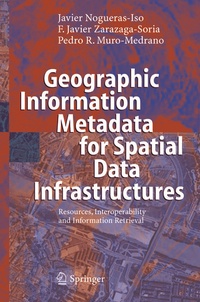
Geographic Information Metadata for Spatial Data Infrastructures
Resources, Interoperability and Information Retrieval
1st Edition
Published on 12. December 2005
XXI, 263 pages
978-3-540-27508-4 (ISBN)
Description

Metadata play a fundamental role in both DLs and SDIs. Commonly defined as "structured data about data" or "data which describe attributes of a resource" or, more simply, "information about data", it is an essential requirement for locating and evaluating available data. Therefore, this book focuses on the study of different metadata aspects, which contribute to a more efficient use of DLs and SDIs. The three main issues addressed are: the management of nested collections of resources, the interoperability between metadata schemas, and the integration of information retrieval techniques to the discovery services of geographic data catalogs (contributing in this way to avoid metadata content heterogeneity).
Reviews / Votes
From the reviews:
"The book focuses on technologies and methodologies that can provide better utilization of metadata within spatial data infrastructures. . The concepts exposed, in addition to the examples and a thorough corpus of additional bibliographic references, will bring readers to a better understanding of the design and management of future geospatial data infrastructures. This is an excellent book, which I recommend reading." (Alessandro Berni, ACM Computing Reviews, Vol. 49 (5), 2008)
More details
Other editions
Additional editions
Javier Nogueras-Iso | Francisco Javier Zarazaga-Soria | Pedro R. Muro-Medrano
Geographic Information Metadata for Spatial Data Infrastructures
Resources, Interoperability and Information Retrieval
Book
03/2005
Springer
€160.49
Shipment within 10-15 days
Content
Spatial Data Infrastructures and related concepts.- A metadata infrastructure for the management of nested collections.- Interoperability between metadata standards.- The use of disambiguated thesauri to improve information retrieval.- Integrating the concepts within the components of a Spatial Data Infrastructure.- Conclusions and future work.
3 Interoperability between metadata standards (p .89)
3.1 Introduction
The term "interoperability" is usually defined as "the ability of two or more systems or components to exchange information and to use the information that has been exchanged" (IEEE, 1990). Obviously, the main obstacle for the interoperation of systems is the heterogeneity in data and services managed by these systems (Visser et al., 1997). In order to determine whether systems are heterogeneous one can focus on different characteristics and this yields different types of heterogeneity and consequently different types of interoperability.
A commonly made distinction is that between syntactic (solving syntactic heterogeneity) and semantic interoperability (solving semantic heterogeneity) (Kolodziej, 2003). The syntactic interoperability is concerned with the technical level, i.e. it refers to the ability for a system or components of a system to provide information portability and interapplication as well as cooperative process control.
It comprises intercommunication at communication level protocol, hardware, software, and data compatibility layers. The semantic interoperability, in contrast, deals with the domain knowledge necessary for informatics services to "understand" each other's intentions and capabilities.
A more detailed categorization can be found in (Sheth, 1999), where four types of heterogeneity are distinguished: system heterogeneity (e.g., use of different operating systems and computing platforms), syntactic heterogeneity (e.g., differences in machine readable aspects of data representation), structural heterogeneity (e.g., schematic heterogeneity that particularly appears in structured databases), and semantic heterogeneity (equivalent to the semantic interoperability de.ned in (Kolodziej, 2003)). This second division is comparable with the first one because the first three types are instances of the syntactic interoperability de.ned in (Kolodziej, 2003).
The creation of standards and the existence of agreed conventions have facilitated enormously the syntactic interoperability. For instance, standards like CORBA (Orfali et al., 1999) facilitate the interoperation of systems which may have been implemented with di.erent programming languages and in dif- ferent computing platforms, HTML is a language for the creation and presentation of Web contents with an agreed syntax, or standards like UML (Booch et al., 1998) facilitate structural interoperability by enabling the definition commonly understood application schemas.
However, the syntactic interoperability is not enough to understand data and services (Ostman et al., 2002). For instance, one may receive a file in a standardized format, e.g. a .le in SHAPE file format (proprietary format used by ArcView GIS tool1) containing a set of polygons, but this does not informs about its content and use. At first glance, one can not distinguish whether these polygons represent lakes, nature reserves or provinces. Therefore, it results vital to improve the semantic interoperability.
The use of metadata describing data and services facilitates the semantic interoperability. Promoting a commonly understood set of descriptors, it increases the possibility of semantic interoperability across disciplines. For instance, networks of library catalogs, which use agreed metadata schemas like MARC (U.S. Library of Congress, 2004b), facilitate search and retrieval of data with a high degree of accuracy while resting assured of its potential use and authenticity. Nevertheless, one may also find heterogeneity in the schemas used for metadata.
3.1 Introduction
The term "interoperability" is usually defined as "the ability of two or more systems or components to exchange information and to use the information that has been exchanged" (IEEE, 1990). Obviously, the main obstacle for the interoperation of systems is the heterogeneity in data and services managed by these systems (Visser et al., 1997). In order to determine whether systems are heterogeneous one can focus on different characteristics and this yields different types of heterogeneity and consequently different types of interoperability.
A commonly made distinction is that between syntactic (solving syntactic heterogeneity) and semantic interoperability (solving semantic heterogeneity) (Kolodziej, 2003). The syntactic interoperability is concerned with the technical level, i.e. it refers to the ability for a system or components of a system to provide information portability and interapplication as well as cooperative process control.
It comprises intercommunication at communication level protocol, hardware, software, and data compatibility layers. The semantic interoperability, in contrast, deals with the domain knowledge necessary for informatics services to "understand" each other's intentions and capabilities.
A more detailed categorization can be found in (Sheth, 1999), where four types of heterogeneity are distinguished: system heterogeneity (e.g., use of different operating systems and computing platforms), syntactic heterogeneity (e.g., differences in machine readable aspects of data representation), structural heterogeneity (e.g., schematic heterogeneity that particularly appears in structured databases), and semantic heterogeneity (equivalent to the semantic interoperability de.ned in (Kolodziej, 2003)). This second division is comparable with the first one because the first three types are instances of the syntactic interoperability de.ned in (Kolodziej, 2003).
The creation of standards and the existence of agreed conventions have facilitated enormously the syntactic interoperability. For instance, standards like CORBA (Orfali et al., 1999) facilitate the interoperation of systems which may have been implemented with di.erent programming languages and in dif- ferent computing platforms, HTML is a language for the creation and presentation of Web contents with an agreed syntax, or standards like UML (Booch et al., 1998) facilitate structural interoperability by enabling the definition commonly understood application schemas.
However, the syntactic interoperability is not enough to understand data and services (Ostman et al., 2002). For instance, one may receive a file in a standardized format, e.g. a .le in SHAPE file format (proprietary format used by ArcView GIS tool1) containing a set of polygons, but this does not informs about its content and use. At first glance, one can not distinguish whether these polygons represent lakes, nature reserves or provinces. Therefore, it results vital to improve the semantic interoperability.
The use of metadata describing data and services facilitates the semantic interoperability. Promoting a commonly understood set of descriptors, it increases the possibility of semantic interoperability across disciplines. For instance, networks of library catalogs, which use agreed metadata schemas like MARC (U.S. Library of Congress, 2004b), facilitate search and retrieval of data with a high degree of accuracy while resting assured of its potential use and authenticity. Nevertheless, one may also find heterogeneity in the schemas used for metadata.
Table of content (1) (JPG)
Table of content (2) (JPG)
Table of content (3) (JPG)
Foreword (1) (JPG)
Foreword (2) (JPG)
Foreword (3) (JPG)
Foreword (4) (JPG)
Foreword (5) (JPG)
Foreword (6) (JPG)
Foreword (7) (JPG)
Foreword (8) (JPG)
Foreword (9) (JPG)
Content (1) (JPG)
Content (2) (JPG)
Content (3) (JPG)
Content (4) (PDF)
