

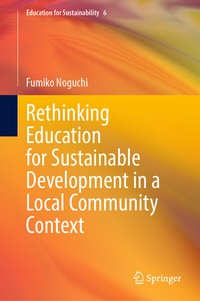
Rethinking Education for Sustainable Development in a Local Community Context
Description

This book bridges the gap between Education for Sustainable Development and community development and examines the contributions of critical environmental education as a theoretical framework to the policy, research, and practice of Education for Sustainable Development. The book investigates what Education for Sustainable Development really means when it happens from the perspectives of a marginalized individual at the very bottom of society in a local community, where there is no such 'educational' institution, no policy or no curriculum to support the effort, but there is the necessity of learning and empowerment for changing the situation. In particular, drawing on the experience of the indigenous Ainu fisherman, it critically examines the theoretical foundation of Education for Sustainable Development, critical environmental education, investigating methodologically and epistemologically the relevance and efficacy of critical environmental education to socially critical approaches to Education for Sustainable Development in a community development context. And this investigation leads to develop a praxis framework for socially critical Education for Sustainable Development in a community development context so that both fields would be mutually supportive to strengthen the practices.
More details
Other editions
Additional editions
Person
Fumiko Noguchi is currently a research fellow at the Education for Sustainable Development (ESD) Program at the UNU-IAS. Born in Tokyo, Noguchi received an undergraduate degree in international economics and finance from Tsuda University. After her first career experience in banking in Japan, she moved to Australia to obtain a Master's degree in Environmental Education at Griffith University. Since then, she has lived, worked, and studied in Japan and Australia. She completed her Ph.D. in ESD at RMIT University. She has gained extensive experience in practice, policy advocacy, research, teaching, and module development for ESD in the Asia-Pacific region for over twenty years. Throughout, she has consistently taken a community-based approach, valuing indigenous and local knowledge and learning.
