

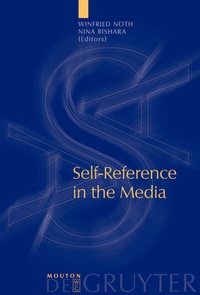
Self-Reference in the Media
Description

This book investigates how the media have become self-referential or self-reflexive instead of mediating between the real or fictional worlds about which their messages pretend to be and between the audience that they wish to inform, counsel, or entertain. The concept of self-reference is viewed very broadly. Self-reflexivity, metatexts, metapictures, metamusic, metacommunication, as well as intertextual, and intermedial references are all conceived of as forms of self-reference, although to different degrees and levels.
The contributions focus on the semiotic foundations of reference and self-reference, discuss the transdisciplinary context of self-reference in postmodern culture, and examine original studies from the worlds of print advertising, photography, film, television, computer games, media art, web art, and music. A wide range of different media products and topics are discussed including self-promotion on TV, the TV show Big Brother , the TV format "historytainment," media nostalgia, the documentation of documentation in documentary films, Marilyn Monroe in photographs, humor and paradox in animated films, metacommunication in computer games, metapictures, metafiction, metamusic, body art, and net art.
More details
Other editions
Additional editions
Persons
Content
2 - Contents [Seite 9]
3 - Self-reference in the media:The semiotic framework [Seite 15]
4 - Distortion, fabrication, and disclosure in a self-referential culture:The irresistible force of reality [Seite 43]
5 - Modes of self-reference in advertising [Seite 59]
6 - Metapictures and self-referential pictures [Seite 73]
7 - "Absolut Anonymous": Self-reference in opaque advertising [Seite 91]
8 - The death of photography in self-reference [Seite 107]
9 - Marilyn:A paragone of the camera gaze [Seite 119]
10 - The self-reflexive screen: Outlines of a comprehensive model [Seite 137]
11 - Nostalgia of the media / in the media [Seite 155]
12 - Self-reference in animated films [Seite 167]
13 - On the use of self-disclosure as a mode of audiovisual reflexivity [Seite 177]
14 - The old in the new: Forms and functions of archive material in the presentation of television history on television [Seite 195]
15 - There's no business without show-business: Self-reference as self-promotion [Seite 207]
16 - Computer games:The epitome of self-reference [Seite 219]
17 - Self-reference in computer games: A formalistic approach [Seite 231]
18 - Metacommunication in play and in (computer) games [Seite 249]
19 - Self-reflexivity in computer games: Analyses of selected examples [Seite 265]
20 - Looking through the computer screen: Self-reflexivity in net.art [Seite 281]
21 - The artist and her bodily self: Self-reference in digital art/media [Seite 303]
22 - Metafiction and metamusic: Exploring the limits of metareference [Seite 315]
23 - Backmatter [Seite 337]
