

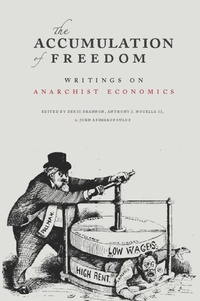
The Accumulation of Freedom
Writings on Anarchist Economics
Published on 14. February 2012
320 pages
978-1-84935-095-2 (ISBN)
Description

The only crisis of capitalism is capitalism itself. Let's toss credit default swaps, bailouts, environmental externalities and, while we're at it, private ownership of production in the dustbin of history. The Accumulation of Freedom brings together economists, historians, theorists, and activists for a first-of-its-kind study of anarchist economics. The editors aren't trying to subvert the notion of economics—they accept the standard definition, but reject the notion that capitalism or central planning are acceptable ways to organize economic life.
Contributors include Robin Hahnel, Iain McKay, Marie Trigona, Chris Spannos, Ernesto Aguilar, Uri Gordon, and more.
More details
Other editions
Additional editions
Anthony J. Nocella | Deric Shannon | John Asimakopoulos
The Accumulation of Freedom
Writings on Anarchist Economics
Book
04/2012
AK Press
€23.00
Article not available at the moment
Persons
Deric Shannon is a PhD. candidate in sociology at the University of Connecticut, where he studies prefigurative politics and radical social movements. He is a co-editor of the book Contemporary Anarchist Studies: An Introductory Reader of Anarchy in the Academy and the author of numerous articles and book chapters, typically on radical political thought. He is a member of the Workers Solidarity Alliance, Queers without Borders, and co-runs the independent record label, Wooden Man Records.
Anthony J. Nocella, II, while finishing his Ph.D. in Social Science at Syracuse University, he teaches at SUNY Cortland and Le Moyne College in Criminology and life skills at a youth detention facility. He is also an associate of a number of scholarly institutes including the Program on the Analysis and Resolution of Conflicts (PARC) and is the Executive Director of the Central New York Peace Studies Consortium and the Institute for Critical Animal Studies (ICAS). His books include Terrorists or Freedom Fighters? (ed.), Academic Repression (ed.), Igniting a Revolution (ed.), and Contemporary Anarchist Studies (ed.).
John Asimakopoulos, Ph.D. is Director of the scholar-activist Transformative Studies Institute (TSI). He also edits the interdisciplinary per-reviewed journal Theory in Action. His work focuses on labor, globalization, and sociological theory. He currently teaches Sociology at Montclair State University and has taught Economics, Sociology, and Political Science at many New York and New Jersey Universities.
Anthony J. Nocella, II, while finishing his Ph.D. in Social Science at Syracuse University, he teaches at SUNY Cortland and Le Moyne College in Criminology and life skills at a youth detention facility. He is also an associate of a number of scholarly institutes including the Program on the Analysis and Resolution of Conflicts (PARC) and is the Executive Director of the Central New York Peace Studies Consortium and the Institute for Critical Animal Studies (ICAS). His books include Terrorists or Freedom Fighters? (ed.), Academic Repression (ed.), Igniting a Revolution (ed.), and Contemporary Anarchist Studies (ed.).
John Asimakopoulos, Ph.D. is Director of the scholar-activist Transformative Studies Institute (TSI). He also edits the interdisciplinary per-reviewed journal Theory in Action. His work focuses on labor, globalization, and sociological theory. He currently teaches Sociology at Montclair State University and has taught Economics, Sociology, and Political Science at many New York and New Jersey Universities.
Content
Preface: Ruth Kinna
Acknowledgments
Dedication
Introduction - Anarchist Economics: An Holistic View
Deric Shannon, Anthony J. Nocella, II, and John Asimakopoulos
PART 1. HISTORY
1. Examining the History of Anarchist Economics to See the Future
Chris Spannos
2. Laying the Foundations: Proudhon's Contribution to Anarchist Economics: Iain Mackaye
PART 2. ANALYSIS
3. Capitalism in the 2000s: Abbey Willis and Deric Shannon
4. Fight to Win! Tools for Confronting Capital: Jeff Monaghan and D.T. Cochrane
5. Escaping Capitalist Hegemony: Re-reading Western Economies: Richard J. White and Colin C. Williams
PART 3. CRITIQUE
6. Globalized Contradictions of Capitalism and the Imperative for Epochal Change: John Asimakopoulos
7. The Economic Crisis and Libertarian Socialists: Robin Hahnel
8. Education's Diminishing Returns and Revolutionary Potential in the US and Beyond: William T. Armaline and William D. Armaline
PART 4. PRACTICE
9. Anarchist Economics in Practice: Uri Gordon
10. Currency and Café Anarchy: Do-it-Yourself Economics and Participatory Resistance to Global Capitalism: Caroline Kaltefleiter
PART 5. RESISTANCE
11. Occupy, Resist, Produce!: Lessons From Latin America's Occupied Factories: Marie Trigona
12. Call It An Uprising: People of Color and the Third World Organize Against Capitalism: Ernesto Aguilar
13. Raising the Curtain: Resistance, Culture, and Ideology: Deric Shannon
PART 6. VISION
14. Ditching Class: the praxis of anarchist communist economics: Todd Hamilton
15. The Anarchist Method: An Experimental Approach to Post-Capitalist Economies: Wayne Price
Afterword-Porous Borders of Anarchist Vision and Strategy: Michael Albert
Acknowledgments
Dedication
Introduction - Anarchist Economics: An Holistic View
Deric Shannon, Anthony J. Nocella, II, and John Asimakopoulos
PART 1. HISTORY
1. Examining the History of Anarchist Economics to See the Future
Chris Spannos
2. Laying the Foundations: Proudhon's Contribution to Anarchist Economics: Iain Mackaye
PART 2. ANALYSIS
3. Capitalism in the 2000s: Abbey Willis and Deric Shannon
4. Fight to Win! Tools for Confronting Capital: Jeff Monaghan and D.T. Cochrane
5. Escaping Capitalist Hegemony: Re-reading Western Economies: Richard J. White and Colin C. Williams
PART 3. CRITIQUE
6. Globalized Contradictions of Capitalism and the Imperative for Epochal Change: John Asimakopoulos
7. The Economic Crisis and Libertarian Socialists: Robin Hahnel
8. Education's Diminishing Returns and Revolutionary Potential in the US and Beyond: William T. Armaline and William D. Armaline
PART 4. PRACTICE
9. Anarchist Economics in Practice: Uri Gordon
10. Currency and Café Anarchy: Do-it-Yourself Economics and Participatory Resistance to Global Capitalism: Caroline Kaltefleiter
PART 5. RESISTANCE
11. Occupy, Resist, Produce!: Lessons From Latin America's Occupied Factories: Marie Trigona
12. Call It An Uprising: People of Color and the Third World Organize Against Capitalism: Ernesto Aguilar
13. Raising the Curtain: Resistance, Culture, and Ideology: Deric Shannon
PART 6. VISION
14. Ditching Class: the praxis of anarchist communist economics: Todd Hamilton
15. The Anarchist Method: An Experimental Approach to Post-Capitalist Economies: Wayne Price
Afterword-Porous Borders of Anarchist Vision and Strategy: Michael Albert
