

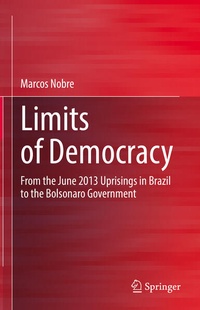
Limits of Democracy
Description

In this timely book, Brazilian political philosopher Marcos Nobre analyzes the social and political roots of the election of Jair Bolsonaro to the presidency of Brazil and shows how this process is connected to the rise of new far-right movements threatening democracy around the world. Nobre describes the rise of the movement that elected Bolsonaro as a reactionary and anti-democratic highjack of the democratic impulse unleashed by the June 2013 uprisings, when millions of Brazilians took to the streets to protest against a dysfunctional political system, and frames the Brazilian case within the global crisis that exposed the limits of a democracy based on the neoliberal consensus after the 2008 financial crisis.
According to Nobre, the June 2013 uprisings in Brazil was part of the global cycle of popular protests that swept many countries between 2011 and 2013, reclaiming a new model of democracy which could go beyond bureaucratic and technocratic parties and cabinets. However, in Brazil, as in many other places, this initial democratic impulse was captured by new far-right movements which are now posing serious threats to democracy.
This book intends to collaborate in a change of attitude, both theoretical and practical, that may help finding ways of fighting the authoritarian threat to democracy as well as of deepening democracy as a life form. The decline of neoliberalism not only did not produce any effectively progressive realist alternative, but also opened the way for a dispute over models of society in which democracy itself has ceased to represent the primary reference in disputes over the best way to regulate life in society. Democracy is no longer self-evident, it is in danger. And the only way to save it is by inventing new democratic practices to overcome the limits imposed by institutional political systems no longer capable of channeling the real struggles in the societies they claim to represent.
More details
Other editions
Additional editions
Person
Marcos Nobre is a Professor of Political Philosophy at the University of Campinas (Unicamp), President of the Brazilian Center of Analysis and Planning (Cebrap), Principal Investigator of the Maria Sybilla Merian Centre Conviviality-Inequality in Latin America (Mecila) and Researcher 1A of The National Council for Scientific and Technological Development (CNPq). Among his publications in the last two years: "The Global Uprising of Populist Conservatism and the Case of Brazil", in: Klaus-Gerd Giesen (ed.), Ideologies in World Politics. Springer, 2020; "'Pémédébisme', présidentialisme de coalition et crise de la démocratie", Brésil(s), no. 19, 2021; Limites da democracia: De Junho de 2013 ao governo Bolsonaro, São Paulo: Todavia, 2022. Springer also published his "Foreword" to Camila Rocha; Esther Solano; Jonas Medeiros. The Bolsonaro Paradox: Public Sphere and Right-Wing Counterpublicity in Contemporary Brazil. Springer, 2021.
