

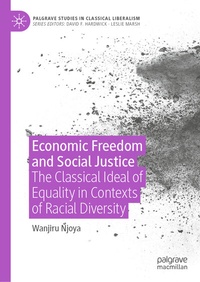
Economic Freedom and Social Justice
Description

This book analyses the egalitarian foundations of equality law from a classical liberal perspective by asking two central questions: does justice ideally demand equality? Are differences in abilities among people in some sense unfair? The book examines these questions in the context of racial diversity.
Racial justice as a component of social justice is often considered to be so emotionally and morally compelling that its implications for economic freedom are rarely subjected to critical scrutiny. In defending the classical ideal of formal equality in contexts of racial diversity this book questions the ethical status of egalitarian social and moral ideals. Economic Freedom and Social Justice argues that egalitarian ideals, like all subjective value judgements, must be subjected to critical intellectual inquiry rather than treated axiomatically. Drawing upon the legal framework in the UK and other common law jurisdictions, this book shows some of the ways in which egalitarian ideals, in addition to resting on false premises, are costly, harmful, and ultimately inimical to justice and liberty. The book argues that legal entitlements and policy guidelines constructed upon notions of racial equity are wrongly constituted as the main prism through which liberal market democracies govern private relationships, including the employment relationship.
Written in a clear and forthright style, this book will be of interest to students and scholars in law, economics, philosophy and political economy.
Reviews / Votes
"Wanjiru Njoya's Economic Freedom and Social Justice insightfully examines the foundations and effects of contemporary equality law, mainly applied to issues of employment and race. ... The book does not . assume that readers are versed in that literature, so the book remains accessible and excellently introduces readers without that background to the classical liberal tradition. The target audience includes scholars across multiple disciplines. While the book engages with complicated issues in law, philosophy, and economics, it remains accessible." (Chad Van Schoelandt, Journal of Economics, Race, and Policy, Vol. 7 (1), 2024)
"Njoya's concern about the proper meaning and value of equality and liberty, particularly concerning the rule of law. The book brings the reader back to the fundamental philosophic issues and emphasizes foundational disputes between classical liberals and egalitarians. This conclusion argues that these disputes are about the content of justice, not whether to support justice." (Chad Van Schoelandt, Journal of Economics, Race, and Policy, December 27, 2023)
More details
Other editions
Additional editions
Person
Wanjiru Njoya is a Senior Lecturer at the University of Exeter Law School, UK and a Fellow of the UK Higher Education Academy. She has previously taught law at St John's College, Oxford, the London School of Economics, and Queen's University, Canada. She has published widely in the field of employment law and labour regulation, most recently in the King's Law Journal, the Journal of Law, Economics & Policy, and the Journal of Libertarian Studies. Dr Njoya is a graduate of the University of Nairobi, Kenya, and a former Rhodes Scholar (St Edmund's College, Cambridge, 1998). Her doctoral research on the conceptual framework of the employment relationship is published under the title Property in Work: the Employment Relationship in the Anglo-American Firm . She lives in East Devon, England.
