

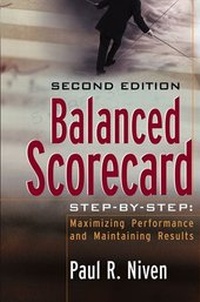
Balanced Scorecard Step-by-Step
Maximizing Performance and Maintaining Results
2nd Edition
Published on 18. June 2010
336 pages
978-0-470-89373-9 (ISBN)
Description

PRAISE FOR Balanced Scorecard Step-By-Step: MaximizingPerformance and Maintaining Results, Second Edition
"As a practitioner and thought leader, Paul Niven is superblybridging the gulf between BSC theory and application throughhands-on experiences and real-world case studies. The book providesa practical road map, step-by-step, to plan, execute, and sustain awinning scorecard campaign. Easy to read . . . tells a powerfulstory with lessons learned/best practices from global customerimplementations. Must-read for anyone interested in BSC orgrappling with how to create a strategically alignedorganization."
--Vik Torpunuri, President and CEO, e2e Analytix
"In Balanced Scorecard Step-by-Step, Second Edition, PaulNiven provides an intuitive and incredibly effective blueprint fortransitioning strategic ambition to execution. Paul's pragmaticapproach provides leaders with a tool for managing a company'sjourney from strategic ideas to world-class performance. TheBalanced Scorecard is a masterful tool for guiding companiesthrough transformation, and I speak from personal experience when Isay Paul's blueprint works! It is the most effective guide I haveseen. Balanced Scorecard Step-by-Step will serve any leaderwell if their ambition is to efficiently engage their teams inachieving a set of strategic goals."
--Allan A. MacDonald, Vice President, Sales and CustomerSolutions Bell Canada National Markets
"Paul Niven has done it again!!! With this book, he has furtheroperationalized the enlightened Balanced Scorecard concept into afully functional system that optimizes business execution andperformance!"
--Barton Johnson, President, Financial Freedom Senior FundingCorporation, The Reverse Mortgage Specialist
"As a practitioner and thought leader, Paul Niven is superblybridging the gulf between BSC theory and application throughhands-on experiences and real-world case studies. The book providesa practical road map, step-by-step, to plan, execute, and sustain awinning scorecard campaign. Easy to read . . . tells a powerfulstory with lessons learned/best practices from global customerimplementations. Must-read for anyone interested in BSC orgrappling with how to create a strategically alignedorganization."
--Vik Torpunuri, President and CEO, e2e Analytix
"In Balanced Scorecard Step-by-Step, Second Edition, PaulNiven provides an intuitive and incredibly effective blueprint fortransitioning strategic ambition to execution. Paul's pragmaticapproach provides leaders with a tool for managing a company'sjourney from strategic ideas to world-class performance. TheBalanced Scorecard is a masterful tool for guiding companiesthrough transformation, and I speak from personal experience when Isay Paul's blueprint works! It is the most effective guide I haveseen. Balanced Scorecard Step-by-Step will serve any leaderwell if their ambition is to efficiently engage their teams inachieving a set of strategic goals."
--Allan A. MacDonald, Vice President, Sales and CustomerSolutions Bell Canada National Markets
"Paul Niven has done it again!!! With this book, he has furtheroperationalized the enlightened Balanced Scorecard concept into afully functional system that optimizes business execution andperformance!"
--Barton Johnson, President, Financial Freedom Senior FundingCorporation, The Reverse Mortgage Specialist
More details
Other editions
Additional editions

Software
08/2015
Wiley
€46.80
No shipping information available
Book
09/2006
2nd Edition
Wiley
€49.00
Shipment within 10-20 days
Person
PAUL R. NIVEN is a management consultant and noted speakeron the subjects of Performance Management and the BalancedScorecard. As both a practitioner and consultant, he has developedsuccessful Performance Management systems for organizations largeand small around the globe. His clients include Fortune 500companies, public sector agencies from all levels, and nonprofitorganizations. He may be reached through his Web site atwww.senalosa.com.
Content
Preface.
Acknowledgments.
Chapter 1. Performance Measurement and the Need for a balancedScorecard.
Chapter 2. Getting Started.
Chapter 3. Mission, Values, Vision, and Strategy.
Chapter 4. Strategy Maps.
Chapter 5. Creating Performance Measures.
Chapter 6. Setting Targets and Prioritizing Initiatives.
Chapter 7. Cascading the Balanced Scorecard to BuildOrganizational Alignment.
Chapter 8. Using the Balanced Scorecard to StrategicallyAllocate resources.
Chapter 9. Additional Balanced Scorecard linkages: Compensationand Corporate Governance.
Chapter 10. Reporting Balanced Scorecard Results.
Chapter 11. Maintaining the Balanced Scorecard.
Chapter 12. Concluding Thoughts on Balanced ScorecardSuccess.
Index.
Acknowledgments.
Chapter 1. Performance Measurement and the Need for a balancedScorecard.
Chapter 2. Getting Started.
Chapter 3. Mission, Values, Vision, and Strategy.
Chapter 4. Strategy Maps.
Chapter 5. Creating Performance Measures.
Chapter 6. Setting Targets and Prioritizing Initiatives.
Chapter 7. Cascading the Balanced Scorecard to BuildOrganizational Alignment.
Chapter 8. Using the Balanced Scorecard to StrategicallyAllocate resources.
Chapter 9. Additional Balanced Scorecard linkages: Compensationand Corporate Governance.
Chapter 10. Reporting Balanced Scorecard Results.
Chapter 11. Maintaining the Balanced Scorecard.
Chapter 12. Concluding Thoughts on Balanced ScorecardSuccess.
Index.
Preface Four years ago I wrote Balanced Scorecard Step-by-Step to provide a systematic implementation guide to readers incorporating or considering incorporating the Balanced Scorecard methodology in their organization. My experiences as a Balanced Scorecard practitioner with a large Canadian company taught me that tremendous results are possible with the tool, but to attain those results, you must overcome numerous pitfalls that can derail or significantly damage the implementation effort. I have been amazed and humbled at the success of the first edition, which has now been translated in over a dozen languages. The many e-mails, calls, and letters I have received from readers who have benefited in some way from the guidance offered in the book have been very gratifying and demonstrate that, with a little help, every organization can derive tremendous success from the Balanced Scorecard system. This second edition contains the same core implementation guidance found in the original volume but has been updated and enhanced to include guidance on a number of topics that were still relatively immature as of the first printing in 2002. The most significant change is my expanded coverage of strategy maps, powerful communication tools signaling to the entire workforce (and beyond) what is critical in executing the organization's strategy. The text also provides new and updated information on the linkage between the Balanced Scorecard and corporate governance, the critical importance of strategy-centered management meetings, and an emerging trend, the Office of Strategy Management. In addition to entirely new sections, you will find the latest thinking on all aspects of the Balanced Scorecard journey, honed from my work as a consultant and researcher.
Organizations in today's change-filled, highly competitive environment must devote significant time, energy, and human and financial resources to measuring their performance in achieving strategic goals. Most do just that, but despite the substantial effort and related costs, many are dissatisfied with their measurement efforts. In fact, at any given time, as many as 50 percent of organizations are making changes to their performance measurement systems.a Increasingly, organizations are concluding that while measurement is more crucial than ever, their systems for capturing, monitoring, and sharing performance information are critically flawed. Today's systems in many ways bear a remarkable resemblance to their reporting ancestors. Although the methods of modern business have transformed dramatically over the decades, our systems of measurement have remained firmly mired in the past. At the root of our measurement misery is an almost exclusive reliance on financial measures of performance. These systems may have been perfectly suited to the machinelike, physical asset-based nature of early industrial endeavors, but they are ill-equipped to capture the value-creating mechanisms of today's modern business organization. Intangible assets such as employee knowledge, customer and supplier relationships, and innovative cultures are the key to producing value in today's economy. Additionally, the importance of a differentiating strategy is more important today than it has ever been. Whether you're a high-tech newcomer or an established manufacturing veteran, executing strategy effectively is crucial in an era of globalization, customer power, and rapid change. But the sobering fact is that about 9 out of 10 organizations fail to implement their strategies. What is needed is a measurement system that balances the historical accuracy and integrity of financial numbers with today's drivers of economic success, and in so doing allows the organization to beat the odds of executing strategy. The Balanced Scorecard has emerged as a proven and effective tool in our quest to capture, describe, and translate intangible assets into real value for all of an organization's stakeholders and, in the process, to allow organizations to implement their differentiating strategies successfully. Developed by Robert Kaplan and David Norton, this deceptively simple methodology translates an organization's strategy into performance objectives, measures, targets, and initiatives in four balanced perspectives: Financial, Customer, Internal Process, and Employee Learning and Growth. Organizations around the globe have embraced the Balanced Scorecard and reaped swift benefits from its commonsense principles. Such benefits include increased financial returns, greater employee alignment with overall goals, improved collaboration, and an unrelenting focus on strategy, to name just a few. To reap those rewards, however, an organization must possess the tools necessary to craft an effective Balanced Scorecard.
In the mid-1990s I was working with an organization that, like so many others, was about to undergo significant change. The industry structure was changing, competitors appeared more nimble and threatening than ever, and customers were demanding better service with no price increases. A new strategy was developed that, if effectively implemented, would see the organization enhance employee skills, develop new processes, build customer loyalty, and ultimately deliver breakthrough financial performance. But how could the strategy be executed successfully? The organization's chief financial officer investigated the Balanced Scorecard approach and determined it was the right tool at the right time. Acting as the executive sponsor for the initiative, he appointed me to lead a team charged with the responsibility for developing a new management system featuring the Balanced Scorecard as the cornerstone. Two years later his intuition paid off in a big way. Employee knowledge of strategy had increased significantly, internal processes were functioning more efficiently than ever, customer loyalty was on the rise, and despite many adverse factors beyond the organization's control, financial returns were on target. The organization just described is Nova Scotia Power, Inc. (NSPI), a Canadian electric utility company. As the results demonstrate, its Balanced Scorecard implementation was a great success and has been featured in case studies and shared at conferences throughout North America and beyond, and has earned the organization a spot in the Balanced Scorecard Collaborative's Hall of Fame. As successful as the implementation was, however, it was not without challenges. Our team quickly learned that building a Balanced Scorecard is far more than a metrics project; instead it touches many disparate organizational processes. Building an effective team; generating support and enthusiasm for a change initiative; efficiently gathering and sharing data; and coaching, training, and facilitating are just some of the many exciting and challenging tasks we faced. At that time, Balanced Scorecard literature and support services were at a nascent stage, and we were left to our own devices when grappling with the many issues awaiting us. Although Scorecard literature and related consulting and support products have proliferated in recent years, few if any focus on the wide array of organizational activities that must accompany a winning Scorecard campaign. This book has been written to fill the void existing between theory and application. Since its original publication in 2002, it has guided thousands of organizations worldwide through their Balanced Scorecard journeys. Organizations embarking on a Scorecard effort must be aware of-and properly equipped with the tools to navigate successfully-the many potential pitfalls associated with an initiative of this magnitude. Based on my experience as a consultant working with organizations around the globe plus extensive research, these pages guide the reader through the entire Balanced Scorecard process on a step-by-step basis. From determining your guiding rationale for the Scorecard, to testing your mission, to building a Strategy Map, to developing measures and targets, to placing the Scorecard at the center of your management system, to tips for sustaining your success, you'll find all this and more. Let's now take a look at how the book is organized and consider how you can use it to best suit your needs.
This second edition of Balanced Scorecard Step-by-Step is comprised of 12 chapters, spanning the entire Scorecard experience. The opening chapter is designed to familiarize you with the field of performance measurement and provide a solid grounding of Scorecard background and principles. It elaborates on the discussion begun in this preface by examining how the Scorecard solves three fundamental modern business issues: reducing the reliance on financial performance measures, the rise of intangible assets to value creation, and the difficulty of implementing strategy. Chapter Two lays the foundation for the work ahead by examining the purpose of developing a Balanced Scorecard, securing executive sponsorship, creating a team, and preparing a development plan. The core elements of any effective Balanced Scorecard-mission, values, vision, and strategy -are the subject of Chapter Three. You'll discover why each of these elements is crucial to the success of a Balanced Scorecard. With the Scorecard building blocks firmly in place, Chapter Four explores the world of Strategy Maps, powerful communication tools signaling to everyone in the organization what is critical in executing strategy. You will learn why Strategy Maps are a decisive ingredient to overall Scorecard success and be provided with numerous tips on development and...
THE BALANCED SCORECARD
Organizations in today's change-filled, highly competitive environment must devote significant time, energy, and human and financial resources to measuring their performance in achieving strategic goals. Most do just that, but despite the substantial effort and related costs, many are dissatisfied with their measurement efforts. In fact, at any given time, as many as 50 percent of organizations are making changes to their performance measurement systems.a Increasingly, organizations are concluding that while measurement is more crucial than ever, their systems for capturing, monitoring, and sharing performance information are critically flawed. Today's systems in many ways bear a remarkable resemblance to their reporting ancestors. Although the methods of modern business have transformed dramatically over the decades, our systems of measurement have remained firmly mired in the past. At the root of our measurement misery is an almost exclusive reliance on financial measures of performance. These systems may have been perfectly suited to the machinelike, physical asset-based nature of early industrial endeavors, but they are ill-equipped to capture the value-creating mechanisms of today's modern business organization. Intangible assets such as employee knowledge, customer and supplier relationships, and innovative cultures are the key to producing value in today's economy. Additionally, the importance of a differentiating strategy is more important today than it has ever been. Whether you're a high-tech newcomer or an established manufacturing veteran, executing strategy effectively is crucial in an era of globalization, customer power, and rapid change. But the sobering fact is that about 9 out of 10 organizations fail to implement their strategies. What is needed is a measurement system that balances the historical accuracy and integrity of financial numbers with today's drivers of economic success, and in so doing allows the organization to beat the odds of executing strategy. The Balanced Scorecard has emerged as a proven and effective tool in our quest to capture, describe, and translate intangible assets into real value for all of an organization's stakeholders and, in the process, to allow organizations to implement their differentiating strategies successfully. Developed by Robert Kaplan and David Norton, this deceptively simple methodology translates an organization's strategy into performance objectives, measures, targets, and initiatives in four balanced perspectives: Financial, Customer, Internal Process, and Employee Learning and Growth. Organizations around the globe have embraced the Balanced Scorecard and reaped swift benefits from its commonsense principles. Such benefits include increased financial returns, greater employee alignment with overall goals, improved collaboration, and an unrelenting focus on strategy, to name just a few. To reap those rewards, however, an organization must possess the tools necessary to craft an effective Balanced Scorecard.
About This Book
In the mid-1990s I was working with an organization that, like so many others, was about to undergo significant change. The industry structure was changing, competitors appeared more nimble and threatening than ever, and customers were demanding better service with no price increases. A new strategy was developed that, if effectively implemented, would see the organization enhance employee skills, develop new processes, build customer loyalty, and ultimately deliver breakthrough financial performance. But how could the strategy be executed successfully? The organization's chief financial officer investigated the Balanced Scorecard approach and determined it was the right tool at the right time. Acting as the executive sponsor for the initiative, he appointed me to lead a team charged with the responsibility for developing a new management system featuring the Balanced Scorecard as the cornerstone. Two years later his intuition paid off in a big way. Employee knowledge of strategy had increased significantly, internal processes were functioning more efficiently than ever, customer loyalty was on the rise, and despite many adverse factors beyond the organization's control, financial returns were on target. The organization just described is Nova Scotia Power, Inc. (NSPI), a Canadian electric utility company. As the results demonstrate, its Balanced Scorecard implementation was a great success and has been featured in case studies and shared at conferences throughout North America and beyond, and has earned the organization a spot in the Balanced Scorecard Collaborative's Hall of Fame. As successful as the implementation was, however, it was not without challenges. Our team quickly learned that building a Balanced Scorecard is far more than a metrics project; instead it touches many disparate organizational processes. Building an effective team; generating support and enthusiasm for a change initiative; efficiently gathering and sharing data; and coaching, training, and facilitating are just some of the many exciting and challenging tasks we faced. At that time, Balanced Scorecard literature and support services were at a nascent stage, and we were left to our own devices when grappling with the many issues awaiting us. Although Scorecard literature and related consulting and support products have proliferated in recent years, few if any focus on the wide array of organizational activities that must accompany a winning Scorecard campaign. This book has been written to fill the void existing between theory and application. Since its original publication in 2002, it has guided thousands of organizations worldwide through their Balanced Scorecard journeys. Organizations embarking on a Scorecard effort must be aware of-and properly equipped with the tools to navigate successfully-the many potential pitfalls associated with an initiative of this magnitude. Based on my experience as a consultant working with organizations around the globe plus extensive research, these pages guide the reader through the entire Balanced Scorecard process on a step-by-step basis. From determining your guiding rationale for the Scorecard, to testing your mission, to building a Strategy Map, to developing measures and targets, to placing the Scorecard at the center of your management system, to tips for sustaining your success, you'll find all this and more. Let's now take a look at how the book is organized and consider how you can use it to best suit your needs.
How the Book Is Organized
This second edition of Balanced Scorecard Step-by-Step is comprised of 12 chapters, spanning the entire Scorecard experience. The opening chapter is designed to familiarize you with the field of performance measurement and provide a solid grounding of Scorecard background and principles. It elaborates on the discussion begun in this preface by examining how the Scorecard solves three fundamental modern business issues: reducing the reliance on financial performance measures, the rise of intangible assets to value creation, and the difficulty of implementing strategy. Chapter Two lays the foundation for the work ahead by examining the purpose of developing a Balanced Scorecard, securing executive sponsorship, creating a team, and preparing a development plan. The core elements of any effective Balanced Scorecard-mission, values, vision, and strategy -are the subject of Chapter Three. You'll discover why each of these elements is crucial to the success of a Balanced Scorecard. With the Scorecard building blocks firmly in place, Chapter Four explores the world of Strategy Maps, powerful communication tools signaling to everyone in the organization what is critical in executing strategy. You will learn why Strategy Maps are a decisive ingredient to overall Scorecard success and be provided with numerous tips on development and...
