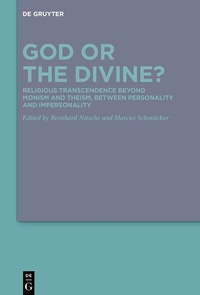
God or the Divine?
Description

Is there a language of transcendence which does not fall under the well-worn categories of monism, theism, pantheism, biblical or pagan monotheism, personal or tripersonal God, or an impersonal absolute, conceived as immanent and/or transcendent? The present set of studies from different fields of research centers on the question whether it is possible to speak at all of transcendence or a divinity, and if it is, under what limitations does such speech proceed.
In current discussion in theology and in philosophy of religion, there is a pervasive awareness that the inherited terms and alternatives, developed in the western tradition, no longer facilitate an adequate understanding of the divine. Increasing familiarity with the languages of 'immanence' and 'transcendence' (under erasure) in Hindu and Buddhist thought has further jumbled our coordinates, while holding out the promise of a more subtle and vital engagement with the matter itself of religious inquiry.
A further long-established distinction, between 'personal' and 'impersonal,' also takes on rich new hues in Asian contexts, where the very notion of 'person' may undergo unsettling critiques. Transgressing the categories of 'personal' and 'impersonal' points to the mystical depth of religious traditions, emphasizes their openness and reintegrates essential elements of both perspectives. Advancing with curiosity and caution, all the contributors take seriously the diversity of historical religious traditions, while nevertheless searching for a fresh language that may connect these traditions and provide a common ground of understanding.
More details
Other editions
Additional editions